All species › Passerines › Tanagers and allies › Silver-throated Tanager
Silver-throated Tanager | Tangara icterocephala
Zilverkeeltangare | Tangara goliplateada | Saíra-de-garganta-prateada
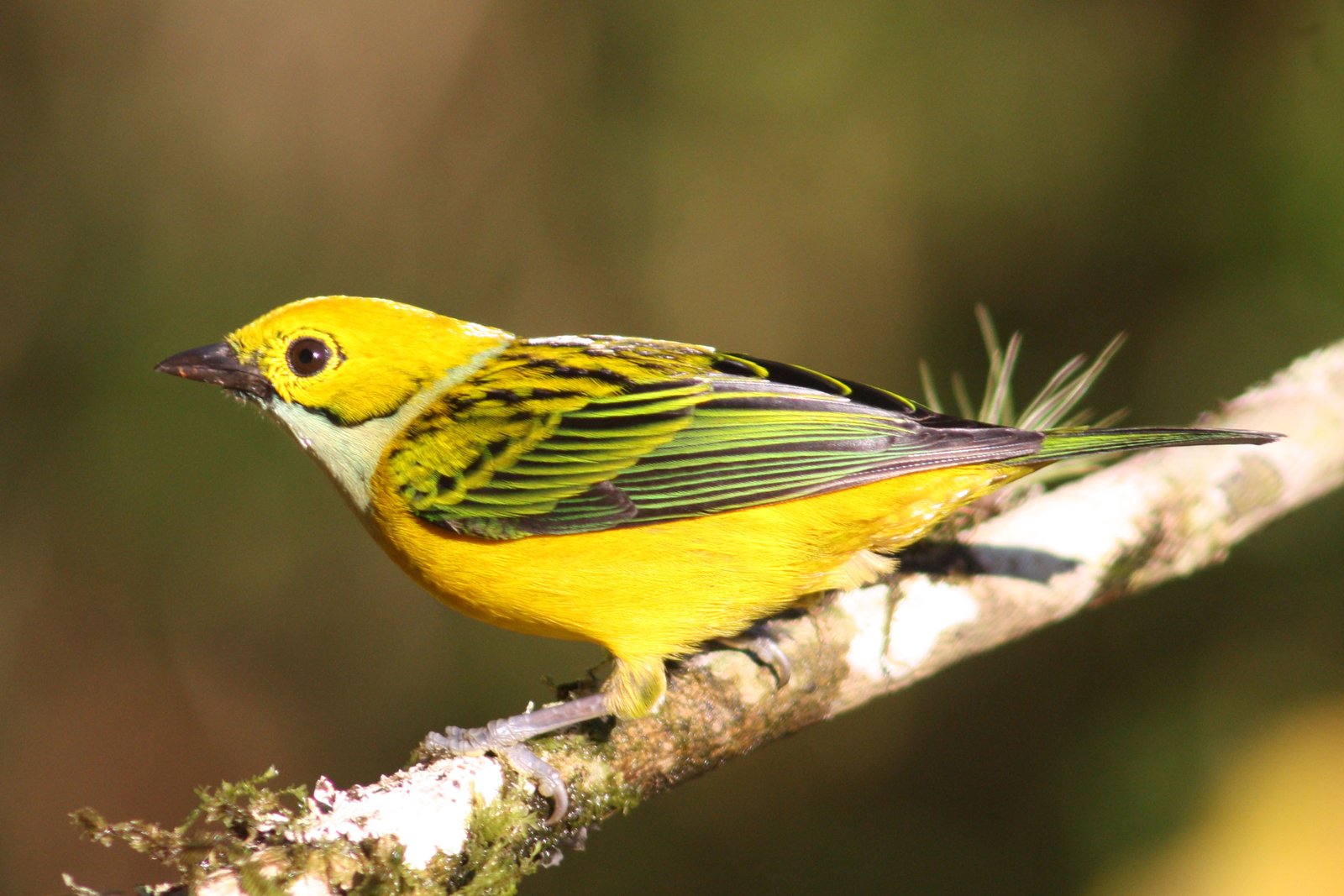
The Silver-throated Tanager is a small, mainly yellow tanager of humid forest on the Pacific side of the Andes in Colombia and Ecuador, with a silvery-white throat and a black-streaked back. It is a regular member of mixed tanager flocks and often visits fruiting trees along forest edges.
Voice
Gives a dry, rasping bzeet and short tsit notes, often repeated while foraging; no distinct song is known.
Recording: Daniel Errichetti — CC BY-NC-SA 4.0 · xeno-canto
Identification
13 cm. Head and underparts are bright golden yellow, the throat silvery white and bordered at the side by a narrow black malar stripe. The back is yellow with black streaks; wings and tail are black with green edges. The female is slightly duller, with a greener back and a greyer throat. Juveniles are greenish yellow with little pattern.
Confusion species
Golden Tanager Tangara arthus is a deeper golden yellow, with a black ear patch and no silvery-white throat. Saffron-crowned Tanager Tangara xanthocephala has a yellow-orange head with a black mask and a blue-green body. Emerald Tanager Tangara florida is mainly green with a yellow crown.
Habitat
Humid and wet montane forest, the lower cloud forest, forest edges, secondary woodland and shade coffee, mostly from about 600 to 2000 m. It eats mainly small fruit and searches mossy branches for insects, in pairs or small groups with mixed flocks in the middle storey and canopy. The nest is a moss cup in a tree or shrub.
Where the bird is most at home, classified by the vegetation units of the Andes and the west coast.


Range and movements
In Colombia on the Pacific slope and in the Western Andes, locally also in the northern Central Andes. In Ecuador on the western slope of the Andes from the Colombian border southward. Does not occur in Peru, Bolivia or on the Galápagos. Outside the guide area in Costa Rica and Panama.
- Resident
- dark = core range, pale = thinly spread
How and when to look
Search mixed flocks along forest edges and roads in the cloud forest of the western slope, for example around Mindo in Ecuador; the dry bzeet call often gives the birds away before their plumage does.
Conservation status
Least Concern. Common in suitable forest; tolerates forest edges and shade coffee, but depends on forest cover on the western slope.
Scientific name
Tangara icterocephala | (Bonaparte, 1851)
Bonaparte described the species in 1851 as Calliste icterocephala; because it was later moved to another genus, the author and year stand in brackets. The genus Tangara was introduced in 1760 by Brisson. The genus name comes from the extinct Tupi language, in which tangara means 'dancer'. The specific name comes from Greek ikteros, 'jaundice' (hence 'yellow'), and kephalē, 'head', referring to the yellow head. The specimen the first description was based on came from Punta Playa, south of Quito, Ecuador.