All species › Passerines › Tityras, becards and allies › Slaty Becard
Slaty Becard | Pachyramphus spodiurus
Leikleurige bekarde | Anambé pizarra | Caneleiro-ardósia
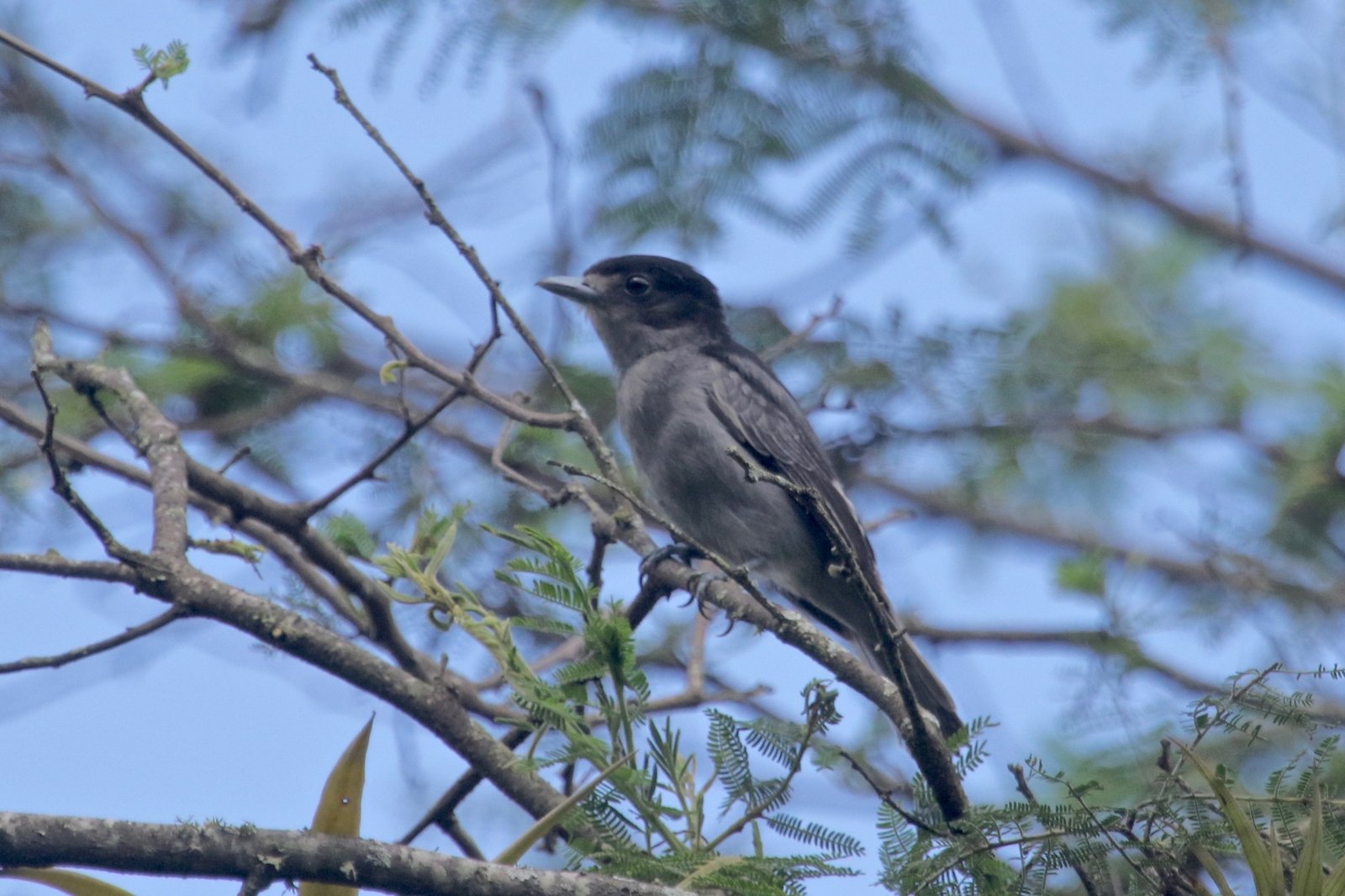
The Slaty Becard is a small grey becard of dry and semi-humid lowland forest in the Tumbesian region of western Ecuador and north-western Peru. The male is dark slate-grey with a black crown, the female cinnamon-brown. The species has a small range and is vulnerable because of forest loss.
Voice
The song is a fast, accelerating series of sharp, high notes running into a trill. Also short, thin calls.
Recording: Rainforest Connection — CC BY-NC-SA 4.0 · xeno-canto
Identification
14.5 cm, a compact becard with a large head and a short, fairly thick bill. The male is dark slate-grey with a glossy black crown, slightly paler grey below, and has blackish wings with narrow grey to whitish edges to the coverts and tertials; the tail is black. The female is rufous to cinnamon above, with a slightly darker crown, and paler ochre-buff below. Young males at first resemble the female.
Confusion species
One-colored Becard Pachyramphus homochrous occurs in the same area but is larger, with a heavier bill; the male is more uniformly blackish grey and the female has a paler throat. Cinnamon Becard Pachyramphus cinnamomeus resembles the female but has a clear pale stripe above the dark lores. The male Cryptic Becard Pachyramphus salvini is paler grey, with white wing bars and a pale supercilium.
Habitat
Deciduous and semi-humid forest, forest edges, old secondary forest and wooded pastures in the lowlands and low hills, mostly below 800 m, locally higher. It takes insects and some fruit in the middle storey and the canopy, often in mixed flocks. Like other becards it builds a large, globular nest with a side entrance, high on a branch.
Where the bird is most at home, classified by the vegetation units of the Andes and the west coast.


Range and movements
In Ecuador in the western lowlands, from Esmeraldas and Pichincha south through Manabí, Guayas and El Oro to Loja. In Peru in the north-west, in Tumbes and Piura and locally in Lambayeque and Cajamarca. Absent from Colombia, Bolivia and the Galápagos. Does not occur outside the guide area.
- Resident
- dark = core range, pale = thinly spread
How and when to look
Search the dry forests of south-western Ecuador, for example around Guayaquil and in southern Loja, or the forests of Tumbes in Peru. In the rainy season listen for the accelerating song from the canopy and check mixed flocks along forest edges.
Conservation status
Vulnerable. Its habitat in the Tumbesian region has largely been converted to farmland and the remaining forest is being further fragmented. The species occurs in a few protected areas.
Scientific name
Pachyramphus spodiurus | Sclater, 1860
Sclater described the species in 1860 and placed it straight away in the genus where it still stands. The genus Pachyramphus was introduced in 1840 by Gray. The genus name comes from Greek pakhus, 'stout, thick', and rhamphos, 'bill'. The species name comes from Greek spodios, 'ash-grey', and -ouros, '-tailed'. The specimen the first description was based on came from Babahoyo, Los Ríos, Ecuador.