All species › Passerines › Tityras, becards and allies › Barred Becard
Barred Becard | Pachyramphus versicolor
Gebandeerde bekarde | Cabezón barrado | Caneleiro-barrado
The Barred Becard is a small becard of Andean cloud forest, the only one with fine barring on the underparts. It lives in the middle and upper foliage and often joins mixed flocks of tanagers and other songbirds.
Voice
A soft, sweet series of high notes that first rises and then falls, and a short, dry chatter.
Recording: Jacob Wijpkema — CC BY-NC-SA 4.0 · xeno-canto
Identification
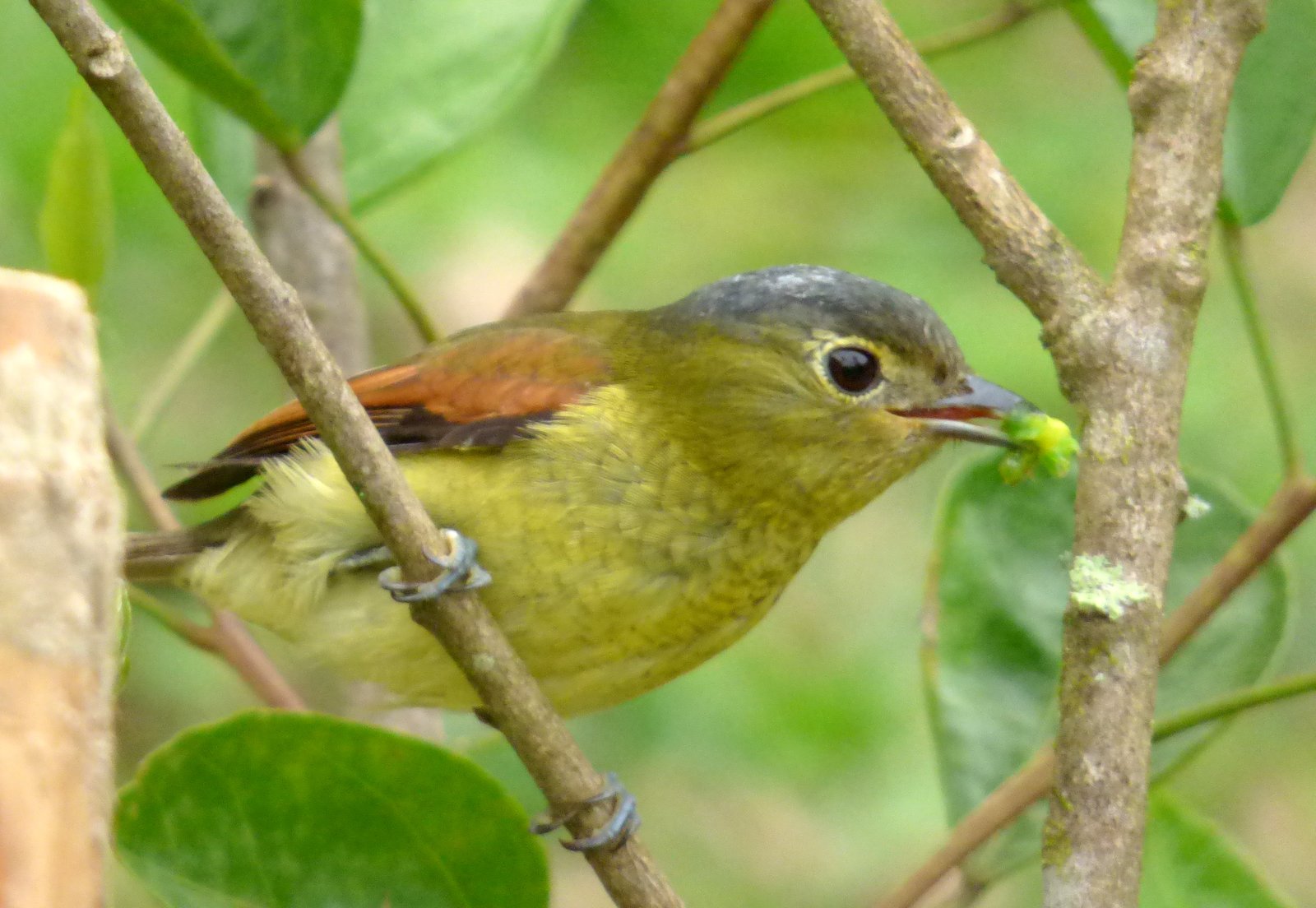
12–13 cm, with a large head and a short bill. The male has a glossy black crown and back, black wings with white edges and coverts, and a yellowish face and throat. The underparts are pale grey to yellowish white, finely barred dark. The female has a grey crown, an olive-green back and rufous wing coverts and wing edges; the face and breast are yellow with fine barring.
Confusion species
Black-and-white Becard Pachyramphus albogriseus is larger, the male with a white eyebrow and unbarred grey underparts; the female has a chestnut crown edged black. Green-backed Becard Pachyramphus viridis is larger, unbarred, and lives lower on the eastern slope.
Habitat
Cloud forest and upper montane forest, forest edges and forest rich in mosses and epiphytes, roughly between 1500 and 3200 m. It searches for insects and some fruit in the middle and upper foliage, often in mixed flocks. The nest is a globular structure of moss and plant fibres with a side entrance, in a tree fork.
Where the bird is most at home, classified by the vegetation units of the Andes and the west coast.


Range and movements
In Colombia in all three Andean ranges. In Ecuador on both slopes of the Andes. In Peru mainly on the eastern slope, along the whole length of the country. In Bolivia in the Yungas. Absent from the Galápagos. Outside the guide area in Costa Rica and western Panama and in western Venezuela.
- Resident
- dark = core range, pale = thinly spread
How and when to look
Work through mixed flocks in cloud forest, for example along roads on the eastern slope of the Andes. Watch for a small, big-headed bird quietly searching branches; the fine barring on the underparts is decisive.
Conservation status
Least Concern. The species is widespread in the Andes; loss of montane forest affects numbers locally.
Scientific name
Pachyramphus versicolor | (Hartlaub, 1843)
Hartlaub described the species in 1843 as Vireo versicolor; because it was later moved to another genus, the author and year stand in brackets. The genus Pachyramphus was introduced in 1840 by Gray. The genus name comes from Greek pakhus, 'stout, thick', and rhamphos, 'bill'. The species name is Latin versicolor, 'variegated, of changing colour'. The specimen the first description was based on came from 'Bogotá', Colombia.