All species › Passerines › Tityras, becards and allies › Green-backed Becard
Green-backed Becard | Pachyramphus viridis
Groenrugbekarde | Anambé verdoso | Caneleiro-verde
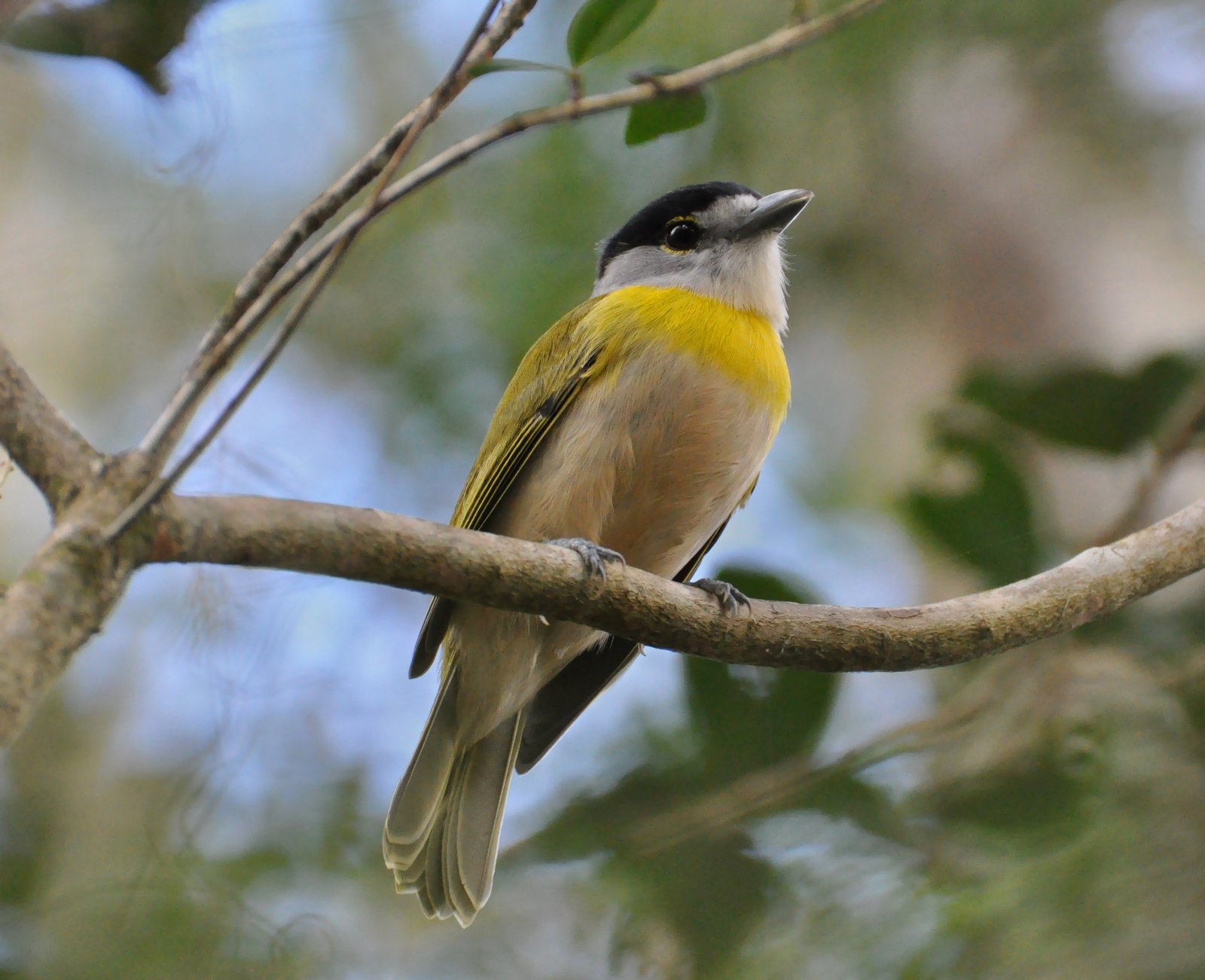
The Green-backed Becard is a medium-sized, olive-green becard, the male with a black crown. Two groups live in the guide area: the yellow-cheeked forms, formerly treated as a separate species, on the eastern slope of the Andes in Ecuador and Peru, and the nominate form in the lowlands of Bolivia. The birds forage quietly in the foliage for insects, often in mixed flocks.
Voice
The song starts abruptly and consists of an ascending, slightly slowing series of sweet notes. The call is a fast, thin, nasal series of notes rising in pitch.
Recording: Fabrício Grigolin — CC BY-NC-SA 4.0 · xeno-canto
Identification
14–15 cm, with a large head and a short, broad bill. The male has a glossy black crown, olive-green back and wings, yellow cheeks and a yellowish breast, shading to a paler belly. In the nominate form in Bolivia the cheeks are greyer and the breast has a yellow band between a pale throat and belly. The female lacks the black crown: the crown is olive-green and the lesser wing coverts are chestnut.
Confusion species
The female Barred Becard Pachyramphus versicolor is smaller, with fine barring on the underparts and rufous wing edges, and lives higher in montane forest. Greenlets of the genus Hylophilus, such as Lemon-chested Greenlet Hylophilus thoracicus, are smaller and slimmer, with a more pointed bill and no black crown or chestnut shoulder.
Habitat
Humid forest, forest edges and clearings with trees in the foothills and lower slopes of the eastern slope, roughly between 700 and 1700 m; in Bolivia also in the lowlands, in forest edges, gallery forest and light woodland. It searches for insects and some fruit in the middle and upper foliage, often in mixed flocks. The nest is a large ball of plant material with a side entrance, high in a tree.
Where the bird is most at home, classified by the vegetation units of the Andes and the west coast.


Range and movements
In Ecuador on the eastern slope of the Andes, south to Zamora-Chinchipe. In Peru locally on the eastern slope, including Huánuco and Junín. In Bolivia in the east and centre of the country, in the lowlands and foothills. Not known with certainty from Colombia. Absent from the Galápagos. Outside the guide area in Venezuela, Guyana, Brazil, Paraguay and northern Argentina.
- Resident
- dark = core range, pale = thinly spread
How and when to look
In the foothills of eastern Ecuador, check mixed flocks in the middle foliage along roads and forest edges; the rising series of sweet notes gives the species away. In Bolivia look for it in forest edges and gallery forest in the lowlands around Santa Cruz.
Conservation status
Not Evaluated in the broad species limits used here. Both parts of which it consists are assessed separately as Least Concern; numbers are probably declining, but no immediate threats are known.
Scientific name
Pachyramphus viridis | (Vieillot, 1816)
Vieillot described the species in 1816 as Tityra viridis; because it was later moved to another genus, the author and year stand in brackets. The genus Pachyramphus was introduced in 1840 by Gray. The genus name comes from Greek pakhus, 'stout, thick', and rhamphos, 'bill'. The species name is Latin viridis, 'green'. The specimen the first description was based on came from Paraguay.