All species › Passerines › Tityras, becards and allies › Masked Tityra
Masked Tityra | Tityra semifasciata
Maskertityra | Titira enmascarada | Anambé-branco-de-máscara-negra
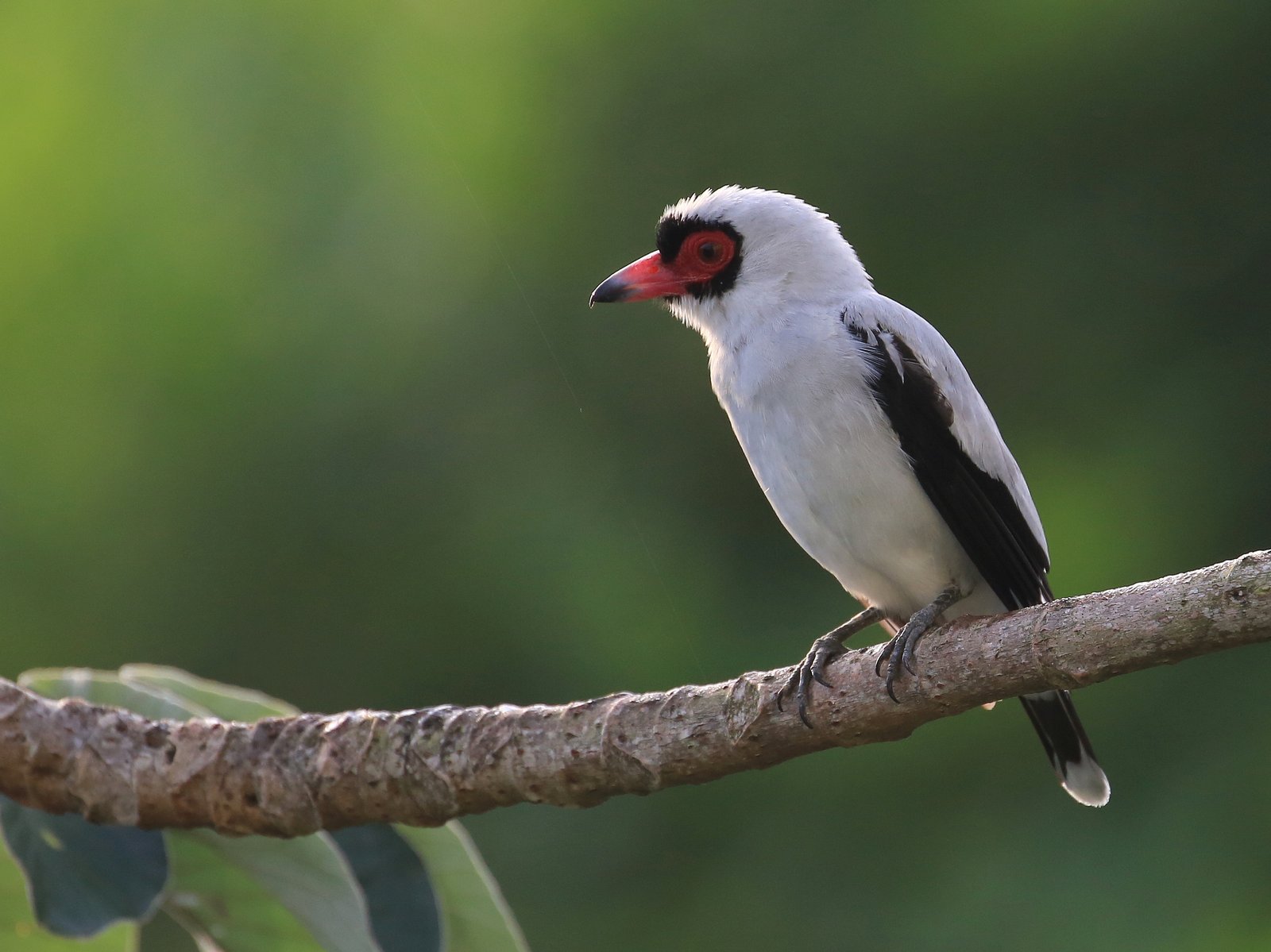
The Masked Tityra is a large, pale grey tityra with a black mask and red skin around the eye. It occurs on both sides of the Andes, from the lowlands into the lower montane forests. Like the other tityras it likes to sit on bare branches above the canopy, giving grunting, frog-like notes.
Voice
Nasal, grunting notes, such as kwenk, rek or a dry zzrt-zzrt, often given by both birds of a pair. Also heard in flight.
Recording: Ricardo José Mitidieri — CC BY-NC-SA 4.0 · xeno-canto
Identification
20–22 cm, with a large head and a heavy red bill with a black tip; red bare skin around the eye. The male is pale grey, almost white below, with a black mask across the forehead, lores and eye; the crown is pale. The wings are black. The tail is grey with a broad black band in front of the pale tip. The female is browner, with a brownish-grey crown and back and a less distinct mask; the tail has the same pattern.
Confusion species
Black-tailed Tityra Tityra cayana has a wholly black cap extending over the crown and an all-black tail, and lives only east of the Andes. Black-crowned Tityra Tityra inquisitor is smaller, with an all-black bill without red skin and a black crown above a white cheek.
Habitat
The canopy and edges of humid forest, clearings with tall dead trees, and coffee and cacao plantations and pastures with scattered tall trees. From the lowlands to about 1500 m, locally higher. It eats mainly fruit, also large insects and sometimes small lizards. It nests in an old woodpecker hole or a natural cavity high in a dead tree.
Where the bird is most at home, classified by the vegetation units of the Andes and the west coast.


Range and movements
In Colombia widespread: in the Pacific and Caribbean lowlands, in the major valleys between the Andean ranges and east of the Andes. In Ecuador in the west and in the east, mainly along the base of the Andes. In Peru in the far north-west and east of the Andes. In Bolivia in the lowlands and Andean foothills of the north and centre. Absent from the Galápagos. Outside the guide area from Mexico to Amazonian Brazil.
- Resident
- dark = core range, pale = thinly spread
How and when to look
From roads along forest edges in the foothills, scan the bare tops of tall trees; pairs often sit there for long periods. In western Ecuador and Colombia this is the tityra most often met in semi-open country.
Conservation status
Least Concern. The range is very large and the species tolerates landscapes with scattered tall trees and forest remnants.
Scientific name
Tityra semifasciata | (Spix, 1825)
Spix described the species in 1825 as Pachyrhynchus semifasciatus; because it was later moved to another genus, the author and year stand in brackets. The genus Tityra was introduced in 1816 by Vieillot. The genus name comes from Greek tituroi, the name for the satyrs and other companions of Pan and Bacchus. It refers to the noisy, aggressive behaviour of the type species. The species name comes from Latin semi, 'half', and fasciatus, 'banded'. The specimen the first description was based on came from Pará, Brazil.