All species › Passerines › Tityras, becards and allies › Black-crowned Tityra
Black-crowned Tityra | Tityra inquisitor
Zwartkruintityra | Titira pico negro | Anambé-branco-de-bochecha-parda
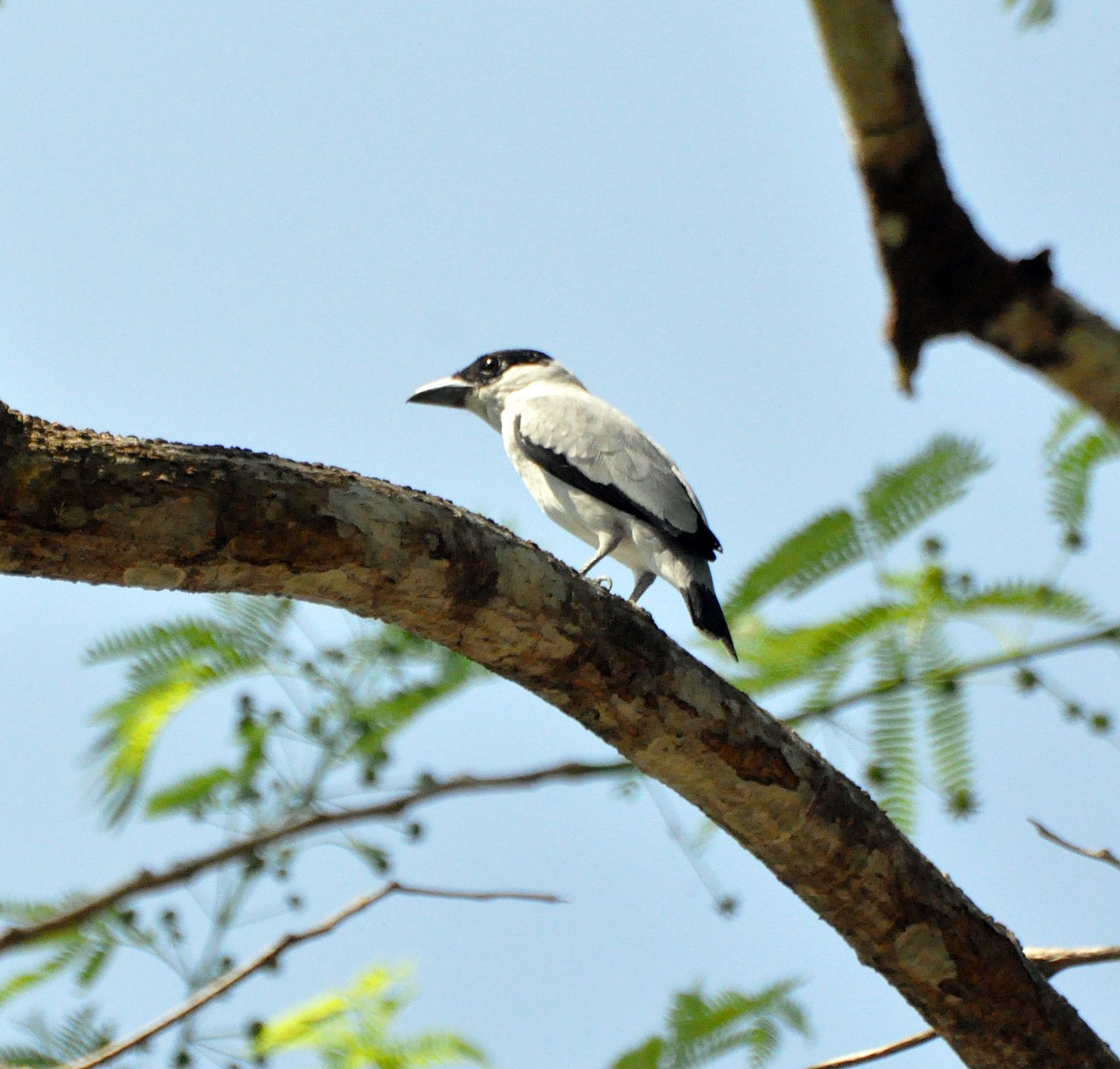
The Black-crowned Tityra is the smallest tityra and the only one without red skin on the face. It lives in the canopy of humid forest on both sides of the Andes. The female is recognised by its rufous cheeks.
Voice
Quieter than the other tityras: dry, nasal ticks and grunts, such as zik zik or zzt, often in short series.
Recording: Luis Seko Pradier — CC BY-NC-SA 4.0 · xeno-canto
Identification
18 cm, with a large head and an all-black bill; no red bare skin around the eye. The male is pale grey above and white below, with a black crown, white cheeks and black wings; the tail is black, in Amazonian birds with a grey base. The female has a black crown, rufous cheeks and a brownish-grey back with dark streaks; the underparts are white with greyish sides.
Confusion species
Black-tailed Tityra Tityra cayana and Masked Tityra Tityra semifasciata are larger and have red skin around the eye and a red bill with a black tip. In Black-tailed Tityra the cheek is also black; Masked Tityra has a pale crown and a black mask.
Habitat
The canopy and edges of humid forest, tall trees in clearings, plantations and gardens with scattered trees, in the lowlands and foothills. Mostly below 1200 m. It eats fruit and insects. It nests in an old woodpecker hole or a natural cavity high in a tree.
Where the bird is most at home, classified by the vegetation units of the Andes and the west coast.


Range and movements
In Colombia both west of the Andes, in the Pacific and Caribbean lowlands and the lower parts of the major valleys, and in the lowlands east of the Andes. In Ecuador in the western and eastern lowlands. In Peru mainly in the lowlands east of the Andes. In Bolivia in the northern and eastern lowlands. Absent from the Galápagos. Outside the guide area from Mexico to north-eastern Argentina.
- Resident
- dark = core range, pale = thinly spread
How and when to look
Look for small tityras in the tops of fruiting trees along forest edges; the birds often sit together with other fruit-eaters. The black bill without red and, in the female, the rufous cheek are decisive.
Conservation status
Least Concern. The species has a very large range and persists in semi-open country with tall trees.
Scientific name
Tityra inquisitor | (Lichtenstein, 1823)
Lichtenstein described the species in 1823 as L[anius] Inquisitor; because it was later moved to another genus, the author and year stand in brackets. The genus Tityra was introduced in 1816 by Vieillot. The genus name comes from Greek tituroi, the name for the satyrs and other companions of Pan and Bacchus. It refers to the noisy, aggressive behaviour of the type species. The species name comes from Latin inquisitor, 'investigator' or 'searcher'. The specimen the first description was based on came from São Paulo, Brazil.