All species › Passerines › Tityras, becards and allies › Black-tailed Tityra
Black-tailed Tityra | Tityra cayana
Zwartstaarttityra | Titira colinegra | Anambé-branco-de-rabo-preto
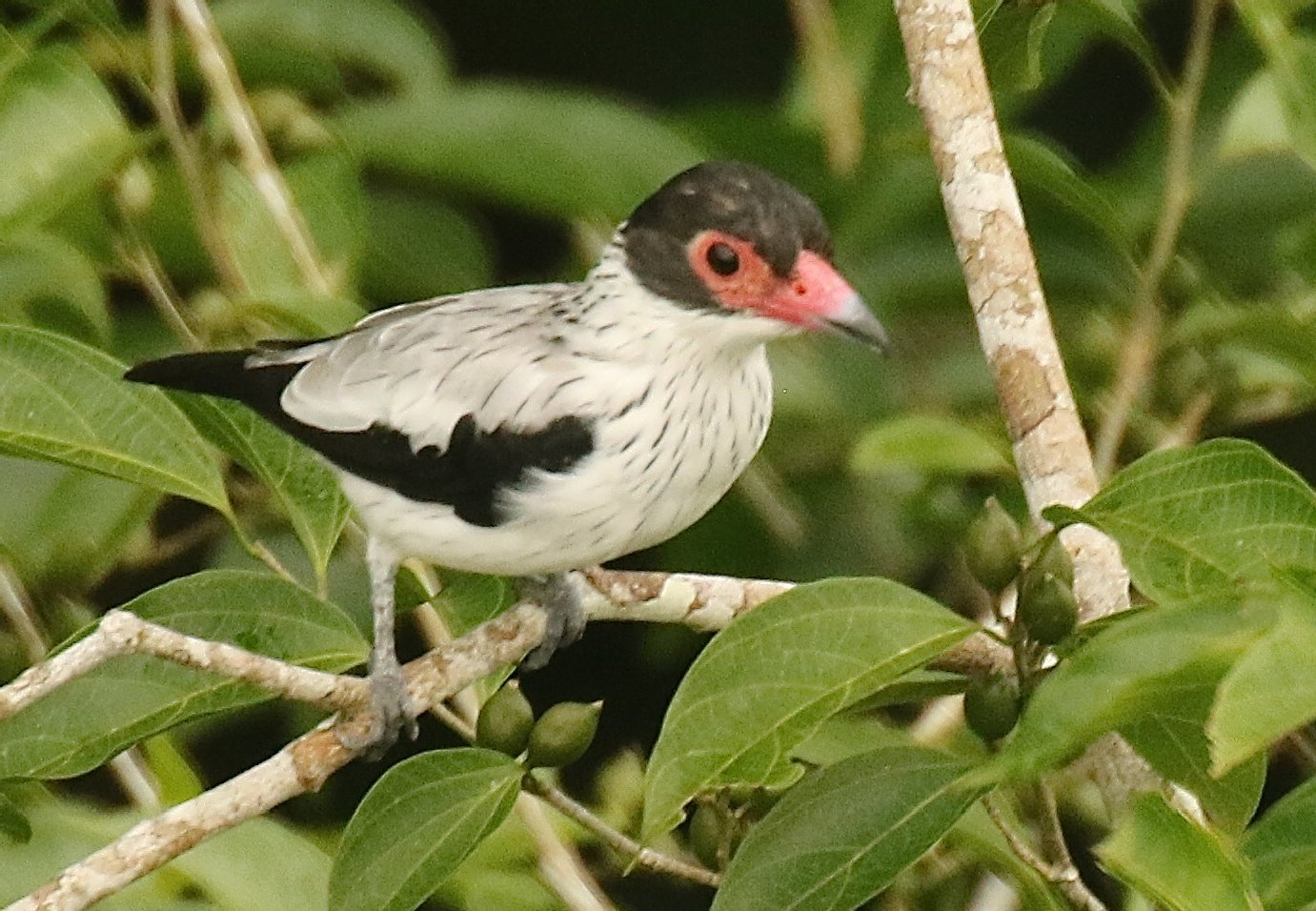
The Black-tailed Tityra is a stocky, big-headed bird of forest edges in the lowlands east of the Andes. The male is silvery white with a black cap, black wings and tail, and red bare skin around the eye and at the base of the bill. Pairs often sit together on bare branches above the canopy, giving dry, grunting notes.
Voice
Dry, nasal, grunting notes, such as rek or zzrrt, often in short series and given by both birds of a pair. Recalls the croaking of a frog.
Recording: Jeremy Minns — CC BY-NC-SA 3.0 · xeno-canto
Identification
20–22 cm, with a large head and a heavy bill that is red with a black tip. A patch of red bare skin surrounds the eye. The male is pale silvery grey above and white below, with a black cap covering the whole crown and the head to below the eye; the wings and tail are wholly black. The female also has a black cap, but the back is brownish grey with dark streaks and the breast is white with fine dark streaks. Young birds are browner, with less black on the head.
Confusion species
Masked Tityra Tityra semifasciata has only a black mask around the bill and eye and a pale crown, and a grey tail with a broad black band. Black-crowned Tityra Tityra inquisitor is smaller, has an all-black bill without red skin and a white cheek below the black crown; the female has rufous cheeks.
Habitat
The canopy and edges of humid lowland forest, clearings with tall dead trees, gallery forest and old plantations with scattered trees. Mostly below 1000 m. It eats mainly fruit, supplemented by large insects. It nests in an old woodpecker hole or a natural cavity high in a dead tree.
Where the bird is most at home, classified by the vegetation units of the Andes and the west coast.


Range and movements
In Colombia east of the Andes, in the llanos and the Amazonian lowlands. In Ecuador in the eastern lowlands. In Peru in the lowlands east of the Andes. In Bolivia in the northern and eastern lowlands. Absent west of the Andes and from the Galápagos. Outside the guide area in Venezuela, the Guianas, Brazil, Paraguay and north-eastern Argentina.
- Resident
- dark = core range, pale = thinly spread
How and when to look
Scan the bare tops of tall trees along forest edges and clearings, for example along rivers in the Amazonian lowlands. Pairs often stay long at the same spot and give themselves away by their grunting calls.
Conservation status
Not Evaluated in the species limits used here. The species is widespread and common in the lowlands and adapts to forest edges and semi-open country.
Scientific name
Tityra cayana | (Linnaeus, 1766)
Linnaeus described the species in 1766 as [Lanius] cayanus; because it was later moved to another genus, the author and year stand in brackets. The genus Tityra was introduced in 1816 by Vieillot. The genus name comes from Greek tituroi, the name for the satyrs and other companions of Pan and Bacchus. It refers to the noisy, aggressive behaviour of the type species. The species name cayana refers to Cayenne in French Guiana. The specimen the first description was based on came from Cayenne, French Guiana.