All species › Passerines › Tityras, becards and allies › White-browed Purpletuft
White-browed Purpletuft | Iodopleura isabellae
Witkeeldwergcotinga | Yodopleura cejiblanca | Anambezinho
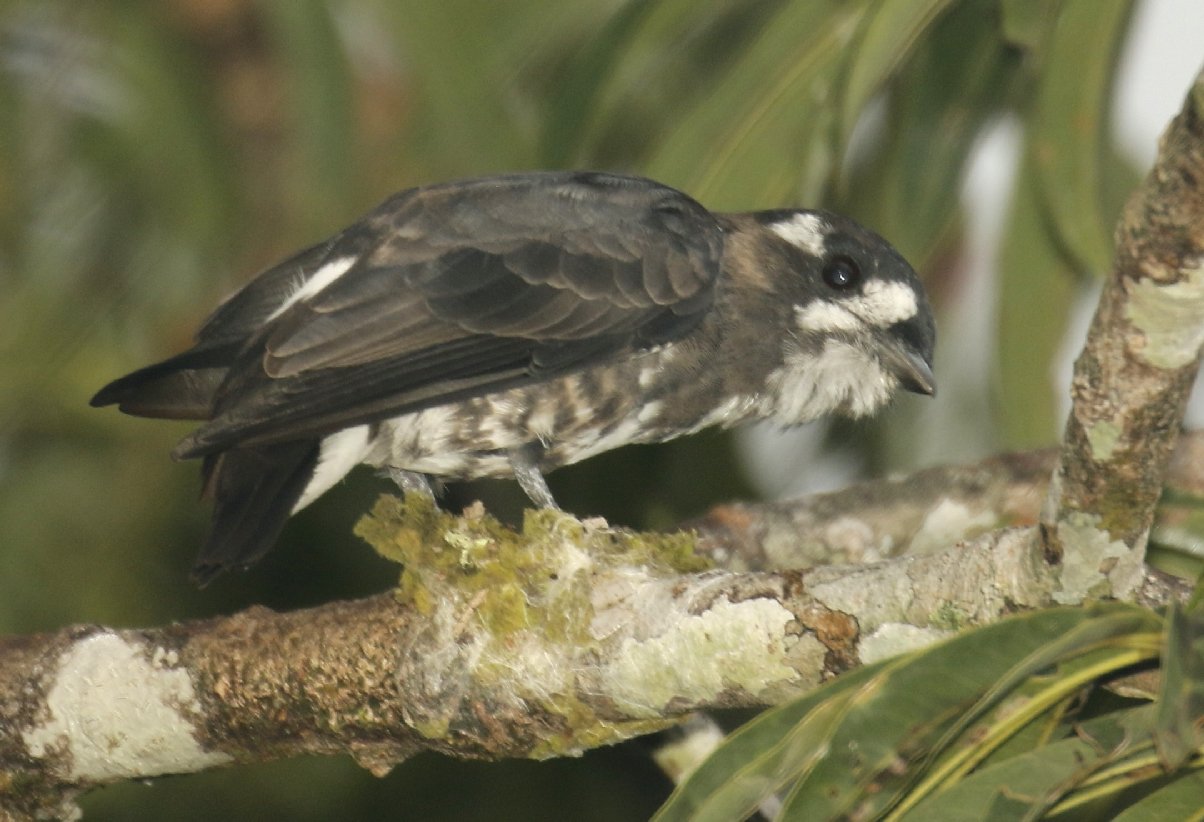
The White-browed Purpletuft is a small, stocky bird of the canopy in the Amazonian lowlands, with long, pointed wings and a short tail. It often sits for long periods on bare branches high in tall trees, sallying from there for flying insects. The purple tufts on the sides of the breast that give the group its name are usually hidden under the wing in the male.
Voice
Usually silent. Gives high, thin, whistled notes, such as a soft tsee, singly or in short series, mainly from a high perch.
Recording: JAYRSON ARAUJO DE OLIVEIRA — CC BY-NC-SA 4.0 · xeno-canto
Identification
11–12 cm, with a short, broad bill, long wings and a short tail. The upperparts are dark greyish brown, with a white band across the rump. On the head a white spot in front of the eye, a white stripe behind the eye and a white moustachial stripe outline the dark cheek. The throat and centre of the underparts are white, the flanks and sides of the breast broadly brown. The male has a tuft of purple feathers on the sides of the breast; in the female these are white. Young birds are lightly scaled above.
Confusion species
Swallow-winged Puffbird Chelidoptera tenebrosa uses the same kind of bare branches and also has a white rump, but is larger and almost wholly black, with a rufous belly and no white stripes on the head. No other purpletuft occurs in the guide area; the related Dusky Purpletuft Iodopleura fusca lives in the Guianas.
Habitat
The canopy and edges of humid lowland forest, both terra firme and várzea, and clearings and riverbanks with tall, partly dead trees. Mostly below 600 m. It eats small fruits, including those of mistletoes, and insects caught in short sallies from a perch. The nest is a very small, shallow cup on top of a horizontal branch high in a tree.
Where the bird is most at home, classified by the vegetation units of the Andes and the west coast.


Range and movements
In Colombia in the Amazonian lowlands of the south-east. In Ecuador in the eastern lowlands. In Peru in the lowlands east of the Andes. In Bolivia in the northern lowlands. Absent from the Galápagos. Outside the guide area in southern Venezuela and Amazonian Brazil.
- Resident
- dark = core range, pale = thinly spread
How and when to look
Scan the bare tops of tall trees from canopy towers, riverbanks and clearings. Birds often sit upright there for long periods and make short sallies, so they can be followed well with a telescope.
Conservation status
Least Concern. The range is large and largely forested; the species depends on forest with tall trees and disappears where forest is cleared on a large scale.
Scientific name
Iodopleura isabellae | Parzudaki, 1847
Parzudaki described the species in 1847 and placed it straight away in the genus where it still stands. The genus Iodopleura was introduced in 1839 by Lesson. The genus name comes from Greek iōdēs, 'violet-coloured', and pleura, 'side, flank', after the purple feather tufts on the male's flanks. The species name honours Isabelle Thirion, wife of Eugène Thirion; the 1847 description states that the species was dedicated to her. The specimen the first description was based on came from San Carlos de Río Negro, Amazonas, Venezuela.