All species › Passerines › Tityras, becards and allies › Brown-winged Schiffornis
Brown-winged Schiffornis | Schiffornis turdina
Bruinvleugelschiffornis | Llorón alipardo | Flautim-marrom
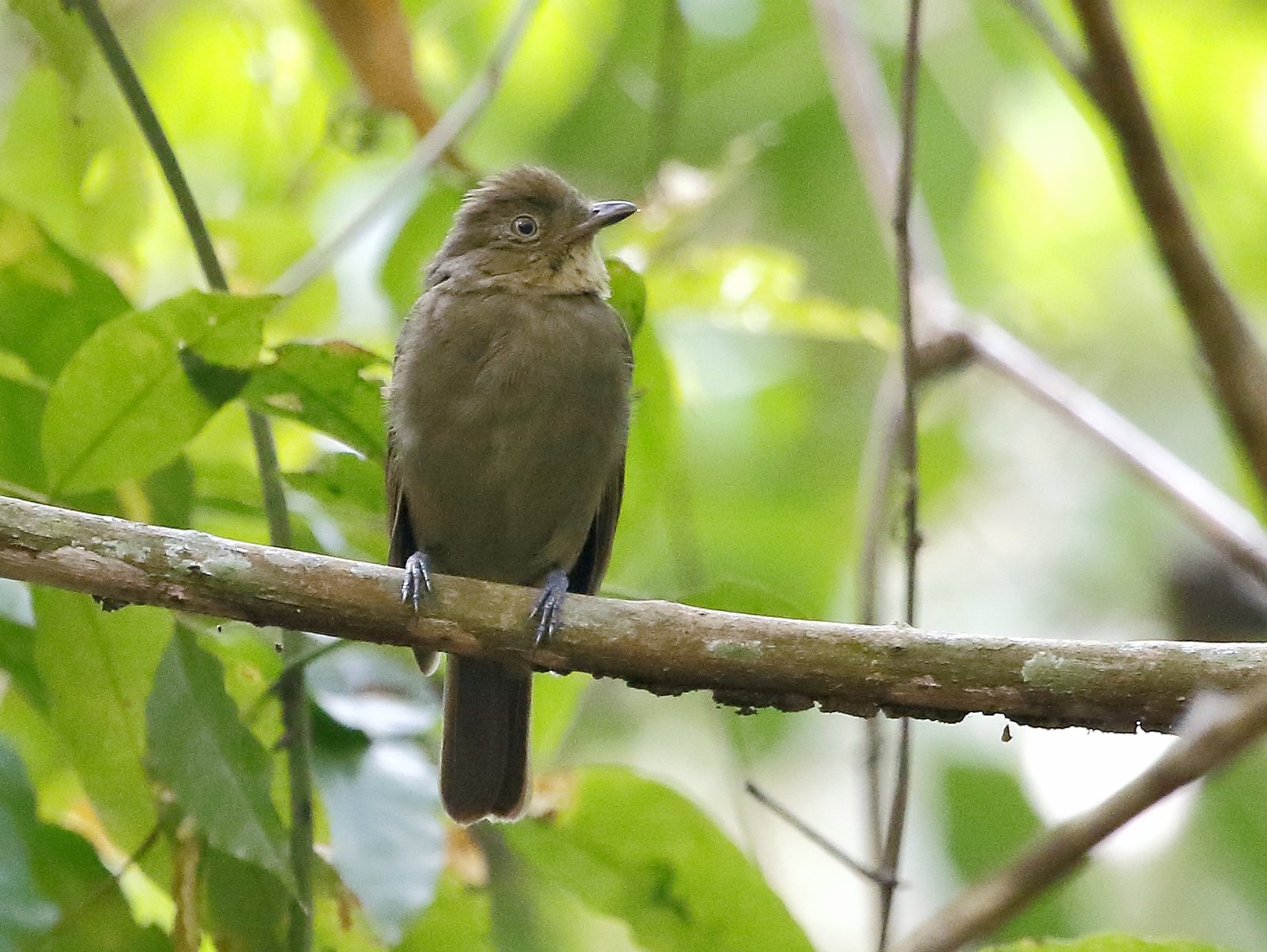
The Brown-winged Schiffornis is a plain olive-brown bird of the undergrowth of Amazonian lowland forest. It was formerly treated as one species together with several related forms; in the guide area it now covers the birds of the Amazonian lowlands. It lives hidden low in the forest and is mainly noticed by its whistled song.
Voice
A clear, rather slow series of three or four whistles, the first often drawn out; repeated mainly in the morning.
Recording: João Capurucho — CC BY-NC-SA 4.0 · xeno-canto
Identification
16–17 cm, with a rounded head, large dark eyes and a fairly long tail. Mainly olive-brown, with warmer brown wings and tail; throat and breast olive-grey, the belly paler greyish brown. No markings. The sexes are alike; young birds are somewhat more rufous.
Confusion species
Foothill Schiffornis Schiffornis aenea lives higher, at the foot of the Andes, and has a different song. Varzea Schiffornis Schiffornis major is cinnamon-brown and lives in flooded forest. Ochre-bellied Flycatcher Mionectes oleagineus is smaller, with an ochre belly and a thin bill. Female manakins are smaller and greener, with a shorter tail.
Habitat
Undergrowth and lower level of humid terra firme lowland forest, also old secondary forest, up to about 1000 m. It lives alone or in pairs and sometimes joins mixed flocks. It eats small fruits and insects. The nest is a cup of moss and leaves, low near the ground, often in a hollow stump.
Where the bird is most at home, classified by the vegetation units of the Andes and the west coast.


Range and movements
In Colombia in the Amazonian lowlands east of the Andes. In Ecuador in the eastern lowlands. In Peru throughout the Amazonian lowlands. In Bolivia in the northern and central lowlands. Absent from the Galápagos. Outside the guide area in Brazilian Amazonia and the Atlantic Forest of eastern Brazil.
- Resident
- dark = core range, pale = thinly spread
How and when to look
Walk slowly along trails in lowland forest early in the morning and listen for the slow whistled series; the bird sits low and still and, when disturbed, flies a short distance to a new perch.
Conservation status
Least Concern. Widespread in large lowland forest.
Scientific name
Schiffornis turdina | (Wied-Neuwied, 1831)
Wied-Neuwied described the species in 1831 as Muscicapa turdina; because it was later moved to another genus, the author and year stand in brackets. The genus Schiffornis was introduced in 1854 by Bonaparte. The genus name combines the surname of the German physiologist Moritz Schiff (1823–1896) with Greek ornis, 'bird'. The species name is Latin turdinus, 'thrush-like', from turdus, 'thrush'. The specimen the first description was based on came from Bahia, Brazil.