All species › Passerines › Tityras, becards and allies › Foothill Schiffornis
Foothill Schiffornis | Schiffornis aenea
Heuvelschiffornis | Llorón bronceado | Flautim-do-sopé
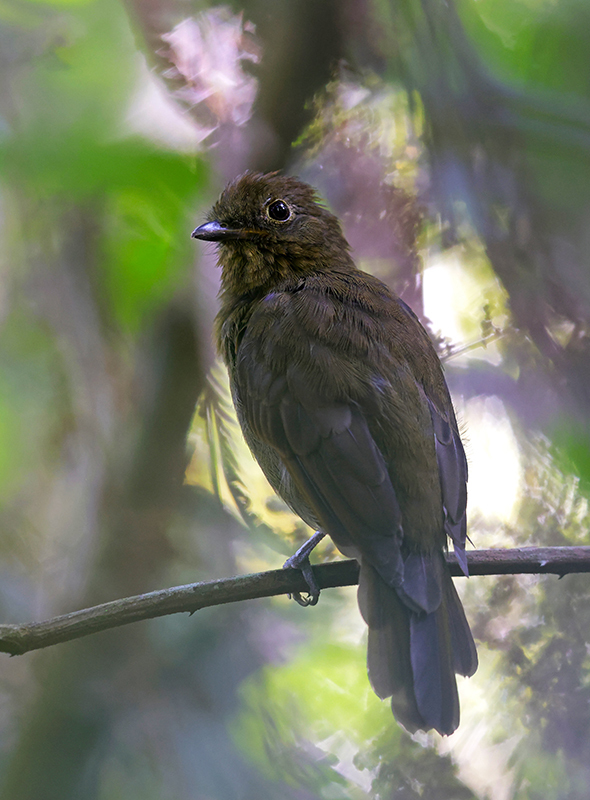
The Foothill Schiffornis is a dark, olive-brown bird of the foothills on the eastern slope of the Andes in Ecuador and Peru. It was long regarded as a form of the Brown-winged Schiffornis, but differs in song and elevational range. It lives hidden in the undergrowth.
Voice
A short series of clear whistles, usually three or four, varying in pitch; differs in rhythm and pitch from the song of the Brown-winged Schiffornis.
Recording: Fabrice Schmitt — CC BY-NC-SA 4.0 · xeno-canto
Identification
16 cm, with a rounded head, large dark eyes and a fairly long tail. Mainly dark olive-brown, slightly warmer brown on the wings and tail; throat and breast olive-grey, the belly somewhat paler. No wing bars or other markings. The sexes are alike.
Confusion species
Brown-winged Schiffornis Schiffornis turdina is very similar, but lives lower, in the Amazonian lowlands, and has a different song. Ochre-bellied Flycatcher Mionectes oleagineus is smaller, with an ochre belly and a thin bill, and often lifts one wing.
Habitat
Undergrowth of humid foothill forest and lower montane forest on the eastern slope of the Andes, roughly between 600 and 1600 m. It lives alone or in pairs low in the forest. It eats fruit and insects. Little is known about the nest.
Where the bird is most at home, classified by the vegetation units of the Andes and the west coast.


Range and movements
In Ecuador along the eastern slope of the Andes. In Peru along the eastern slope, south to the centre of the country. Not known with certainty from Colombia or Bolivia. Absent from the Galápagos. Does not occur outside the guide area.
- Resident
- dark = core range, pale = thinly spread
How and when to look
Listen along forest trails in the foothills of eastern Ecuador or northern Peru for the short whistled series; the singer sits low and still in dense undergrowth.
Conservation status
Least Concern. Its foothill habitat is locally under pressure from deforestation.
Scientific name
Schiffornis aenea | Zimmer, 1936
Zimmer described the species in 1936 and placed it straight away in the genus where it still stands. The genus Schiffornis was introduced in 1854 by Bonaparte. The genus name combines the surname of the German physiologist Moritz Schiff (1823–1896) with Greek ornis, 'bird'. The species name is Latin aeneus, 'bronze-coloured', after the olive-brown tone of the plumage. The specimen the first description was based on came from Chaupe, Piura, Peru.