All species › Waders, gulls and terns › Sandpipers and allies › Solitary Sandpiper
Solitary Sandpiper | Tringa solitaria
Amerikaanse bosruiter | Andarríos solitario | Maçarico-solitário
The Solitary Sandpiper is a dark sandpiper of small, sheltered fresh waters that, as its scientific name solitaria indicates, usually feeds alone. It breeds in the boreal forests of North America and winters south to northern Argentina. In the guide area it is a widespread winter visitor to forest pools, ditches and riverbanks, mainly in the lowlands.
Voice
A high, sharp peet-weet or peet-weet-weet, often on take-off; higher and sharper than the call of Spotted Sandpiper.
Recording: Jeff Stewart — CC BY-NC-SA 4.0 · xeno-canto
Identification
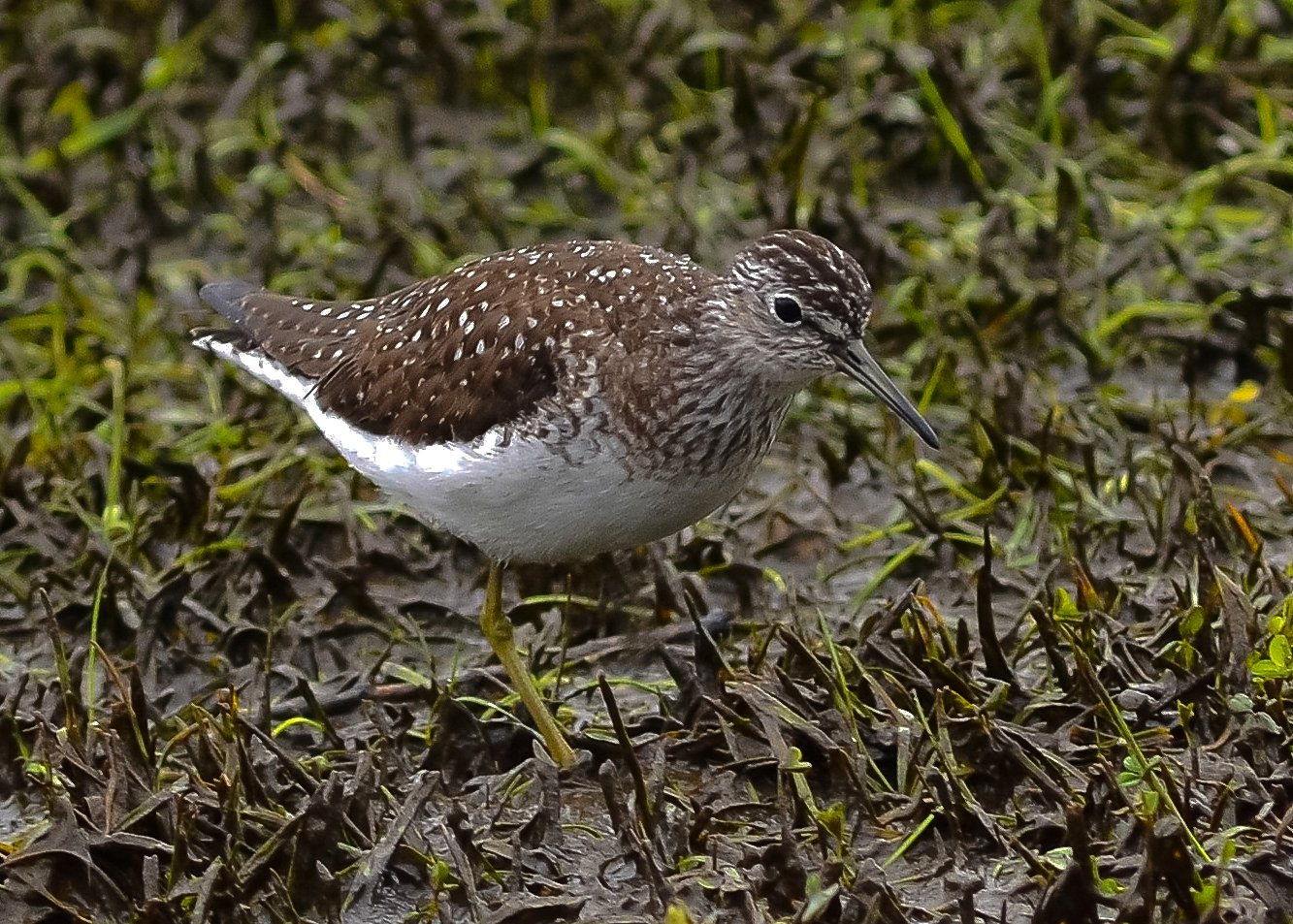
19–23 cm, a slender, dark sandpiper with a straight, medium-length, dark bill and fairly long, greenish legs. The upperparts are dark olive-brown with fine white spots, the head, neck and breast streaked greyish brown, the belly white. A prominent white eye-ring and a short pale line from bill to eye. In flight dark wings without a wing bar, dark underwings, a dark rump and central tail and white, black-barred outer tail feathers. It often bobs its head and foreparts. The sexes are alike; in non-breeding plumage the pattern is duller, and juveniles have finer, warmer-toned spots.
Confusion species
Lesser Yellowlegs Tringa flavipes has bright yellow legs, a white rump and paler upperparts, and often stands in flocks in open water. Spotted Sandpiper Actitis macularius is smaller and shorter-legged, with a white wing bar, a white notch in front of the bend of the wing and a constantly teetering rear end, and flies low with stiff, flickering beats. Stilt Sandpiper Calidris himantopus has a white rump and a bill with a slightly drooping tip.
Habitat
Edges of small freshwater pools, forest ponds, ditches, streams, rice fields, oxbow lakes (cochas) and muddy spots along rivers, usually in or near forest; rarely on salt water or open mudflats. Mainly in the lowlands, locally up to about 3000 m and higher on migration. It walks slowly along the water's edge, picking insects, larvae, small crustaceans and snails; it sometimes stirs the water with one foot. It does not breed in the guide area; on the breeding grounds it lays its eggs in old songbird nests in trees, which is unusual for a shorebird.
Where the bird is most at home, classified by the vegetation units of the Andes and the west coast.


Range and movements
In Colombia a winter visitor in almost the whole country up to about 3000 m, most numerous in the lowlands east of the Andes. In Ecuador a winter visitor mainly in the Amazonian lowlands and scarcer in the west and in the Andes. In Peru a winter visitor mainly east of the Andes, scarce on the coast and in the high mountains. In Bolivia a winter visitor in the lowlands, mainly in the Beni savannas and the Amazon region. A rare visitor to the Galápagos. Breeds in the boreal forests of Alaska and Canada and winters from Central America to northern Argentina.
- Resident
- Winter visitor (c. Oct–Mar)
- Passage (Mar–Apr, Oct–Nov)
- dark = core range, pale = thinly spread
How and when to look
From September to April on the edges of small, sheltered waters: forest pools, ditches, ponds in pastures and cochas in the Amazonian lowlands; usually alone. On take-off the dark underwings and the white, black-barred tail sides show.
Conservation status
Least Concern. The population appears stable, but is poorly known because of the species' dispersed habits on both breeding and wintering grounds.
Scientific name
Tringa solitaria | Wilson, 1813
Wilson described the species in 1813 and placed it straight away in the genus where it still stands. The genus Tringa was introduced in 1758 by Linnaeus. The genus name is the New Latin word Ulisse Aldrovandi gave to the Green Sandpiper, from Greek trungas, a thrush-sized, white-rumped wading bird mentioned by Aristotle. The species name is Latin solitarius, 'solitary', after its habit of feeding alone. The specimen the first description was based on came from Pocono Mountains, Pennsylvania, United States.