All species › Waders, gulls and terns › Sandpipers and allies › Wandering Tattler
Wandering Tattler | Tringa incana
Amerikaanse grijze ruiter | Playero vagabundo | Maçarico-errante
The Wandering Tattler is a plain grey sandpiper of rocky coasts that migrates between mountain streams in Alaska and north-eastern Siberia and the shores of the Pacific. It winters as far as remote islands in mid-ocean; its English and Spanish names refer to this wandering. In the guide area it is a winter visitor to rocky mainland coasts and widespread on the lava shores of the Galápagos.
Voice
A rapid series of six to ten clear, whistled notes on one pitch, dididididi…, often on take-off.
Recording: Steve Hampton — CC BY-NC-SA 4.0 · xeno-canto
Identification
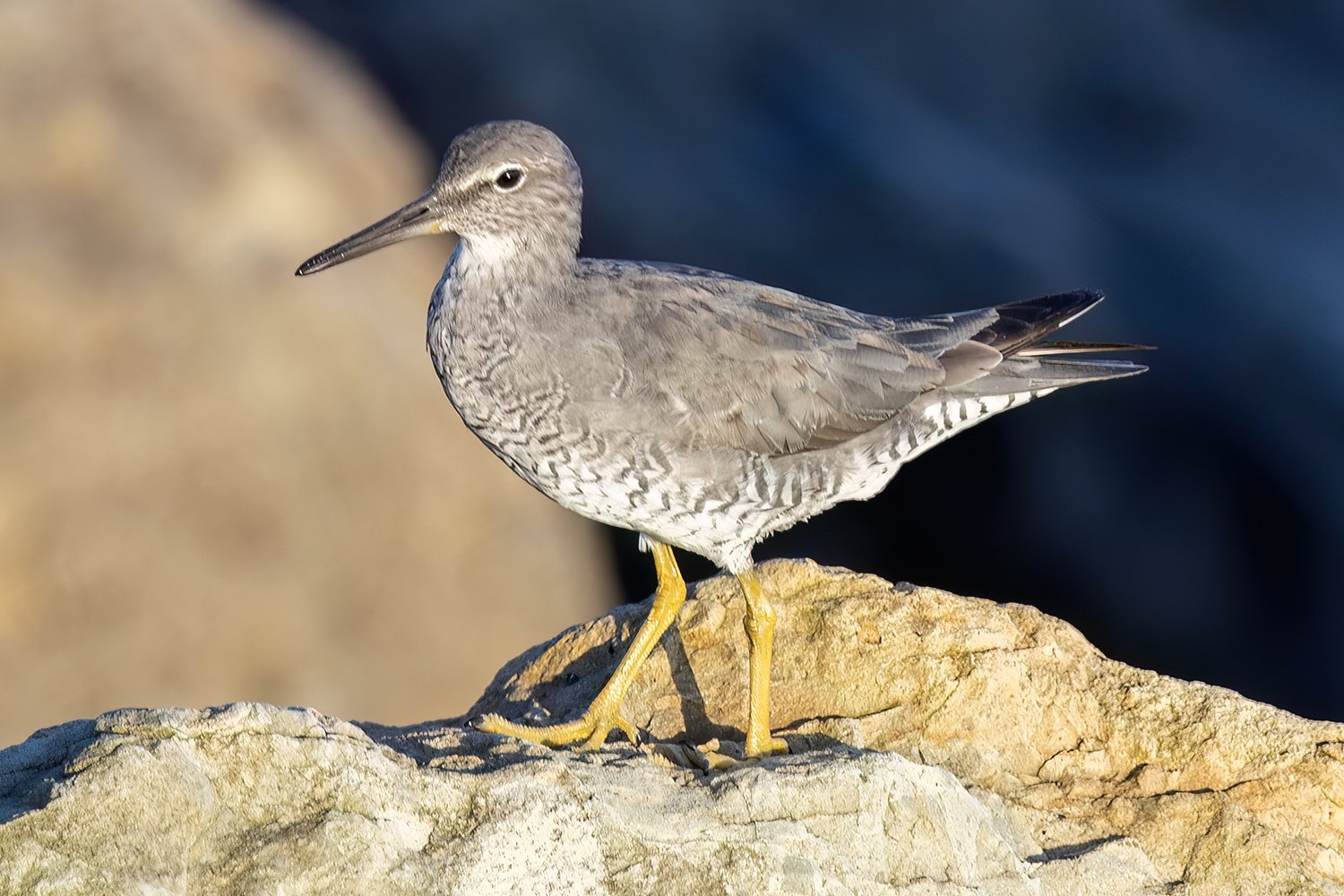
26–29 cm, a medium-sized, plain grey sandpiper with a straight, dark bill, short yellow legs and long wings. In non-breeding plumage the upperparts, head, breast and flanks are uniform slate grey, with a white supercilium in front of the eye, a dark loral stripe and a white belly. In breeding plumage, sometimes already in March–April, the underparts are densely barred dark grey. In flight uniform dark grey wings, rump and tail without pattern. It constantly teeters and bobs its rear end. The sexes are alike; juveniles have fine pale fringes on the upperparts.
Confusion species
Surfbird Calidris virgata, which uses the same rocks, has a short, blunt bill, a white wing bar and a white tail base with a black terminal band. Willet Tringa semipalmata is larger, with blue-grey legs and a broad white band across black wings. Spotted Sandpiper Actitis macularius is smaller, with white underparts in non-breeding plumage, a white notch in front of the bend of the wing and a white wing bar.
Habitat
Rocky shores, breakwaters, lava coasts, jetties and rocky sections of sandy beaches in the intertidal zone; rarely on mudflats. It walks over wet, weed-covered rocks, picking crabs, worms, snails and other invertebrates from crevices. It does not breed in the guide area; on the breeding grounds it nests on gravel bars along mountain streams above the tree line.
Where the bird is most at home, classified by the vegetation units of the Andes and the west coast.


Range and movements
In Colombia a winter visitor along the Pacific coast and on islands such as Gorgona and Malpelo. In Ecuador a winter visitor to rocky sections of the coast and to islands such as Isla de la Plata. In Peru a winter visitor along the coast, mainly in the north and scarcer to the south. On the Galápagos a regular winter visitor to the shores of almost all islands. Absent from Bolivia. Breeds in Alaska, north-western Canada and north-eastern Siberia and winters along the Pacific coasts of the Americas and on Pacific islands to Australia.
- Resident
- Winter visitor (c. Oct–Mar)
- Passage (Mar–Apr, Oct–Nov)
- dark = core range, pale = thinly spread
How and when to look
From August to May on the lava shores of the Galápagos, for example around Puerto Ayora on Santa Cruz, and on rocky headlands and breakwaters on the coast of Ecuador and northern Peru; usually alone, sometimes with Ruddy Turnstones. The constant bobbing and the trilled call on take-off help in finding it.
Conservation status
Least Concern. There is no evidence of a steep decline; the population is small and dispersed and is little counted.
Scientific name
Tringa incana | (Gmelin, 1789)
Gmelin described the species in 1789 as Scolopax incana; because it was later moved to another genus, the author and year stand in brackets. The genus Tringa was introduced in 1758 by Linnaeus. The genus name is the New Latin word Ulisse Aldrovandi gave to the Green Sandpiper, from Greek trungas, a thrush-sized, white-rumped wading bird mentioned by Aristotle. The species name is Latin incanus, 'hoary, light grey'. The specimen the first description was based on came from Mo'orea, French Polynesia.