All species › Waders, gulls and terns › Sandpipers and allies › Lesser Yellowlegs
Lesser Yellowlegs | Tringa flavipes
Kleine geelpootruiter | Archibebe patigualdo chico | Maçarico-de-perna-amarela
The Lesser Yellowlegs is a slender sandpiper with bright yellow legs that migrates between the taiga of Alaska and Canada and South America. In the guide area it is one of the most numerous North American shorebirds: from the coast to the lakes of the puna it stands on muddy shores and in shallow water, often in flocks.
Voice
A soft, whistled tew or tew-tew, usually one or two notes; softer and flatter than the call of Greater Yellowlegs.
Recording: Tony Rinaud — CC BY-NC-SA 4.0 · xeno-canto
Identification
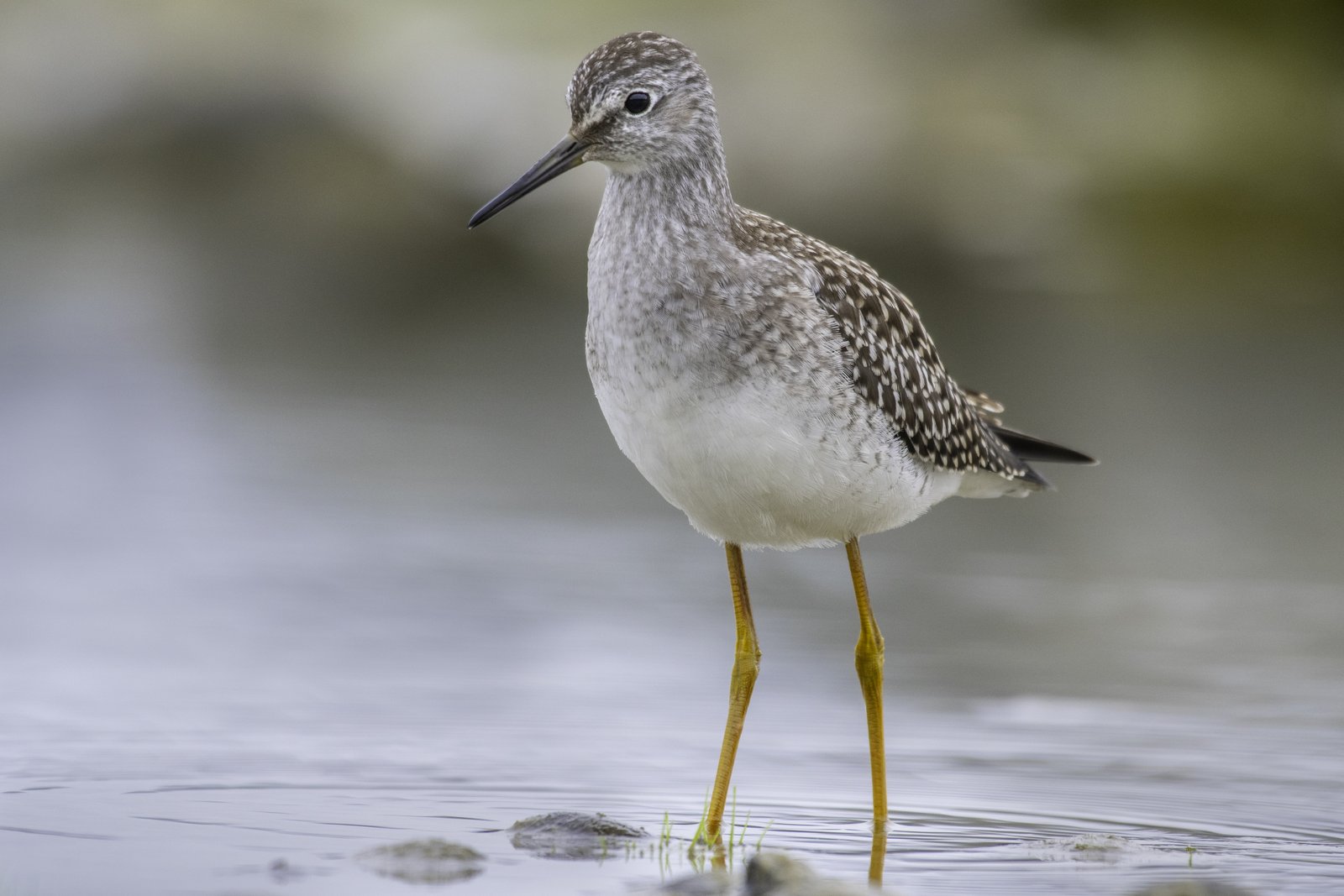
23–27 cm, a slender, long-legged sandpiper with long, bright yellow legs and a thin, straight, black bill about as long as the head. In non-breeding plumage greyish brown, with fine pale spots on the upperparts, a finely streaked grey neck and breast, a short white supercilium in front of the eye and a white belly. In breeding plumage, partly seen in March–April, darker, with black spots on the back and more streaking on the neck and breast. In flight plain dark wings, a square white rump and a faintly barred tail; the legs project well beyond the tail. The sexes are alike; juveniles have a browner back with pale spots and a greyer breast.
Confusion species
Greater Yellowlegs Tringa melanoleuca is larger and heavier, with a bill about one and a half times the length of the head that is often slightly upturned and has a paler base, and a louder call of three or four notes. Solitary Sandpiper Tringa solitaria has a dark rump, a white eye-ring and greenish legs. Stilt Sandpiper Calidris himantopus has a longer bill with a drooping tip and greenish-yellow legs, and feeds by probing with its head under water. Wilson's Phalarope Phalaropus tricolor has a needle-thin bill and shorter legs and often swims.
Habitat
Shallow water and muddy shores of all kinds of wetlands: mudflats, lagoons, salt pans and shrimp farms on the coast, freshwater marshes, rice fields, flooded pastures and the edges of cochas in the lowlands, and lakes and bofedales on the puna up to about 4500 m. It walks quickly through shallow water, picking insects, larvae, crustaceans and small fish from the surface. Often in flocks, sometimes hundreds together. It does not breed in the guide area.
Where the bird is most at home, classified by the vegetation units of the Andes and the west coast.


Range and movements
In Colombia a winter visitor and passage migrant in almost the whole country, on both coasts and in the lowlands, and on migration also on Andean lakes. In Ecuador a winter visitor along the coast and in the Amazonian lowlands, and on migration also in the Andes. In Peru a winter visitor and passage migrant along the coast, on lakes and bofedales of the puna and in the Amazonian lowlands. In Bolivia a winter visitor and passage migrant in the lowlands and on the altiplano. A regular winter visitor to the Galápagos in small numbers. Breeds in the taiga and wooded tundra of Alaska and Canada and winters from the southern United States to Argentina and Chile.
- Resident
- Summer visitor (c. Apr–Sep)
- Winter visitor (c. Oct–Mar)
- Passage (Mar–Apr, Oct–Nov)
- dark = core range, pale = thinly spread
How and when to look
From September to April on salt pans and shrimp ponds on the coast of Ecuador and Peru and in lowland rice fields; on migration also on lakes of the altiplano. Flocks often stand next to Greater Yellowlegs, so that size, bill and call can be compared directly.
Conservation status
Vulnerable. The population has declined steeply over a few decades. Threats are hunting in the Caribbean and northern South America, loss of wetlands along the migration route and changes on the breeding grounds.
Scientific name
Tringa flavipes | (Gmelin, 1789)
Gmelin described the species in 1789 as Scolopax flavipes; because it was later moved to another genus, the author and year stand in brackets. The genus Tringa was introduced in 1758 by Linnaeus. The genus name is the New Latin word Ulisse Aldrovandi gave to the Green Sandpiper, from Greek trungas, a thrush-sized, white-rumped wading bird mentioned by Aristotle. The species name combines Latin flavus, 'yellow', with pes, 'foot', after the yellow legs. The specimen the first description was based on came from New York, United States.