All species › Waders, gulls and terns › Sandpipers and allies › Willet
Willet | Tringa semipalmata
Willet | Playero aliblanco | Maçarico-de-asa-branca
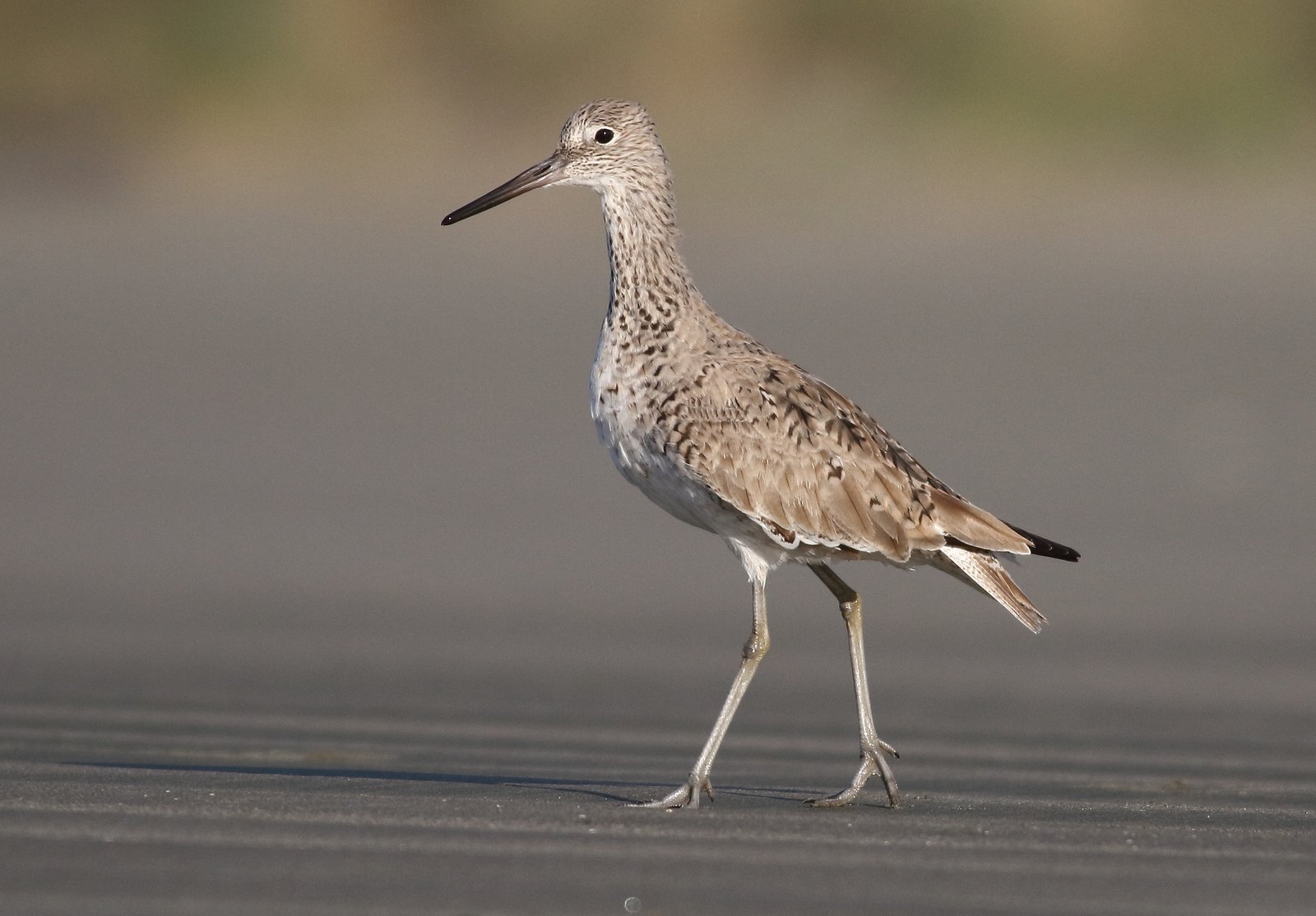
The Willet is a large, grey sandpiper of coasts, named after its call on the breeding grounds. Plain grey on the ground, in flight it shows a broad white band across black wings. In the guide area it is a winter visitor to mudflats, beaches and mangroves along the coast.
Voice
A loud, shrill kee-ya or kip-kip-kip; on the breeding grounds the eponymous pill-will-willet, which is rarely heard in winter quarters.
Recording: Ed Pandolfino — CC BY-NC-SA 4.0 · xeno-canto
Identification
33–40 cm, a large, robust sandpiper with a straight, thick, dark bill with a paler base and fairly long, blue-grey legs. In non-breeding plumage plain pale grey above, with a pale supercilium in front of the eye, a grey breast and a white belly. In breeding plumage brownish grey with dark streaks and bars on the head, breast and flanks. In flight black wings with a broad white band along their whole length, black underwings with a white band, a white rump and a pale grey tail. The western subspecies inornata, which winters along the Pacific, is larger, longer-legged and paler than the eastern subspecies semipalmata. The sexes are alike.
Confusion species
Greater Yellowlegs Tringa melanoleuca has bright yellow legs, a thinner bill, spotted upperparts and plain dark wings. Hudsonian Godwit Limosa haemastica has a long, slightly upturned, two-toned bill and a black tail with a white rump. Wandering Tattler Tringa incana is smaller, with short yellow legs and plain dark grey wings. Hudsonian Whimbrel Numenius hudsonicus is spotted brown, with a decurved bill and a striped crown.
Habitat
Mudflats, sandy beaches, mangrove coasts, lagoons, estuaries, salt pans and shrimp farms; also rocky shores and, on the Galápagos, lava coasts. Almost only at sea level. It picks and probes crabs, worms, molluscs and small fish from mud and sand. It does not breed in the guide area; in North America it breeds in salt marshes and on wet prairies.
Where the bird is most at home, classified by the vegetation units of the Andes and the west coast.


Range and movements
In Colombia a winter visitor along the Caribbean and Pacific coasts. In Ecuador a winter visitor along the whole coast, locally numerous in the Gulf of Guayaquil. In Peru a winter visitor along the coast, most numerous in the north and scarcer to the south. A regular winter visitor to the Galápagos in small numbers. Absent from Bolivia. Breeds along the Atlantic and Gulf coasts of North America, in the Caribbean and on the prairies of the interior, and winters along the coasts from the United States to Peru and Brazil.
- Resident
- dark = core range, pale = thinly spread
How and when to look
From September to April on mudflats and in shrimp farms in the Gulf of Guayaquil and on the coast of Tumbes and Piura; at high-tide roosts often in small groups with whimbrels and godwits. On take-off the black-and-white wing pattern shows at once.
Conservation status
Least Concern. It declined sharply through hunting in the 19th century; today mainly the salt-marsh breeders on the Atlantic coast of North America suffer from habitat loss and sea-level rise.
Scientific name
Tringa semipalmata | (Gmelin, 1789)
Gmelin described the species in 1789 as Scolopax semipalmata; because it was later moved to another genus, the author and year stand in brackets. The genus Tringa was introduced in 1758 by Linnaeus. The genus name is the New Latin word Ulisse Aldrovandi gave to the Green Sandpiper, from Greek trungas, a thrush-sized, white-rumped wading bird mentioned by Aristotle. The species name is New Latin semipalmatus, 'half-webbed', from semi-, 'half', and palmatus, 'webbed', after the partly webbed toes. The specimen the first description was based on came from New York, United States.