All species › Passerines › Tityras, becards and allies › Speckled Mourner
Speckled Mourner | Laniocera rufescens
Geelpluimtreurtiran | Plañidera moteada | Chorona-pintada
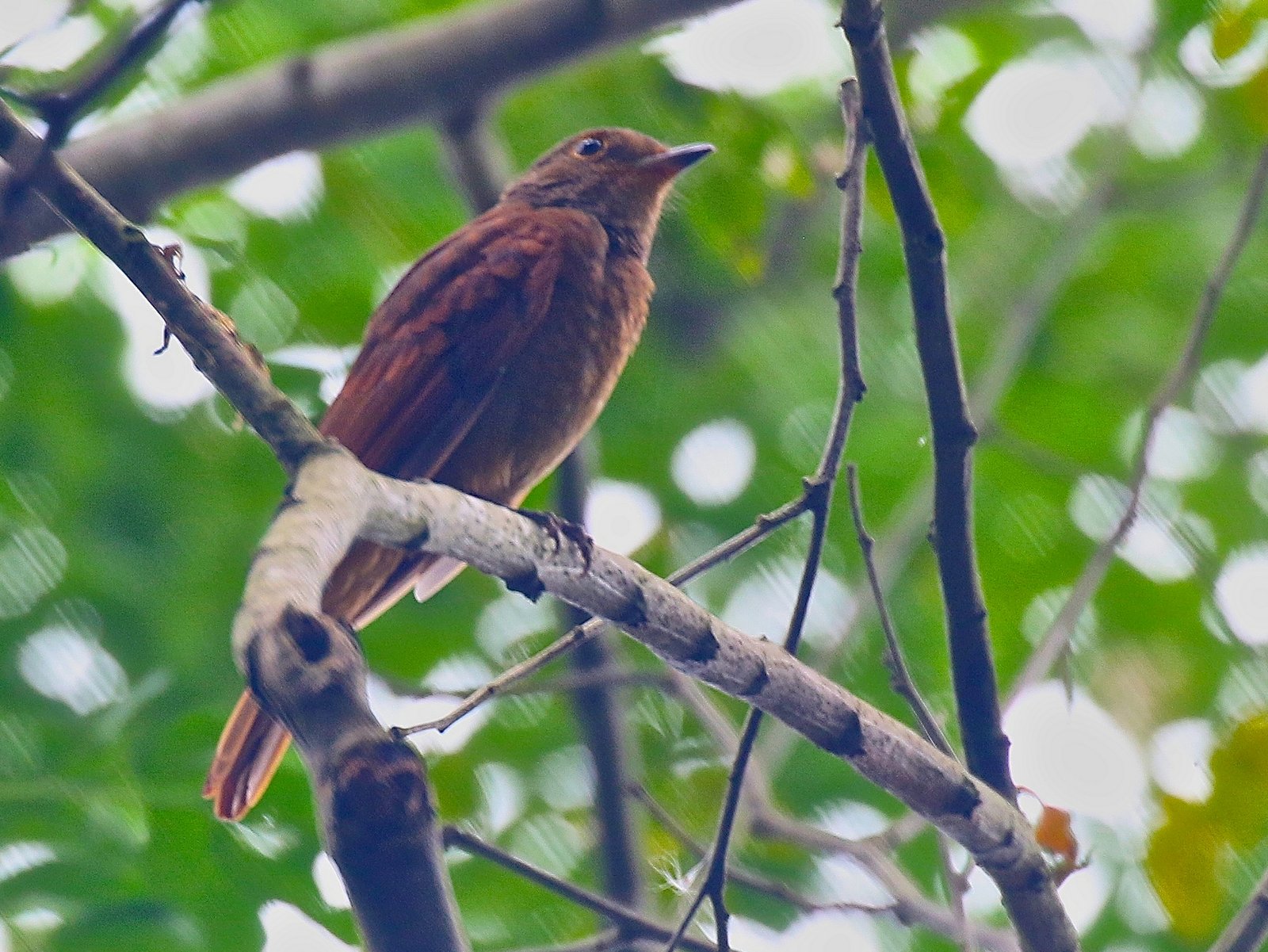
The Speckled Mourner is a rufous-brown bird of the lowland rainforest of Central America and the Chocó. In shape it resembles the Cinereous Mourner, but it is rufous in colour and has spotted wing coverts. In the guide area it reaches its southern limit in north-western Ecuador.
Voice
A long series of clear, penetrating two-syllable whistles, something like tlee-yur, tlee-yur, often repeated for a long time.
Recording: Francis Canto Jr — CC BY-NC-SA 4.0 · xeno-canto
Identification
20 cm, with a rounded head, a straight bill and a fairly long tail. Mainly warm rufous-brown, often with faint dark scaling on the breast. The wing coverts have black and cinnamon tips that form rows of spots. On the side of the breast is a yellow to orange tuft of feathers, often hidden under the wing. The sexes are nearly alike.
Confusion species
Rufous Mourner Rhytipterna holerythra is plain rufous-brown, without wing spots or breast scaling. Rufous Piha Lipaugus unirufus is larger and plain rufous-brown, with a loud, explosive call. Cinnamon Becard Pachyramphus cinnamomeus is smaller, with a shorter tail, a larger head and pale lores.
Habitat
Humid lowland rainforest and tall secondary forest, mostly below 900 m. It lives in the middle level. It eats fruit and insects. Little is known about the nest.
Where the bird is most at home, classified by the vegetation units of the Andes and the west coast.


Range and movements
In Colombia in the Pacific lowlands and in the north, into the lowlands along the Cauca and the Magdalena. In Ecuador rare in the far north-west. Absent from Peru, Bolivia and the Galápagos. Outside the guide area from southern Mexico to Panama.
- Resident
- dark = core range, pale = thinly spread
How and when to look
Listen in lowland forest of the Chocó, in Colombia or north-western Ecuador, for the long whistled series; the bird often sits still for a long time in one place in the middle level.
Conservation status
Least Concern. Fairly scarce and dependent on large forest; deforestation in the Pacific lowlands is a threat.
Scientific name
Laniocera rufescens | (Sclater, 1858)
Sclater described the species in 1858 as Lipaugus rufescens; because it was later moved to another genus, the author and year stand in brackets. The genus Laniocera was introduced in 1841 by Lesson. The genus name combines Lanius, Linnaeus's 1758 shrike genus, with Greek keras, 'horn', here meaning 'bill'. The species name is Latin rufescens, 'reddish', from rufus, 'red'. The specimen the first description was based on came from Cobán, Alta Verapaz, Guatemala.