All species › Passerines › Tanagers and allies › Speckled Tanager
Speckled Tanager | Ixothraupis guttata
Spikkeltangare | Tangara moteada | Saíra-pintada
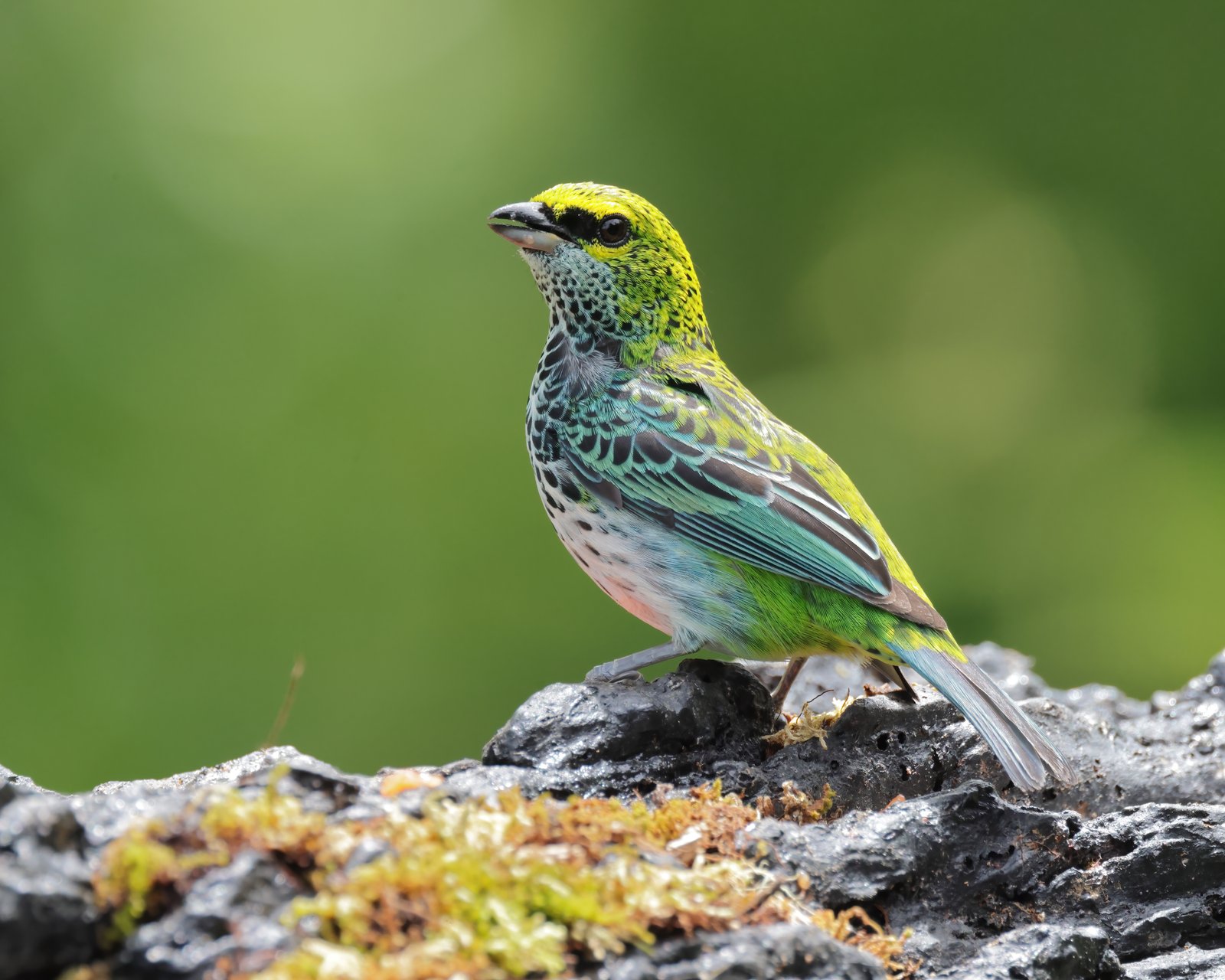
The Speckled Tanager is a green, densely black-spotted tanager with yellow around the eye, found from Central America to northern South America. In the guide area it is mainly a bird of the lower montane forests of Colombia. It forages in the canopy and is a regular member of mixed tanager flocks.
Voice
The call is a high, dry tsip or tsit, often repeated. The song is a series of thin, hissing notes and is inconspicuous.
Recording: Mauricio Cuéllar-Ramírez — CC BY-NC-SA 4.0 · xeno-canto
Identification
13 cm. The upperparts are bright grass green with round black spots on the crown, back and scapulars. The forehead and lores are yellow, with a small black loral line and black around the eye; the cheeks are yellow-green. The wings and tail are black with blue-green edges. The throat, breast and belly are white, densely marked with black spots that are heaviest on the breast; the flanks are washed greenish yellow. The bill is black. The sexes are alike; juveniles are duller and less sharply spotted.
Confusion species
Spotted Tanager Ixothraupis punctata is slightly smaller with less yellow in the face and a greener breast; the two hardly overlap in the guide area. Yellow-bellied Tanager Ixothraupis xanthogastra is green with a yellow belly centre and lives in the Amazonian lowlands. Dotted Tanager Ixothraupis varia is smaller, plain green and finely dotted, without white underparts. Rufous-throated Tanager Ixothraupis rufigula has a black head with a rufous throat.
Habitat
Canopy and edges of humid foothill and lower montane forest, old secondary growth and trees in coffee plantations, mainly from about 500 to 1700 m. It eats small fruits and searches thin twigs and leaves for insects, usually in pairs or small groups in mixed flocks. The nest is a cup in a tree.
Where the bird is most at home, classified by the vegetation units of the Andes and the west coast.


Range and movements
In Colombia in the lower montane forests of all three Andean ranges and their outliers, in the Serranía de Perijá and the Sierra Nevada de Santa Marta. In Ecuador only very locally in the north of the eastern slope. Absent from Peru, Bolivia and the Galápagos. Outside the guide area from Costa Rica and Panama to Venezuela, the tepui region of the Guianas, northern Brazil and Trinidad.
- Resident
- dark = core range, pale = thinly spread
How and when to look
Look in mixed flocks along forest edges and roads in the lower montane zone of Colombia, for example in the Sierra Nevada de Santa Marta or on the slopes of the Magdalena Valley; trees with ripe fruit attract small groups.
Conservation status
Least Concern. Widespread and locally fairly common; it tolerates forest edges and shade plantations, but suffers from further deforestation.
Scientific name
Ixothraupis guttata | (Cabanis, 1851)
Cabanis described the species in 1851 as C[allispiza] guttata; because it was later moved to another genus, the author and year stand in brackets. The genus Ixothraupis was introduced in 1851 by Bonaparte. The genus name combines Greek ixos, 'mistletoe', with thraupis, an unidentified small bird. The species name comes from Latin guttatus, 'spotted, speckled'. The specimen the first description was based on came from Cerro Roraima, Bolívar, Venezuela.