All species › Passerines › Tyrant flycatchers and allies › Streak-necked Flycatcher
Streak-necked Flycatcher | Mionectes striaticollis
Streepnekpipratiran | Mosquerito cuellilistado | Abre-asa-de-pescoço-estriado
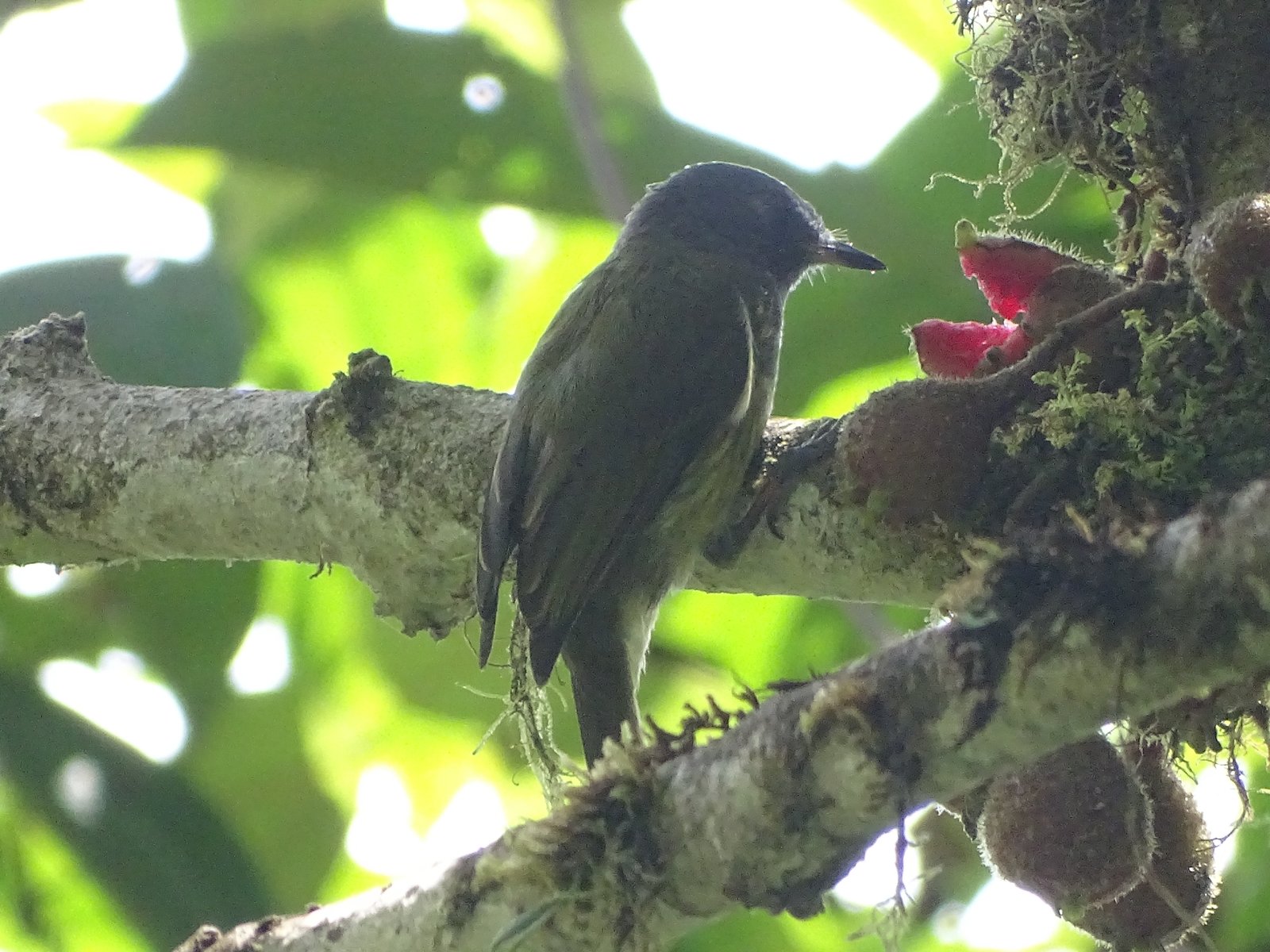
The Streak-necked Flycatcher is an olive-green tyrant flycatcher of Andean montane forest that feeds mainly on small berries. It sits quietly in the understorey and middle storey and, like other Mionectes, occasionally lifts one wing. In courtship males sing alone at fixed sites in the forest.
Voice
Inconspicuous. The male sings a series of very high, thin notes; also a soft, high tsip.
Recording: José María Loaiza B. — CC BY-NC-SA 4.0 · xeno-canto
Identification
13 cm, with a thin, dark bill. The head is greyish olive, with a small pale spot behind the eye. The throat and neck are finely streaked white or yellowish, the breast olive-green with pale streaks, the belly plain yellow. The upperparts and wings are olive-green, without distinct wing-bars. The sexes are alike.
Confusion species
Olive-striped Flycatcher Mionectes olivaceus is very similar, but has an olive, not greyish, head and is streaked on the belly too; it usually lives lower, although they overlap. Ochre-bellied Flycatcher Mionectes oleagineus has an unstreaked ochre belly and lives in the lowlands. Leptopogon species such as Slaty-capped Flycatcher Leptopogon superciliaris have distinct wing-bars and a dark ear patch.
Habitat
The understorey and middle storey of humid montane forest and cloud forest, also forest edges and old secondary forest, roughly between 1200 and 3000 m. It eats mainly small berries and mistletoe and melastome fruits, supplemented with insects; it visits fruiting shrubs and sometimes joins mixed flocks. The nest is a pear-shaped structure of moss, suspended from a branch or root above a bank.
Where the bird is most at home, classified by the vegetation units of the Andes and the west coast.


Range and movements
Colombia: in all three Andean ranges. Ecuador: on both slopes of the Andes. Peru: on the east slope along the whole length of the country, in the north also on the west slope. Bolivia: in the Yungas of La Paz, Cochabamba and Santa Cruz. Absent from the Galápagos. Outside the guide area in western Venezuela.
- Resident
- dark = core range, pale = thinly spread
How and when to look
Watch shrubs with small berries and fruiting mistletoe along cloud-forest edges; the bird often sits still for long periods and draws attention only when it lifts a wing.
Conservation status
Least Concern. The species is widespread in montane forest and also tolerates forest edges and secondary forest.
Scientific name
Mionectes striaticollis | (d'Orbigny, ACVMD & de Lafresnaye, 1837)
D'Orbigny, ACVMD & de Lafresnaye described the species in 1837 as M[uscicapa] striaticollis; because it was later moved to another genus, the author and year stand in brackets. The genus Mionectes was introduced in 1844 by Cabanis. The genus name comes from Greek meionektēs, 'small, having suffered loss', from meionekteō, 'to have too little'. Cabanis (1844) described the species as small birds. The species name comes from Latin striatus, 'striped', and collum, 'neck', referring to the streaked neck. The specimen the first description was based on came from Yuracarés, Bolivia.