All species › Passerines › Tyrant flycatchers and allies › Hudson's Black Tyrant
Hudson's Black Tyrant | Knipolegus hudsoni
Patagonische moortiran | Viudita chica | Maria-preta-do-sul
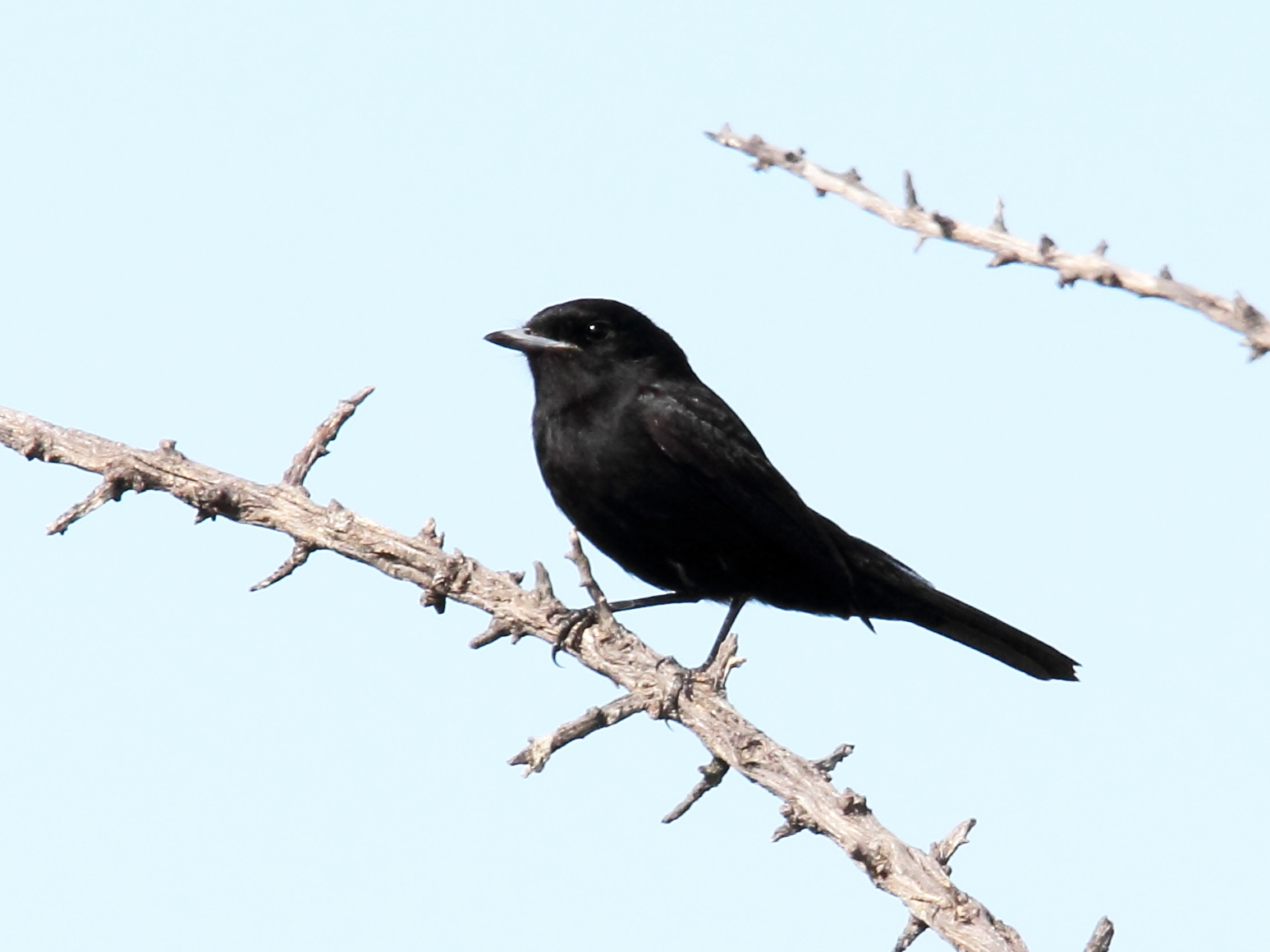
Hudson's Black Tyrant is a small black tyrant that breeds in the scrub of central Argentina and migrates north in the austral winter. In the guide area it is a scarce winter visitor to the lowlands of Bolivia. The male has a small white flank spot, which is often hidden on perched birds.
Voice
Almost silent in its wintering range; at most a soft tik.
Recording: Bernabe Lopez-Lanus — CC BY-NC-SA 4.0 · xeno-canto
Identification
14 cm, with a short bill. The male is entirely glossy black, with a white band at the base of the primaries that is visible in flight and a small white flank spot. The female is greyish brown above, with a rufous rump and tail base, two pale wing bars and whitish underparts with fine brown streaking on the breast. Young birds resemble the female.
Confusion species
White-winged Black Tyrant Knipolegus aterrimus is larger, lacks the white flank spot and lives in the dry Andean valleys. The male Cinereous Tyrant Knipolegus striaticeps is grey with a red iris. Amazonian Black Tyrant Knipolegus poecilocercus lacks white in the wing and lives in flooded forest in Amazonia. The female is very similar to that of Cinereous Tyrant, but lacks the rufous-brown crown.
Habitat
In the guide area in dry woodland, Chaco scrub, savanna with shrubs and forest edges in the lowlands, mostly below 1000 m. It perches low in shrubs and catches insects with short sallies, often to the ground. In Argentina it breeds in open dry scrub; the nest is a small cup in a shrub.
Where the bird is most at home, classified by the vegetation units of the Andes and the west coast.


Range and movements
Bolivia: scarce winter visitor to the lowlands of the east and south-east, mainly in Santa Cruz and the Chaco, in the austral winter. Peru: at most a few records in the south-east. Absent from Colombia, Ecuador and the Galápagos. Outside the guide area it breeds in central Argentina and also winters in Paraguay and western Brazil.
- Summer visitor (c. Apr–Sep)
- Passage (Mar–Apr, Oct–Nov)
- dark = core range, pale = thinly spread
How and when to look
Between April and September search Chaco scrub and forest edges in eastern Bolivia; look for a small black bird with white in the wing low in the shrubs.
Conservation status
Least Concern. The breeding habitat in the scrub of Argentina is locally being cleared for agriculture.
Scientific name
Knipolegus hudsoni | Sclater, 1872
Sclater described the species in 1872 and placed it straight away in the genus where it still stands. The genus Knipolegus was introduced in 1826 by Boie. The genus name comes from Greek knips, 'insect', and legō, 'to pick', for its way of foraging. The species name honours William Henry Hudson (1841–1922), Argentine-born naturalist and writer, who collected birds in Patagonia. The specimen the first description was based on came from Río Negro, Patagonia, Argentina.