All species › Passerines › Tyrant flycatchers and allies › White-winged Black Tyrant
White-winged Black Tyrant | Knipolegus aterrimus
Witvleugelmoortiran | Viudita común | Maria-preta-bate-rabo
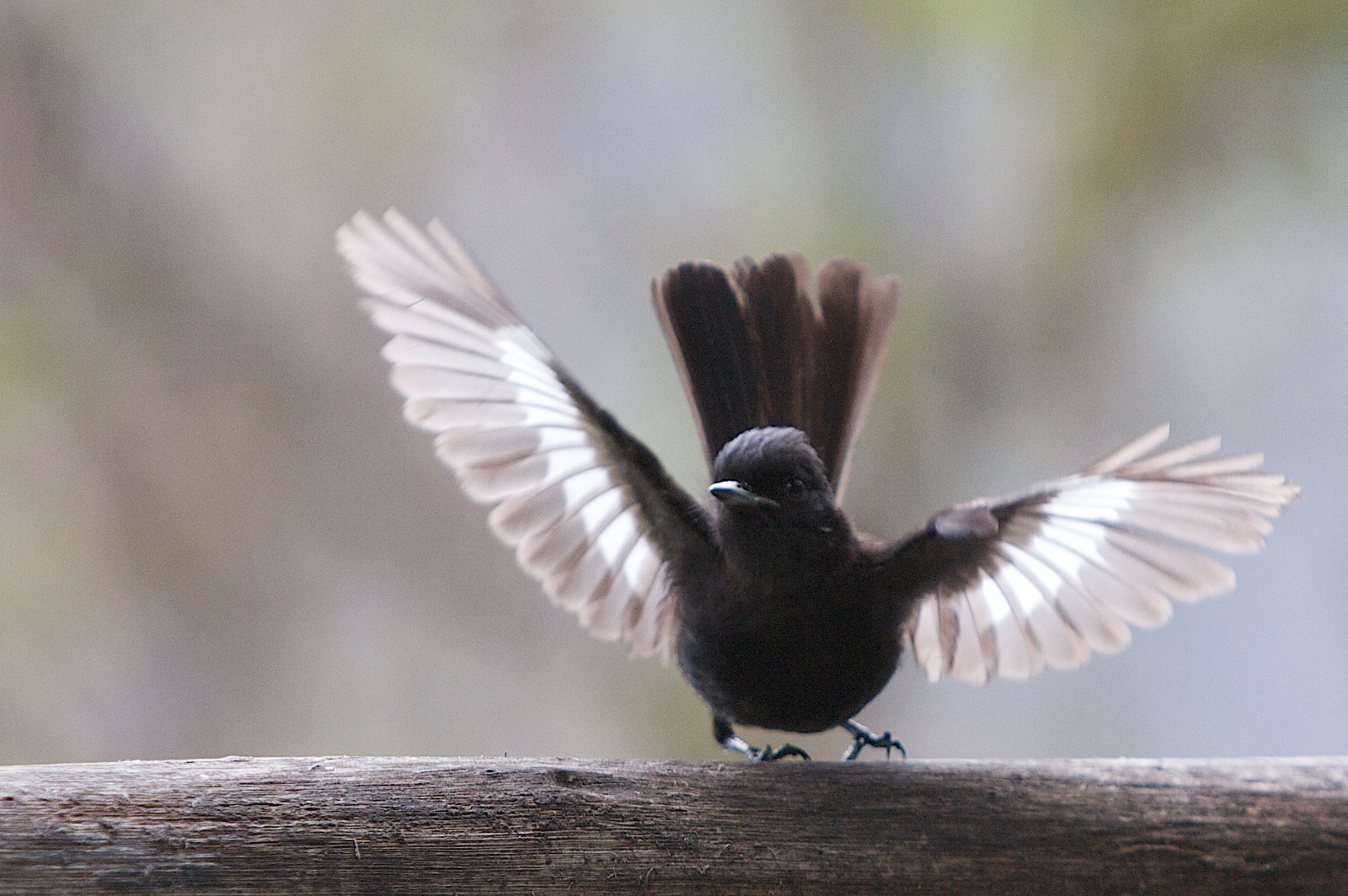
The White-winged Black Tyrant is a black tyrant of dry shrubby slopes and valleys in the Andes of Peru and Bolivia. The male shows a conspicuous white wing band in flight. In display the male flies steeply up from a perch and then drops back down.
Voice
A soft pik or tsik; during the display flight the male makes a dry, rattling or clicking sound.
Recording: Martin Toledo — CC BY-NC-SA 4.0 · xeno-canto
Identification
17 cm, with a fairly long tail and a blue-grey bill. The male is entirely black, with a broad white band across the base of the primaries that is largely hidden at rest and clearly visible in flight. The female is greyish brown above, with a cinnamon rump and tail base, two pale wing bars and pale, cinnamon-tinged underparts. Young birds resemble the female.
Confusion species
Plumbeous Tyrant Knipolegus cabanisi and Jelski's Black Tyrant Knipolegus signatus lack white in the wing and live in montane forest. The male Cinereous Tyrant Knipolegus striaticeps is smaller and grey, and lives in the Chaco. Andean Negrito Lessonia oreas is smaller, with a rufous-brown back, and walks on the ground near water on the high plateau. Spectacled Tyrant Hymenops perspicillatus has a yellow fleshy eye-ring.
Habitat
Dry scrub, shrubby slopes, ravines with cacti and thorn bushes, riverside scrub, hedges and field edges in the dry inter-Andean valleys and on the western slope, roughly between 1500 and 3800 m. It perches fairly openly on top of a shrub or rock and catches insects with short sallies, often to the ground. The nest is a small cup in a shrub or rock crevice.
Where the bird is most at home, classified by the vegetation units of the Andes and the west coast.


Range and movements
Peru: in the Andes from north to south, mainly in the dry inter-Andean valleys and on the western slope. Bolivia: in the dry valleys and on the slopes of the Andes. Absent from Colombia, Ecuador and the Galápagos. Outside the guide area in western Argentina.
- Resident
- dark = core range, pale = thinly spread
How and when to look
Search shrubby slopes in the dry valleys of Peru and Bolivia, for example around Cusco or Cochabamba; look for a black flycatcher that shows a white wing band when it flies up.
Conservation status
Not evaluated in the current taxonomy. The species is fairly common in the dry scrub of the Andes and tolerates small-scale farmland.
Scientific name
Knipolegus aterrimus | Kaup, 1853
Kaup described the species in 1853 and placed it straight away in the genus where it still stands. The genus Knipolegus was introduced in 1826 by Boie. The genus name comes from Greek knips, 'insect', and legō, 'to pick', for its way of foraging. The species name comes from Latin aterrimus, 'very black, jet-black'. The specimen the first description was based on came from Cochabamba, Bolivia.