All species › Passerines › Tyrant flycatchers and allies › Streamer-tailed Tyrant
Streamer-tailed Tyrant | Gubernetes yetapa
Lintstaarttiran | Yetapá grande | Tesoura-do-brejo
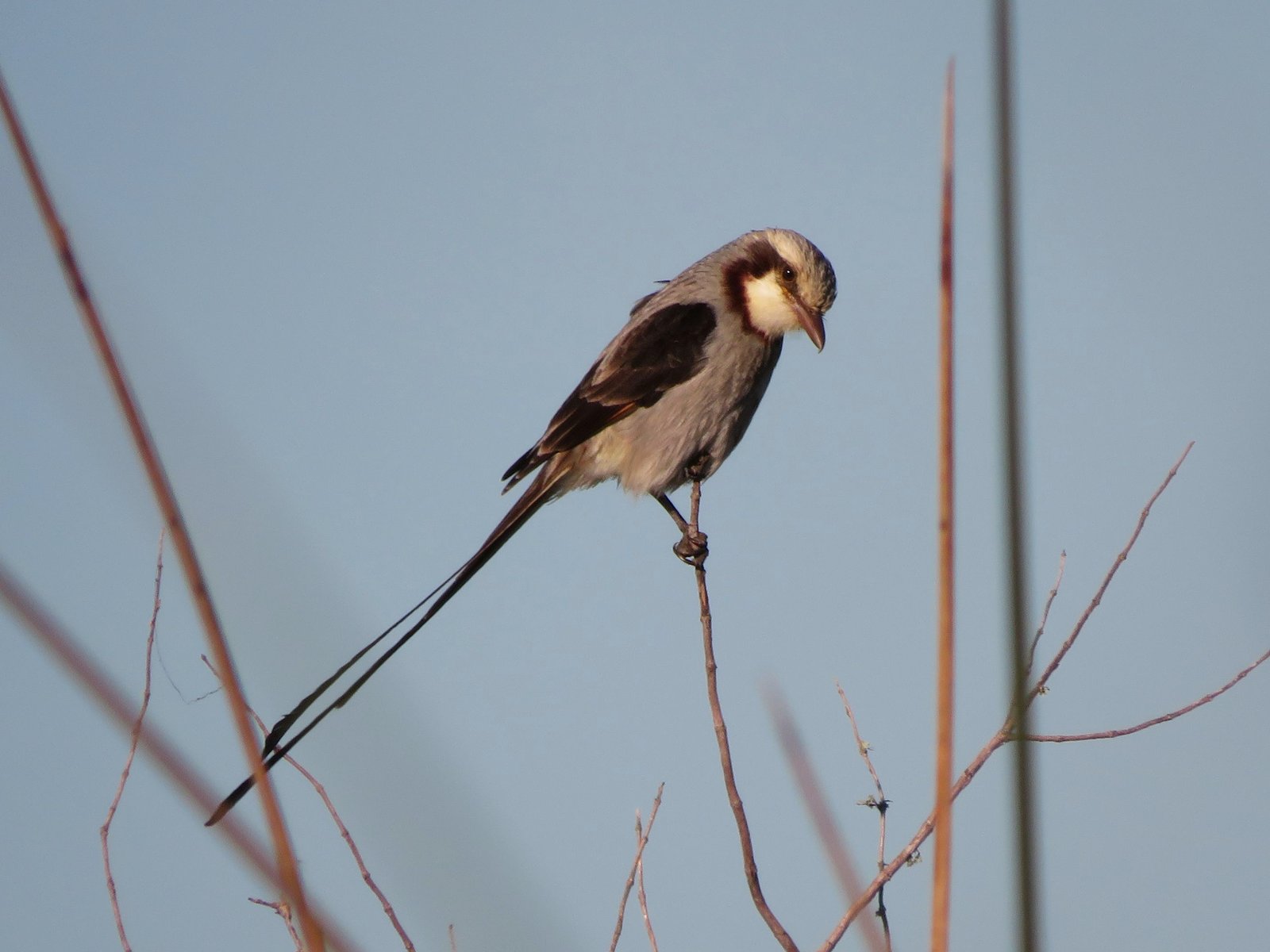
The Streamer-tailed Tyrant is a large, pale grey tyrant with a very long, deeply forked black tail that accounts for more than half its total length. It lives in wet savannas and marshes in the heart of South America and reaches the guide area only in northern and eastern Bolivia. Pairs greet each other with loud calls while raising their wings to show the rufous primaries.
Voice
Loud, clear calls, wheet or twee-wheet, often in duet by both birds of a pair, with wing-raising.
Recording: Fabrício Grigolin — CC BY-NC-SA 4.0 · xeno-canto
Identification
38–42 cm, most of it tail; in the female the tail is somewhat shorter. The upperparts are pale grey, with dark streaks on the crown and back. The throat is white and bordered by a narrow, chestnut breast band; the rest of the underparts are white. The wings are dark, with a cinnamon-rufous base to the primaries that shows mainly in flight. The tail is black, long and deeply forked. Juveniles have a shorter tail and a less distinct breast band.
Confusion species
Fork-tailed Flycatcher Tyrannus savana also has a long forked tail, but is smaller, with a black head, a white throat without a breast band and no rufous in the wing. Cock-tailed Tyrant Alectrurus tricolor is much smaller, black and white, with a short, raised tail in the male.
Habitat
Wet savanna, marsh edges, wet grassland with scattered shrubs, palm groves and the edges of gallery forest in the lowlands, mostly below 500 m. It perches on top of shrubs, palms or fence posts and hunts large flying insects, often over or near water. The nest is a cup of grass and plant material in a shrub or tree.
Where the bird is most at home, classified by the vegetation units of the Andes and the west coast.


Range and movements
Bolivia: in the savannas of Beni and Pando and in eastern Santa Cruz. Peru: only a few records in the far south-east, near the Bolivian border. Absent from Colombia, Ecuador and the Galápagos. Outside the guide area in central and southern Brazil, Paraguay and north-eastern Argentina.
- Resident
- dark = core range, pale = thinly spread
How and when to look
Search the wet savannas of the Beni, for example around marshes and along roads with fence posts; the birds perch conspicuously on top of shrubs and are recognisable at a distance by the long tail.
Conservation status
Least Concern. Locally common in suitable wet savanna, but vulnerable to drainage and conversion to farmland.
Scientific name
Gubernetes yetapa | (Vieillot, 1818)
Vieillot described the species in 1818 as Muscicapa yetapa; because it was later moved to another genus, the author and year stand in brackets. The genus Gubernetes was introduced in 1825 by Such. The genus name comes from Greek kubernētēs, 'pilot, guide'; a journal of 1836 explained it as 'pilot', from the forked, rudder-like tail. The species name comes from the Guaraní name Guihrá jetapá, 'cutter bird'; the name Yetapá is also used for Alectrurus risora. The specimen the first description was based on came from Paraguay.