All species › Passerines › Tyrant flycatchers and allies › Great Kiskadee
Great Kiskadee | Pitangus sulphuratus
Grote kiskadie | Bienteveo común | Bem-te-vi
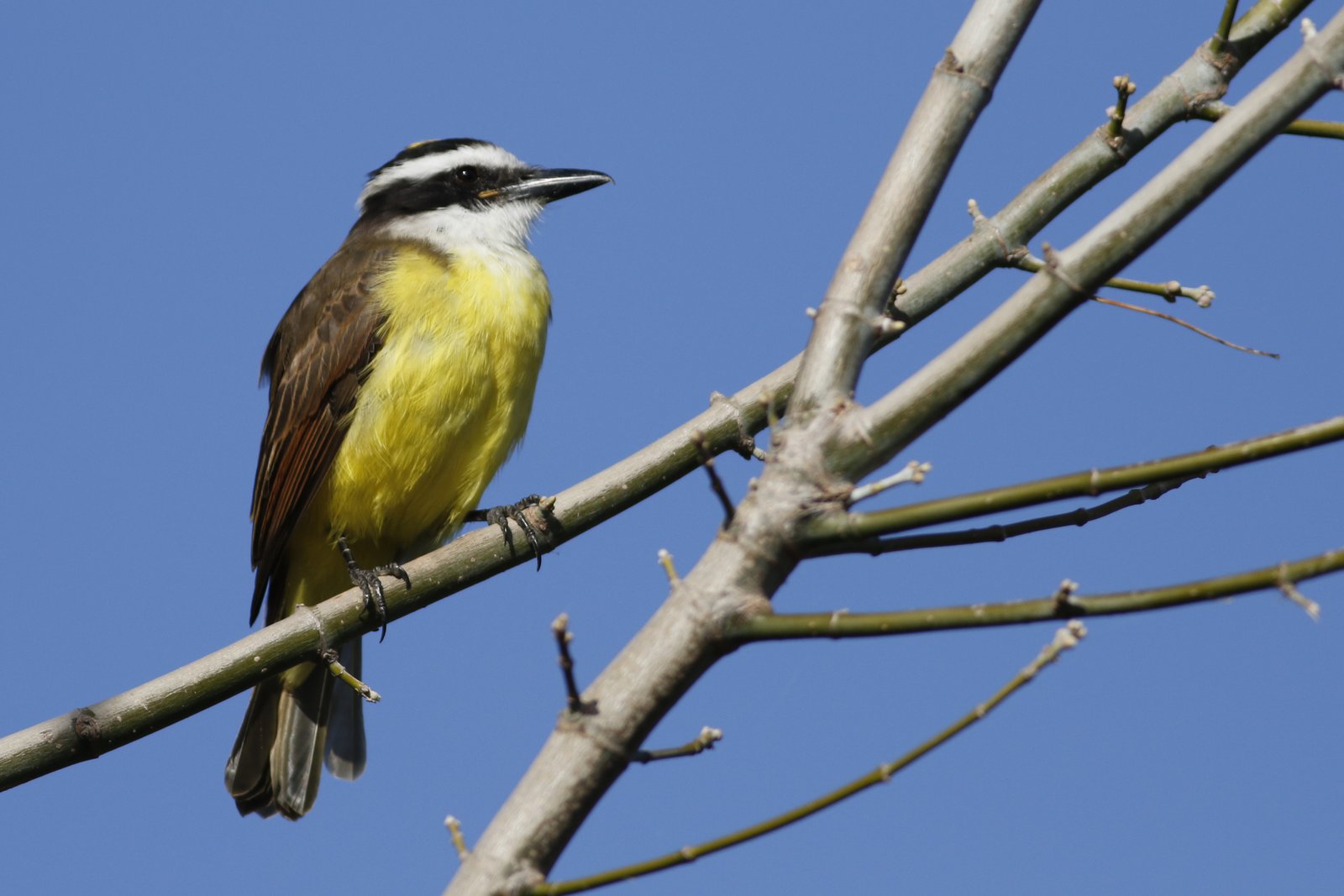
The Great Kiskadee is a large, noisy flycatcher with a black-and-white striped head and a bright yellow belly, and one of the commonest birds of the American tropical lowlands. It lives mainly in open and semi-open country near water, in villages and along rivers. Its call, rendered as kis-ka-dee or bien-te-veo, gives it its name.
Voice
A loud, three-part kis-ka-dee or bien-te-veo, as well as a shrill, drawn-out kee-eer and various loud, strident calls. Very vocal, often in pairs answering each other.
Recording: JAYRSON ARAUJO DE OLIVEIRA — CC BY-NC-SA 4.0 · xeno-canto
Identification
21–24 cm, stocky and big-headed, with a heavy, straight black bill. The head is black with a broad white supercilium that almost meets around the nape, and a concealed yellow crown patch. The back and tail are brown, the wings brown with broad rufous edges to the flight feathers. The throat is white, the underparts bright yellow. The sexes are alike; juveniles lack the crown patch and show more rufous in the wings and tail.
Confusion species
Lesser Kiskadee Philohydor lictor is clearly smaller, with a thinner, longer bill; it perches low over water. Boat-billed Flycatcher Megarynchus pitangua has a very broad, arched bill and little or no rufous in the wings, and sounds very different. Social Flycatcher Myiozetetes similis and Rusty-margined Flycatcher Myiozetetes cayanensis are smaller, with a short, small bill.
Habitat
Riverbanks, lakes and oxbows, flooded forest, forest edges, pasture with trees, savanna and villages, towns and parks, mainly in the lowlands and locally higher in the valleys. Very versatile: it catches insects in flight and from the ground, dives for tadpoles and small fish, and also eats small vertebrates and fruit.
Where the bird is most at home, classified by the vegetation units of the Andes and the west coast.


Range and movements
In Colombia in the Caribbean lowlands, the Magdalena and Cauca valleys, the Llanos and the Amazon basin; in Ecuador, Peru and Bolivia in the lowlands east of the Andes. Absent west of the Andes in Ecuador and Peru, and from the Galápagos. Outside the guide area from southern Texas through Mexico and Central America to Argentina; introduced to Bermuda.
- Resident
- dark = core range, pale = thinly spread
How and when to look
Everywhere in villages and along rivers in the Amazonian lowlands, for example on riverbanks at lodges, and on wires and posts along roads in the Colombian lowlands. Often first identified by its call.
Conservation status
Least Concern. One of the commonest birds of open lowland country; it benefits from deforestation and settlement.
Scientific name
Pitangus sulphuratus | (Linnaeus, 1766)
Linnaeus described the species in 1766 as [Lanius] sulphuratus; because it was later moved to another genus, the author and year stand in brackets. The genus Pitangus was introduced in 1827 by Swainson. The genus name comes from Tupi pitanguá, a Brazilian indigenous name for the Great Kiskadee. Latin sulphuratus refers to sulphur, after the sulphur-yellow underparts; Brisson had already used the word for this colour. The specimen the first description was based on came from Cayenne, French Guiana.