All species › Passerines › Tyrant flycatchers and allies › Ornate Flycatcher
Ornate Flycatcher | Myiotriccus ornatus
Ornaattiran | Mosquerito adornado | Papa-moscas-ornado
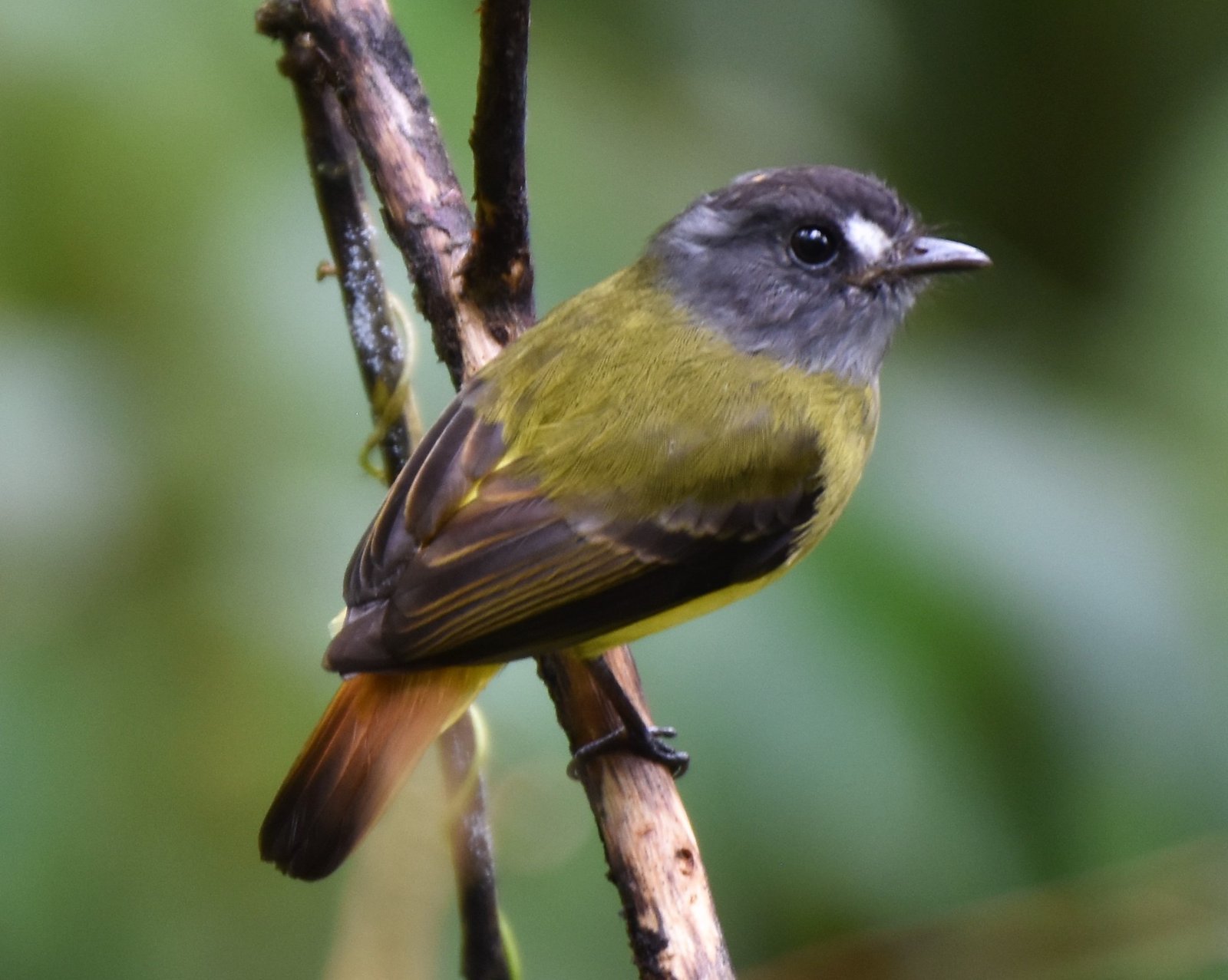
The Ornate Flycatcher is a small, boldly patterned tyrant flycatcher of foothill and lower montane forest, often along streams and forest edges. A white spot in front of the eye and a yellow rump are the features that identify it in every plumage. Birds west of the Andes have a dark tail, those on the east slope a rufous one.
Voice
High, thin, sharp whistles pseet or peeeik, often repeated for long periods.
Recording: Carlos Delgado JUMABITA — CC BY-NC-SA 4.0 · xeno-canto
Identification
12 cm, with a short bill and a rather short tail. The head is dark grey with a prominent white spot between bill and eye; the throat is grey. The back and wings are olive-green, the rump bright yellow. The breast is olive, the belly yellow. The tail is dark west of the Andes and largely rufous on the east slope. The sexes are alike.
Confusion species
Whiskered Myiobius Myiobius barbatus and Tawny-breasted Myiobius Myiobius villosus also have a yellow rump but no white spot in front of the eye, and move through the understorey with a spread tail and drooped wings. Ruddy-tailed Flycatcher Terenotriccus erythrurus has a rufous tail but a grey head without a white spot and lives in the lowlands. Cinnamon Flycatcher Pyrrhomyias cinnamomeus has cinnamon underparts.
Habitat
Humid foothill and lower montane forest, especially along streams, in ravines, at forest edges and by road cuts, mostly between 600 and 2000 m, locally lower on the Pacific side. It perches in the lower and middle storey on an open twig and makes short sallies after insects; often in pairs or small groups. Little is known about the nest.
Where the bird is most at home, classified by the vegetation units of the Andes and the west coast.


Range and movements
Colombia: in the three Andean ranges and on the Pacific slope. Ecuador: on both slopes of the Andes; on the west side the dark-tailed form, on the east side the rufous-tailed form. Peru: on the east slope, south to Cuzco and Puno. Absent from Bolivia and the Galápagos. Outside the guide area in western Venezuela.
- Resident
- dark = core range, pale = thinly spread
How and when to look
Walk along a stream or forest road in foothill forest at 800–1500 m and listen for a high, sharp whistle; the bird often perches low on an open twig above the water or at the forest edge.
Conservation status
Not evaluated in the species limits followed here, in which the forms west of the Andes and on the east slope together form one species. Both forms occur over a large area and tolerate forest edges.
Scientific name
Myiotriccus ornatus | (de Lafresnaye, 1853)
De Lafresnaye described the species in 1853 as Tyrannula ornata; because it was later moved to another genus, the author and year stand in brackets. The genus Myiotriccus was introduced in 1905 by Ridgway. The genus name comes from Greek muia, 'fly', and trikkos, an unidentified small bird, a stem widely used in tyrant-flycatcher names. Latin ornatus, 'adorned', for the striking head and rump pattern. The specimen the first description was based on came from Bogotá, Colombia.