All species › Passerines › Tyrant flycatchers and allies › Wing-barred Piprites
Wing-barred Piprites | Piprites chloris
Streepvleugelmanakin | Piprites alibandeado | Papinho-amarelo
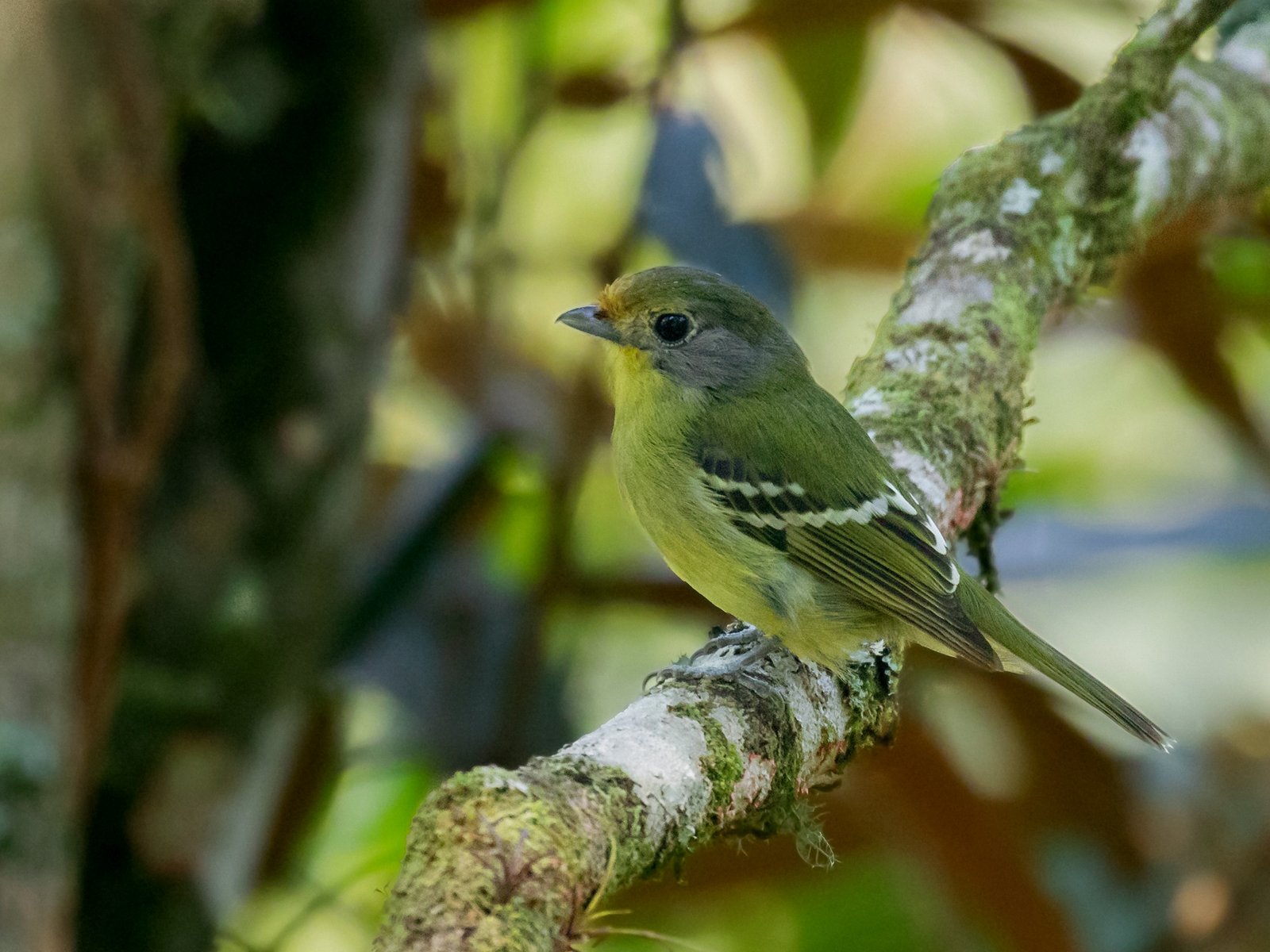
The Wing-barred Piprites is a small, olive-green bird of the canopy of humid lowland and foothill forest. It was long placed with the manakins, but the genus Piprites stands apart and is placed with the tyrant flycatchers in this guide. It often sits still for long periods and is mostly detected by its loud, rhythmic song.
Voice
A loud, rhythmic series of whistles, roughly whip, pip-pip, pipipi-whip, whip, often repeated for long periods from the canopy. The song has a ventriloquial quality.
Recording: Juan Freile — CC BY-NC-SA 4.0 · xeno-canto
Identification
13 cm, with a round head, large dark eyes and a short, stubby bill. The upperparts are olive-green, the wings dark with two yellowish wing bars and pale edges to the tertials. The lores and eye-ring are yellowish, giving the face a pale look; in some forms the nape is greyish. The underparts are greyish olive, yellower towards the belly. The sexes are alike.
Confusion species
Female manakins such as Blue-capped Manakin Lepidothrix coronata are smaller and lack wing bars. Forest Elaenia Myiopagis gaimardii has a slimmer bill, a longer tail and a pale crown stripe. Yellow-margined Flatbill Tolmomyias assimilis has a broad, flat bill and a greyer head.
Habitat
Humid terra firme forest in the lowlands and foothills, also older secondary forest, mostly below about 1200 m. It lives in the canopy and middle storey, often in mixed flocks, and eats insects and small fruits taken from leaves in short sallies. Little is known about the nest.
Where the bird is most at home, classified by the vegetation units of the Andes and the west coast.


Range and movements
In Colombia east of the Andes, in the Amazonian lowlands and foothills. In Ecuador and Peru throughout the eastern lowlands, up into the foothills. In Bolivia in the northern lowlands and the Yungas foothills. Absent west of the Andes and from the Galápagos. Outside the guide area in Venezuela, the Guianas, Amazonian Brazil and the Atlantic Forest of south-eastern Brazil, Paraguay and north-eastern Argentina.
- Resident
- dark = core range, pale = thinly spread
How and when to look
Listen in the morning for the rhythmic song along forest trails and from canopy towers in the Amazonian lowlands, such as at Yasuní, Tambopata and Manu. The bird often sits still on a canopy branch for a long time; look for the pale face and the wing bars.
Conservation status
Least Concern. The species has a large range; locally habitat is lost to deforestation.
Scientific name
Piprites chloris | (Temminck, 1822)
Temminck described the species in 1822 as Pipra chloris; because it was later moved to another genus, the author and year stand in brackets. The genus Piprites was introduced in 1847 by Cabanis. The genus name comes from Greek pipra, 'small bird' (also the manakin name Pipra), with the suffix -itēs, 'resembling'. Greek khlōris means 'greenish' and is also an old name for a green finch, referring to the green plumage. The specimen the first description was based on came from Ipanema, São Paulo, Brazil.