All species › Passerines › Tanagers and allies › Sulphur-rumped Tanager
Sulphur-rumped Tanager | Heterospingus rubrifrons
Zwavelstuitkuiftangare | Tangara lomiazufrada | Tiê-de-uropígio-amarelo
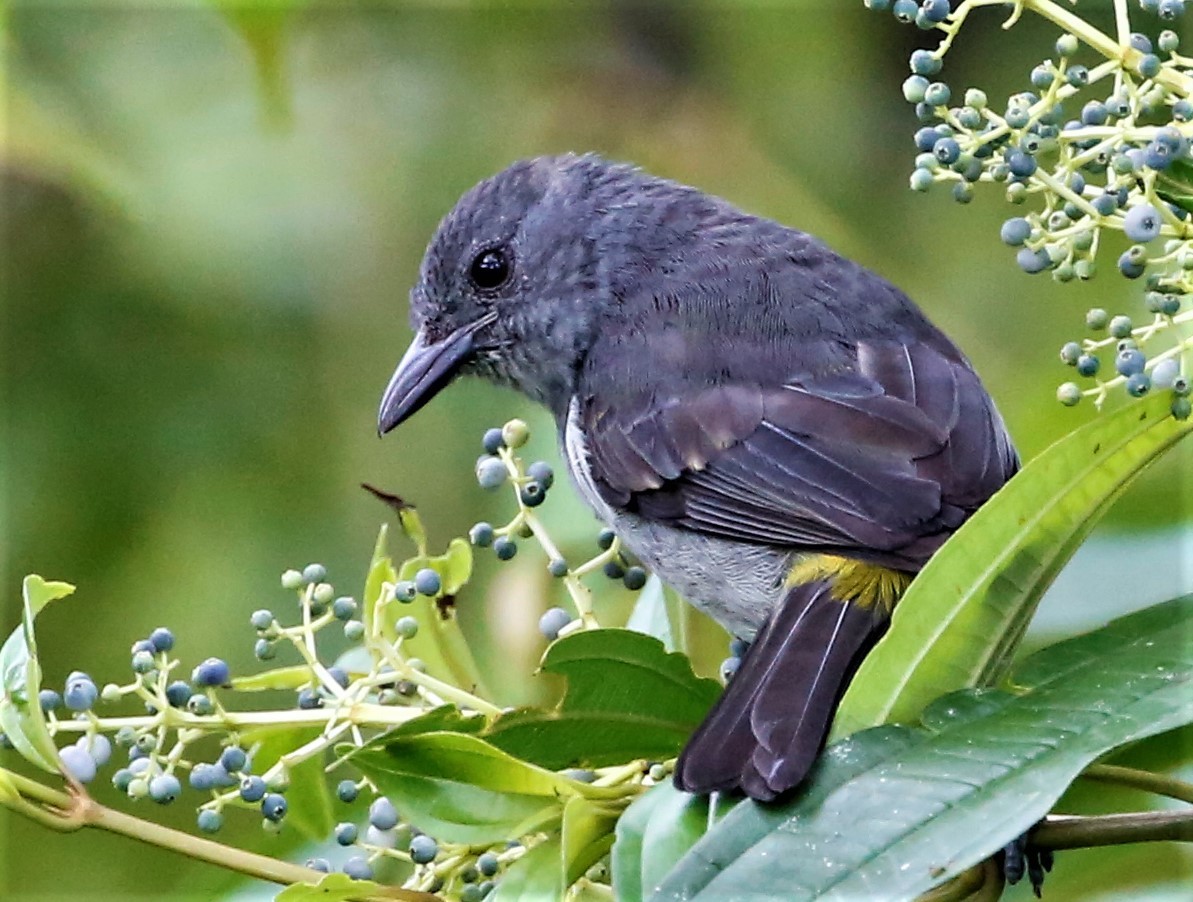
The Sulphur-rumped Tanager is a grey tanager of the lowland forest of Costa Rica and Panama. It is closely related to Scarlet-browed Tanager and was often merged with it in the past. Occurrence in the guide area is unconfirmed: the few older records from north-western Colombia probably refer to Scarlet-browed Tanager.
Voice
Sharp, metallic chip calls; the song, a series of high, squeaky notes, is poorly described.
Recording: Jorge Gabriel Campos — CC BY-NC-SA 4.0 · xeno-canto
Identification
16 cm, with a fairly heavy, dark bill. Slate-grey, paler grey below, with a white tuft on the side of the breast that is often partly hidden under the wing, and a bright yellow rump. The sexes are alike; the male also lacks a red stripe behind the eye.
Confusion species
The female Scarlet-browed Tanager Heterospingus xanthopygius is very similar, with the same yellow rump and white breast tufts; in the field, range and the company of a black male with a red eye-stripe help most. Plain-colored Tanager Tangara inornata is smaller, has a blue shoulder patch and no yellow rump.
Habitat
Canopy and edges of humid lowland forest and tall secondary forest, mainly below 800 m. It often perches on high, bare branches, joins mixed flocks and eats fruit and insects.
Where the bird is most at home, classified by the vegetation units of the Andes and the west coast.


Range and movements
In Colombia only a few older records from Chocó and Córdoba, which probably refer to Scarlet-browed Tanager; definite occurrence has not been demonstrated. Absent from Ecuador, Peru, Bolivia and the Galápagos. Outside the guide area on the Caribbean slope of Costa Rica and in Panama.
How and when to look
A record in the guide area merits documentation with a photograph or sound recording. With pairs, check above all for the absence of a black male with a red eye-stripe.
Conservation status
Least Concern. Locally fairly common in Costa Rica and Panama, but dependent on lowland forest that is shrinking through deforestation.
Scientific name
Heterospingus rubrifrons | (Lawrence, 1865)
Lawrence described the species in 1865 as Tachyphonus rubrifrons; because it was later moved to another genus, the author and year stand in brackets. The genus Heterospingus was introduced in 1898 by Ridgway. The genus name combines Greek heteros, 'different', with spingos, 'finch'. The species name comes from Latin ruber, 'red', and frons, 'forehead'. The specimen the first description was based on came from Lion Hill (Panama Railroad), Panama.