All species › Passerines › Tanagers and allies › Black-and-yellow Tanager
Black-and-yellow Tanager | Chrysothlypis chrysomelas
Citroentangare | Tangara negriamarilla | Tiê-preto-e-amarelo
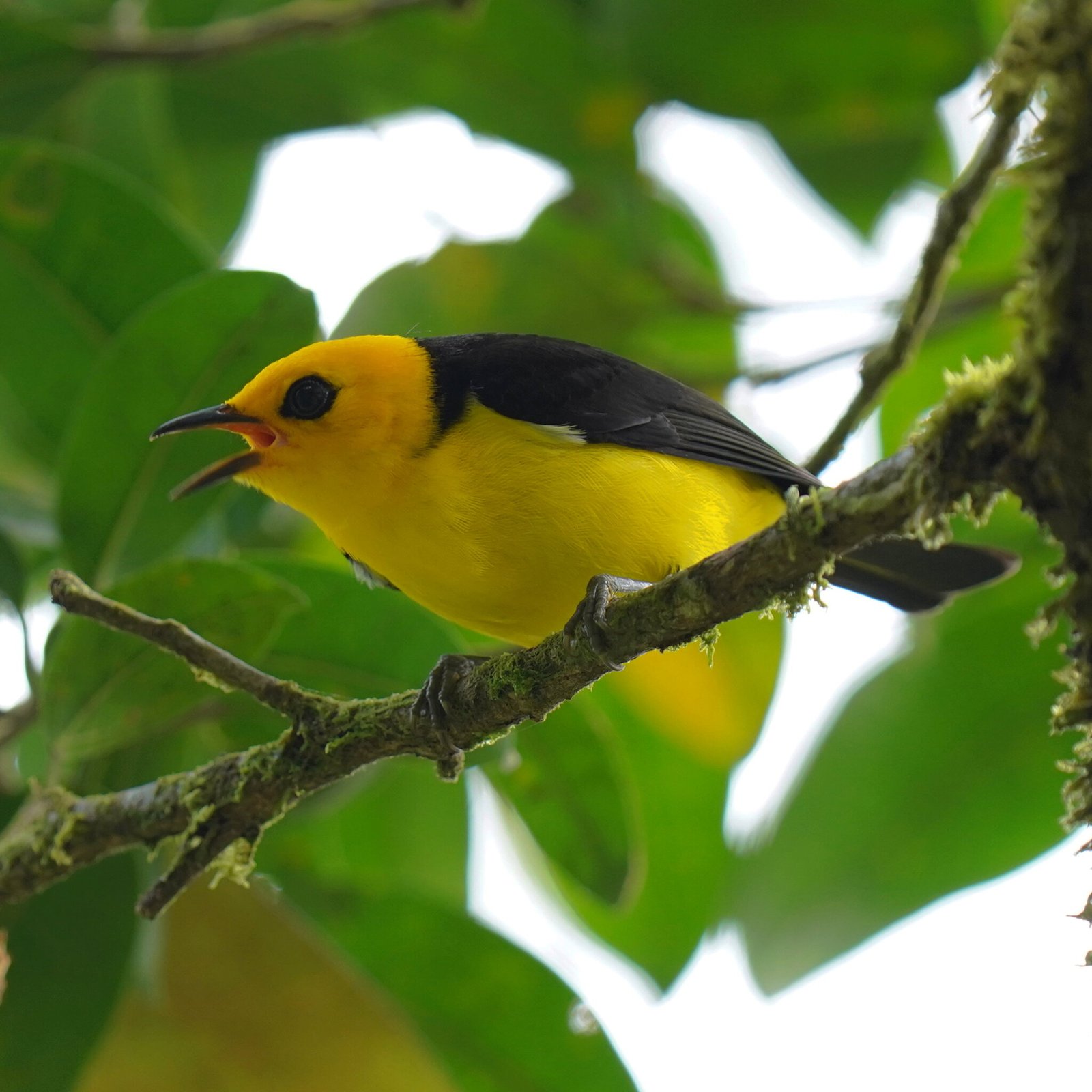
The Black-and-yellow Tanager is a small tanager of humid montane forest in Costa Rica and Panama. In the guide area it is known only as a vagrant or border case, from a few records in the far north-west of Colombia on the border with Panama. The male is bright yellow with a black mantle, wings and tail.
Voice
Thin, high tsit calls and a rapid, high song of squeaky notes; not described from the guide area.
Recording: Nick Athanas — CC BY-NC-SA 3.0 · xeno-canto
Identification
11–12 cm, with a thin, pointed, dark bill. The male is bright yellow on the head, rump and underparts, with a black mantle, wings and tail. The female is olive-green above and yellow below, with a paler throat. Young birds resemble the female.
Confusion species
The male Yellow-backed Tanager Hemithraupis flavicollis likewise has black upperparts and a yellow rump, but only a yellow throat and a whitish belly. The female Guira Tanager Hemithraupis guira is similarly olive-green and yellow, but has a faint yellow eyebrow and lives mainly in lower-lying forest.
Habitat
Canopy and edges of humid foothill and lower montane forest, mainly between about 600 and 1500 m. It actively searches the foliage for insects and eats small fruits, usually in mixed flocks with tanagers and warblers.
Where the bird is most at home, classified by the vegetation units of the Andes and the west coast.


Range and movements
In Colombia only a few records in the far north-west of Chocó, on the border with Panama. Absent from Ecuador, Peru, Bolivia and the Galápagos. Outside the guide area in Costa Rica and Panama.
How and when to look
Its occurrence in the guide area is limited to a remote border region. A record merits documentation with a photograph or sound recording.
Conservation status
Least Concern. Locally fairly common in humid montane forest in Costa Rica and Panama.
Scientific name
Chrysothlypis chrysomelas | (Sclater & Salvin, 1869)
Sclater & Salvin described the species in 1869 as Tachyphonus chrysomelas; because it was later moved to another genus, the author and year stand in brackets. The genus Chrysothlypis was introduced in 1912 by Berlepsch. The genus name comes from Greek khrusos, 'gold', and thlupis, an unidentified bird, a name often used for New World warblers and thin-billed tanagers. The species name comes from Greek khrusos, 'gold', and melas, 'black', referring to the yellow-and-black plumage. The specimen the first description was based on came from Cordillera del Chucu, Veraguas, Panama.