All species › Passerines › Tanagers and allies › Scarlet-rumped Tanager
Scarlet-rumped Tanager | Ramphocelus passerinii
Roodrugtangare | Tangara terciopelo | Pipira-de-uropígio-escarlate
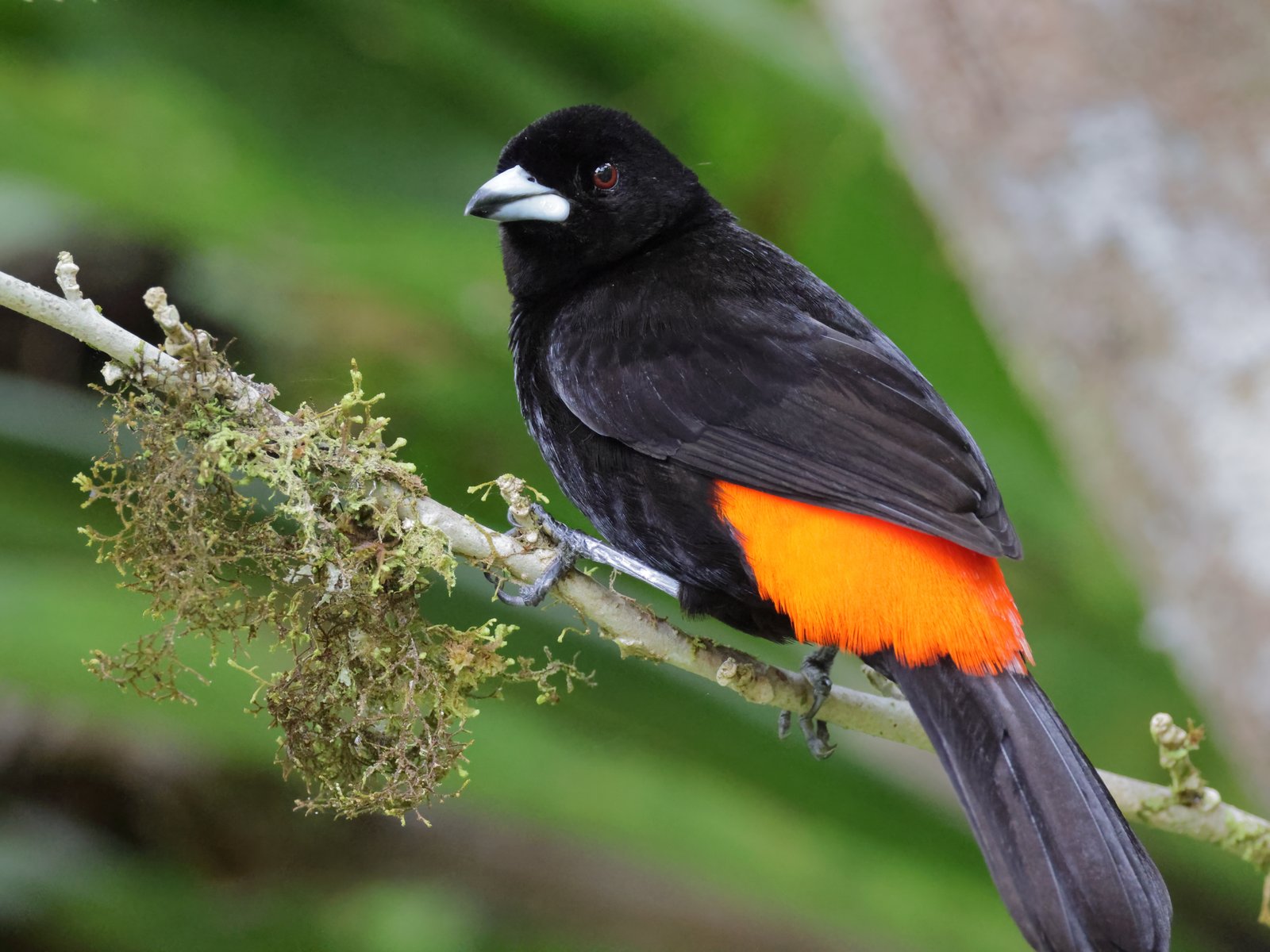
The Scarlet-rumped Tanager is a tanager of forest edges and gardens in the Caribbean lowlands of Central America. The male is velvety black with a scarlet lower back and rump. In the guide area the species is at most a rare vagrant in the far north-west of Colombia.
Voice
Gives a sharp chek; the song is a simple series of clear whistled notes.
Recording: Tyler Wenzel — CC BY-NC-SA 4.0 · xeno-canto
Identification
16–17 cm, with a pale bluish-silver bill with a dark tip. The male is velvety black, with a scarlet lower back and rump. The female has a brownish-grey head, olive-brown upperparts with an orange-olive rump, and a greyish-buff throat above an ochre to orange-olive breast. Juveniles resemble the female.
Confusion species
Flame-rumped Tanager Ramphocelus flammigerus is larger; the male has a flame red-orange to lemon-yellow rump and the female has yellower underparts. Crimson-backed Tanager Ramphocelus dimidiatus has a dark maroon head and back and a red belly.
Habitat
Forest edges, scrub, plantations, gardens and villages in the lowlands. It lives in small flocks that search shrubs and low trees for fruit and insects. The nest is a cup in a shrub.
Where the bird is most at home, classified by the vegetation units of the Andes and the west coast.


Range and movements
Regarded as a rare vagrant in the guide area; there is no regular population in Colombia, Ecuador, Peru or Bolivia, nor on the Galápagos. Outside the guide area on the Caribbean side of Central America, from southern Mexico to western Panama.
How and when to look
A record in the guide area should be well documented; in north-western Colombia note the smaller build and the scarlet, not orange or yellow, rump of the male.
Conservation status
Least Concern. Within its own range the species is common.
Scientific name
Ramphocelus passerinii | Bonaparte, 1831
Bonaparte described the species in 1831 and placed it straight away in the genus where it still stands. The genus Ramphocelus was introduced in 1805 by Desmarest, A-G. The genus name combines Greek rhamphos, 'bill', and koilos, 'hollow, concave'. The species name honours the Italian zoologist and entomologist Carlo Passerini (1793–1857), curator at the natural history museum in Florence. The specimen the first description was based on came from Guatemala.