All species › Passerines › Tanagers and allies › Superciliaried Hemispingus
Superciliaried Hemispingus | Thlypopsis superciliaris
Wenkbrauwtangare | Hemispingo cejudo | Saí-de-sobrancelha
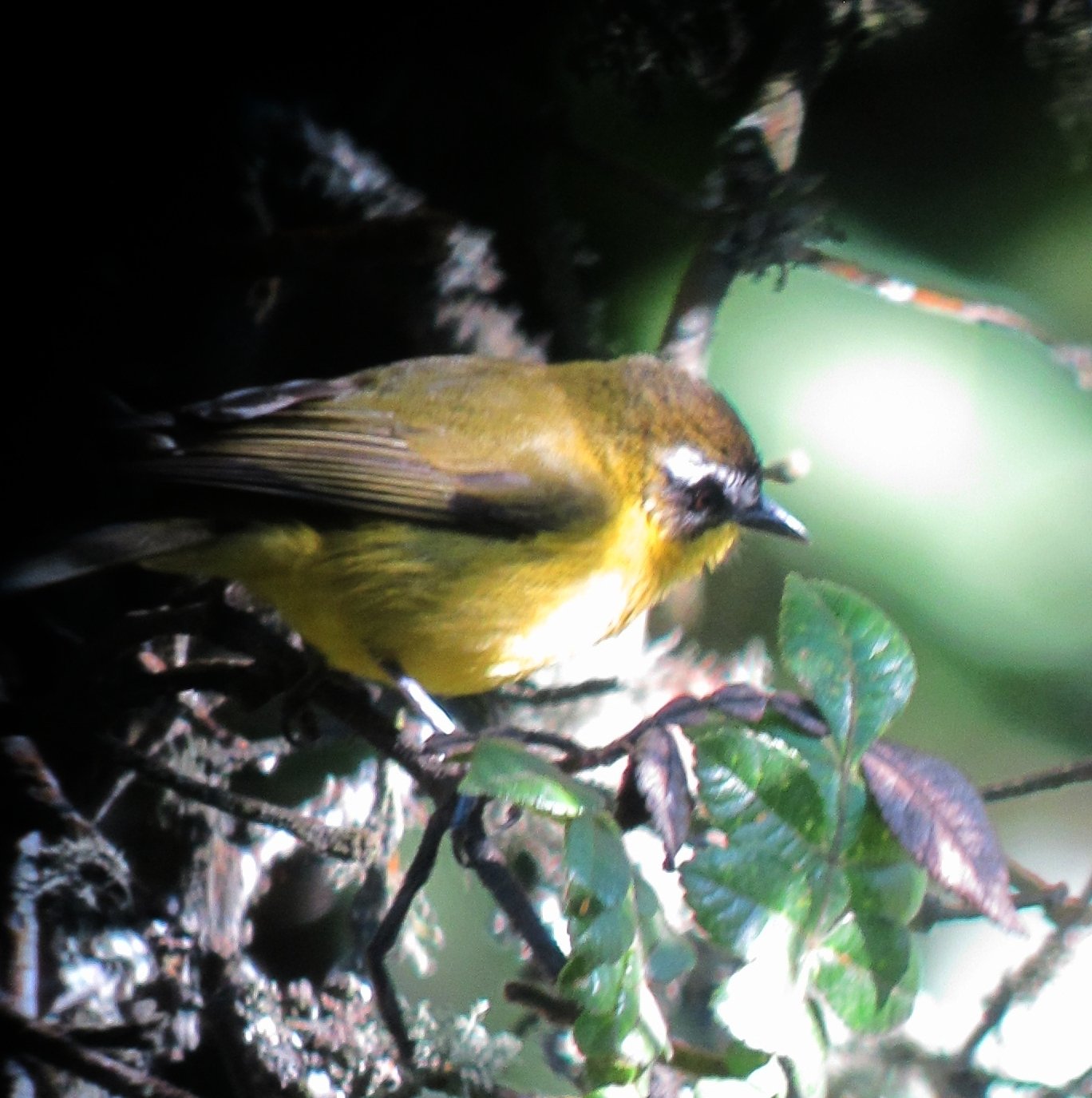
The Superciliaried Hemispingus is a small, olive-and-yellow tanager with a white supercilium, of the higher montane forest from Colombia to Bolivia. It lives in pairs or small groups in dense foliage and is often part of mixed flocks. Molecular studies now place it in the genus Thlypopsis.
Voice
High, thin tsit calls. The song is a fast, chattering series of high notes, often given as a duet by a pair.
Recording: Jerome Fischer — CC BY-NC-SA 4.0 · xeno-canto
Identification
13–14 cm, with a thin, pointed, dark bill. The crown and sides of the head are grey to blackish, depending on the subspecies, with a narrow white supercilium; in some southern populations this stripe is yellowish or faint. The upperparts are olive-green, the underparts bright to olive-yellow. The sexes are alike. Juveniles are duller, with a less distinct supercilium.
Confusion species
Black-capped Hemispingus Kleinothraupis atropileus is larger, with a black crown, a long, pale supercilium and ochre-yellow underparts. Oleaginous Hemispingus Sphenopsis frontalis is duller olive, with a faint, yellowish supercilium. Citrine Warbler Myiothlypis luteoviridis has a yellow supercilium, a dark eye-stripe and a longer tail.
Habitat
Cloud forest, elfin forest at the treeline, forest edges and scrub in the high mountains, roughly between 2000 and 3600 m. It searches among leaves and moss in the middle levels and the canopy for insects, mostly in pairs or small groups within mixed flocks. The nest is a cup of moss and fibres.
Where the bird is most at home, classified by the vegetation units of the Andes and the west coast.


Range and movements
In Colombia on all three Andean ranges. In Ecuador on both slopes of the Andes. In Peru along the Andes over the whole length of the country, mainly on the eastern slope. In Bolivia on the eastern slope of the Andes in the north and centre of the country. Absent from the Galápagos. Outside the guide area in the Andes of Venezuela.
- Resident
- dark = core range, pale = thinly spread
How and when to look
Search mixed flocks in the higher cloud forest and at the treeline. Watch for a small, yellow bird with a grey head and a narrow white supercilium.
Conservation status
Least Concern. The species is locally common and tolerates forest edges and scrub.
Scientific name
Thlypopsis superciliaris | (de Lafresnaye, 1840)
De Lafresnaye described the species in 1840 as Arremon superciliaris; because it was later moved to another genus, the author and year stand in brackets. The genus Thlypopsis was introduced in 1851 by Cabanis. The genus name combines Greek thlupis, an unknown small bird, with opsis, 'appearance'. The species name is Latin superciliaris, 'eyebrowed', for the distinct supercilium. The specimen the first description was based on came from Bogotá, Colombia.