All species › Passerines › Thrushes and allies › Swainson's Thrush
Swainson's Thrush | Catharus ustulatus
Dwerglijster | Zorzalito de Swainson | Sabiá-de-óculos
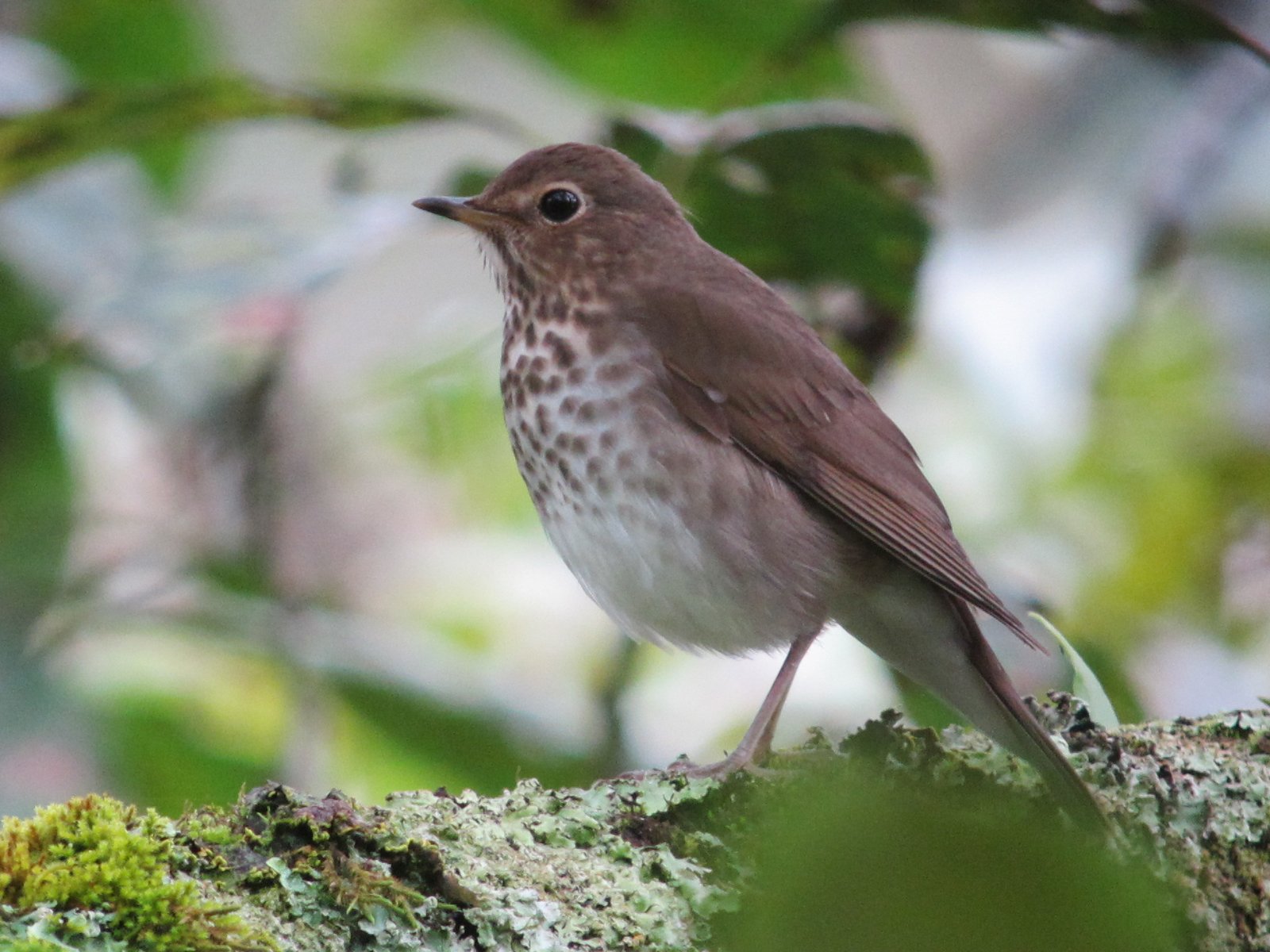
Swainson's Thrush is a small, olive-brown thrush that breeds in the forests of Alaska, Canada and the northern and western United States and winters in large numbers in the Andes. During the northern winter it is one of the most numerous migrants in forest and forest edge at middle elevations in the Andes. The pale buff spectacles are characteristic.
Voice
On the wintering grounds mainly a soft, liquid whit or quip; at night on migration a high, piping heeep. Before departure in March and April the song is sometimes given: a series of fluty phrases spiralling upwards.
Recording: Ed Pandolfino — CC BY-NC-SA 4.0 · xeno-canto
Identification
17–18 cm. The upperparts are plain olive-brown to greyish brown. A buff eye-ring and lores together form clear spectacles. The throat and breast are buff with dark, triangular spots, the belly is white and the flanks are greyish brown. The bill is dark, with a pale base to the lower mandible; the legs are pinkish grey. The sexes are alike. First-year birds sometimes show small pale tips to the greater coverts.
Confusion species
Grey-cheeked Thrush Catharus minimus is greyer, with grey cheeks, an indistinct whitish eye-ring and little buff on the breast. Veery Catharus fuscescens is warmer rufous-brown above, with a faintly spotted breast and no clear spectacles. The resident Catharus species of the guide area, such as Slaty-backed Nightingale-Thrush Catharus fuscater and Orange-billed Nightingale-Thrush Catharus aurantiirostris, have an orange bill and orange legs and no spotted breast.
Habitat
Humid montane forest, forest edges, secondary forest, shade-coffee plantations and gardens, mainly at about 800 to 2500 m, on migration also in the lowlands. It feeds in the middle levels of the forest on fruits and berries, often together with tanagers and other frugivores in fruiting trees, and also takes insects. It does not breed in the guide area.
Where the bird is most at home, classified by the vegetation units of the Andes and the west coast.


Range and movements
In Colombia a winter visitor in the three cordilleras and the Sierra Nevada de Santa Marta, on passage also elsewhere. In Ecuador a winter visitor on both slopes of the Andes and on passage also in the lowlands. In Peru a winter visitor mainly along the eastern slope of the Andes. In Bolivia a winter visitor along the eastern slope of the Andes in the Yungas. Not known as a regular visitor to the Galápagos. Breeds in Alaska, Canada and the northern and western United States and winters from Mexico to north-western Argentina.
- Winter visitor (c. Oct–Mar)
- Passage (Mar–Apr, Oct–Nov)
- dark = core range, pale = thinly spread
How and when to look
Between October and April at fruiting trees and shrubs along forest edges and trails in the mountains; birds often feed in small, loose groups and call frequently.
Conservation status
Not Evaluated in its current species limits. Widespread and numerous; on the wintering grounds it tolerates semi-open landscapes and shade coffee.
Scientific name
Catharus ustulatus | (Nuttall, 1840)
Nuttall described the species in 1840 as Turdus ustulatus; because it was later moved to another genus, the author and year stand in brackets. The genus Catharus was introduced in 1850 by Bonaparte. The genus name comes from Greek katharos, 'pure, clean', referring to the plumage of the Orange-billed Nightingale-Thrush (C. aurantiirostris). The species name comes from Latin ustulatus, 'scorched, burnt', for the brown colour of the upperparts. The specimen the first description was based on came from Fort Vancouver, Washington, United States.