All species › Passerines › Thrushes and allies › Veery
Veery | Catharus fuscescens
Veery | Zorzalito rojizo | Sabiá-norte-americano
The Veery is a warm brown Catharus thrush that breeds in the deciduous forests of southern Canada and the northern United States and winters in the southern Amazon Basin. It crosses the guide area mainly on migration; in the lowlands of Bolivia and south-eastern Peru some birds stay for the winter. The name imitates its call and song.
Voice
The call is a descending, somewhat hoarse veeer or vieew, also at night on migration. The song, a downward-spiralling series of buzzy fluty notes, is rarely heard in the guide area.
Recording: Paul Driver — CC BY-NC-SA 4.0 · xeno-canto
Identification
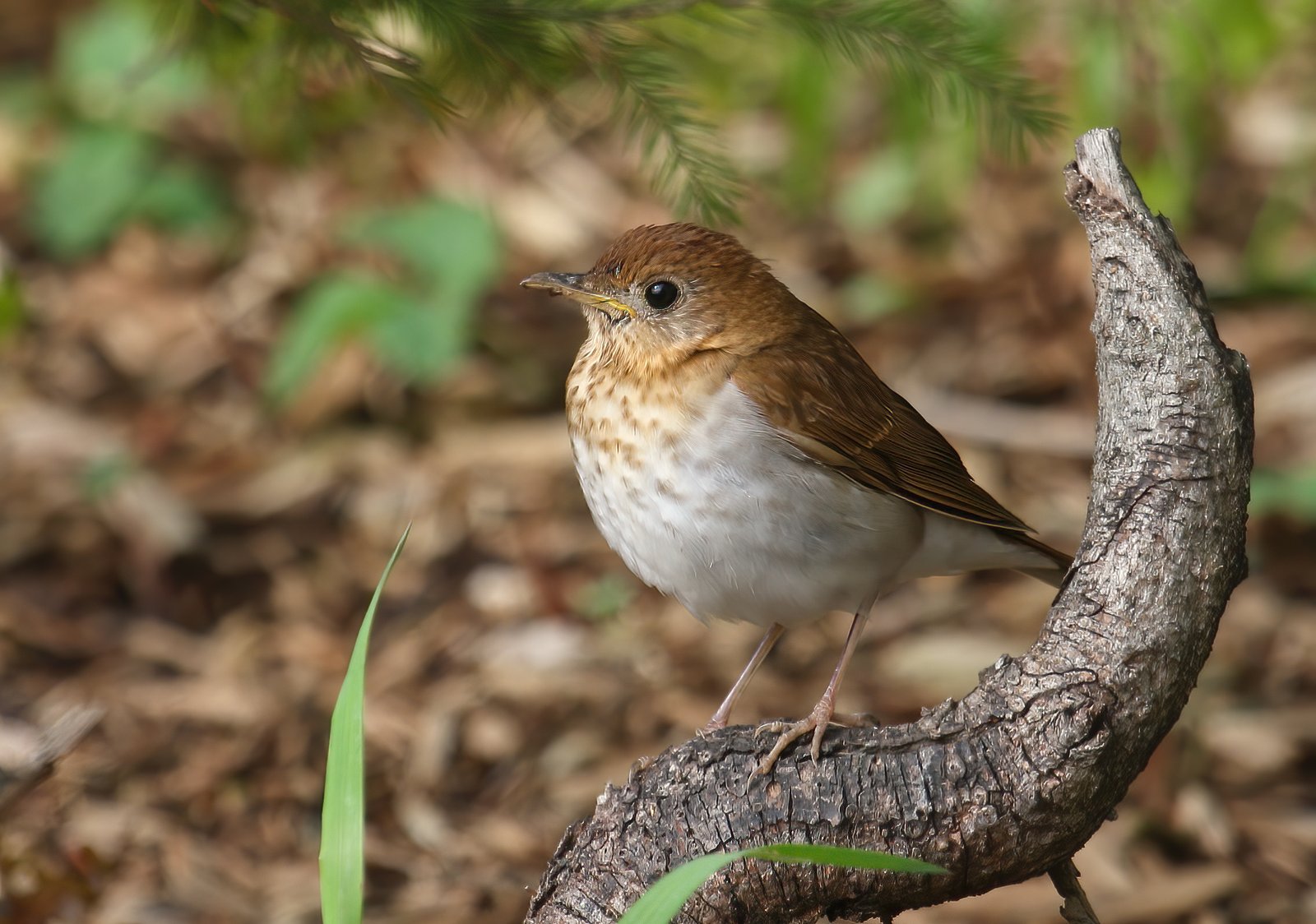
17–18 cm. The upperparts are plain warm rufous-brown to cinnamon-brown, duller olive-brown in some birds. The head has an indistinct grey eye-ring and grey cheeks. The throat and breast are pale buff with small, faint brown spots, the belly is white and the flanks are grey. The bill is dark with a pale base; the legs are pink. The sexes are alike.
Confusion species
Swainson's Thrush Catharus ustulatus is olive-brown, with clear buff spectacles and sharper, dark breast spots. Grey-cheeked Thrush Catharus minimus is colder greyish olive, with grey cheeks and heavier spotting on the breast. The Turdus thrushes of the lowlands are larger and lack a spotted breast.
Habitat
On migration and in winter in lowland rainforest, várzea, secondary forest and forest edge, mainly below 1000 m, on migration also higher on the eastern slope of the Andes. It searches on and just above the forest floor for insects and also eats much fruit. It does not breed in the guide area.
Where the bird is most at home, classified by the vegetation units of the Andes and the west coast.


Range and movements
In Colombia mainly a passage migrant, both in the lowlands and in the Andes, with most records in September–October and April. In Ecuador a scarce passage migrant, mainly in the east. In Peru a passage migrant and in the south-eastern lowlands also a winter visitor. In Bolivia a winter visitor in the lowlands of the north and east. Not known as a regular visitor to the Galápagos. Breeds in southern Canada and the northern United States and winters mainly in the southern Amazon Basin in Brazil.
- Winter visitor (c. Oct–Mar)
- Passage (Mar–Apr, Oct–Nov)
- dark = core range, pale = thinly spread
How and when to look
In October and April search the forest floor and low shrubs along trails in lowland forest and at the foot of the Andes; birds often sit still for long periods and give themselves away by their descending call.
Conservation status
Least Concern. In North America the breeding population has declined in recent decades; deforestation on the wintering grounds is a possible cause.
Scientific name
Catharus fuscescens | (Stephens, 1817)
Stephens described the species in 1817 as Turdus Fuscescens; because it was later moved to another genus, the author and year stand in brackets. The genus Catharus was introduced in 1850 by Bonaparte. The genus name comes from Greek katharos, 'pure, clean', referring to the plumage of the Orange-billed Nightingale-Thrush (C. aurantiirostris). The species name comes from Latin fuscescens, 'darkening, dusky', for the brown upperparts. The specimen the first description was based on came from Pennsylvania, United States.