All species › Passerines › Ovenbirds and woodcreepers › Tawny-throated Leaftosser
Tawny-throated Leaftosser | Sclerurus mexicanus
Bruinkeelbladkrabber | Tirahojas golianteado | Vira-folha-mesoamericano
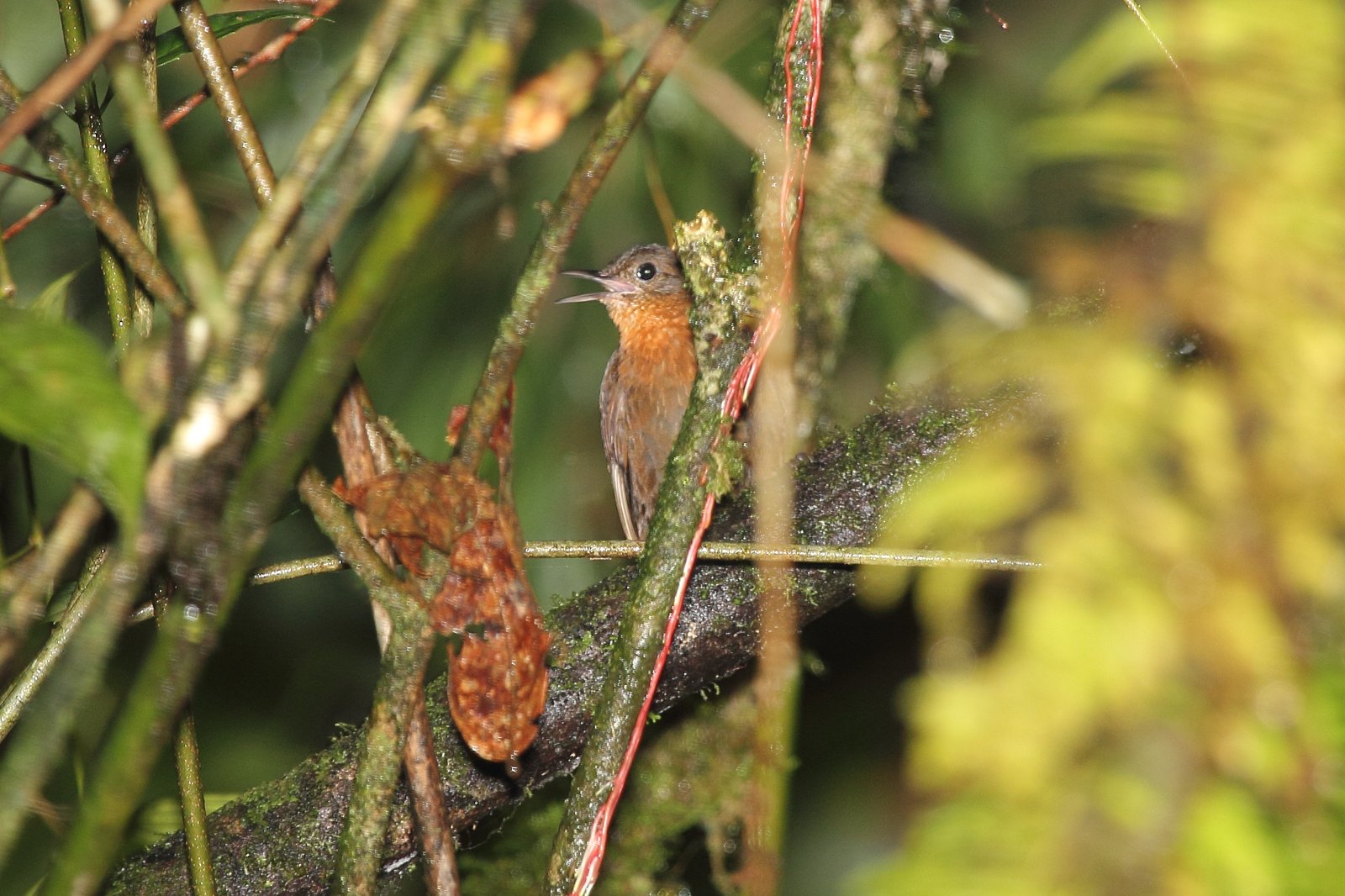
The Tawny-throated Leaftosser is a dark brown leaftosser with a warm ochre throat from the humid forests of Middle America. Since the South American birds were split as Dusky Leaftosser, the species comprises only the birds from Mexico to Panama. Like all leaftossers it works the forest floor, flicking leaves aside with its bill.
Voice
The song is a series of four to more than ten high, upslurred whistles that gradually descend and sometimes end in short, stuttering notes. The call is a sharp, explosive single note, repeated at irregular intervals.
Recording: Jorge Gabriel Campos — CC BY-NC-SA 4.0 · xeno-canto
Identification
15–16 cm, with a long, straight, thin bill, a short blackish tail and short legs. The upperparts are dark chestnut-brown, and the rump is more rufous. The throat and upper breast are warm ochre-brown to rusty brown, merging into a darker brown belly. The upper mandible is dark, the lower mandible paler at the base. The sexes are alike. Juveniles are duller, with fine pale scaling on the throat and breast.
Confusion species
Dusky Leaftosser Sclerurus obscurior is almost identical and replaces this species in South America; in the field they are separated mainly by range. Scaly-throated Leaftosser Sclerurus guatemalensis is larger, with a white, black-scaled throat and no rufous rump. Grey-throated Leaftosser Sclerurus albigularis has a greyish-white throat that contrasts sharply with a rufous breast band.
Habitat
Humid evergreen forest in lowlands and hills, especially on steep slopes and along ravines, up to about 1500 m. It forages alone or in pairs on the ground for insects and other invertebrates, flicking leaves aside and probing litter and rotting wood. The nest is in a chamber at the end of a tunnel in a steep earth bank.
Where the bird is most at home, classified by the vegetation units of the Andes and the west coast.


Range and movements
Not confirmed in the guide area. The nearest birds live in Panama; leaftossers with an ochre throat in Colombia, Ecuador, Peru and Bolivia are Dusky Leaftossers. Absent from the Galápagos. Outside the guide area from southern Mexico through Central America to Panama.
- Resident
- dark = core range, pale = thinly spread
How and when to look
This species can only be seen outside the guide area, in the forests of Central America. Listen there in the early morning for the descending series of whistles and watch for the rustle of tossed leaves on the forest floor.
Conservation status
Not Evaluated in the current, narrower species concept. The leaftosser depends on closed forest with a deep leaf-litter layer and disappears with logging and fragmentation.
Scientific name
Sclerurus mexicanus | Sclater, 1857
Sclater described the species in 1857 and placed it straight away in the genus where it still stands. The genus Sclerurus was introduced in 1827 by Swainson. The genus name combines Greek sklēros, 'stiff', and oura, 'tail'. The species name mexicanus refers to Mexico. The specimen the first description was based on came from Córdoba, Veracruz, Mexico.