All species › Passerines › Finches, euphonias and allies › Thick-billed Euphonia
Thick-billed Euphonia | Euphonia laniirostris
Dikbekorganist | Eufonia piquigruesa | Gaturamo-de-bico-grosso
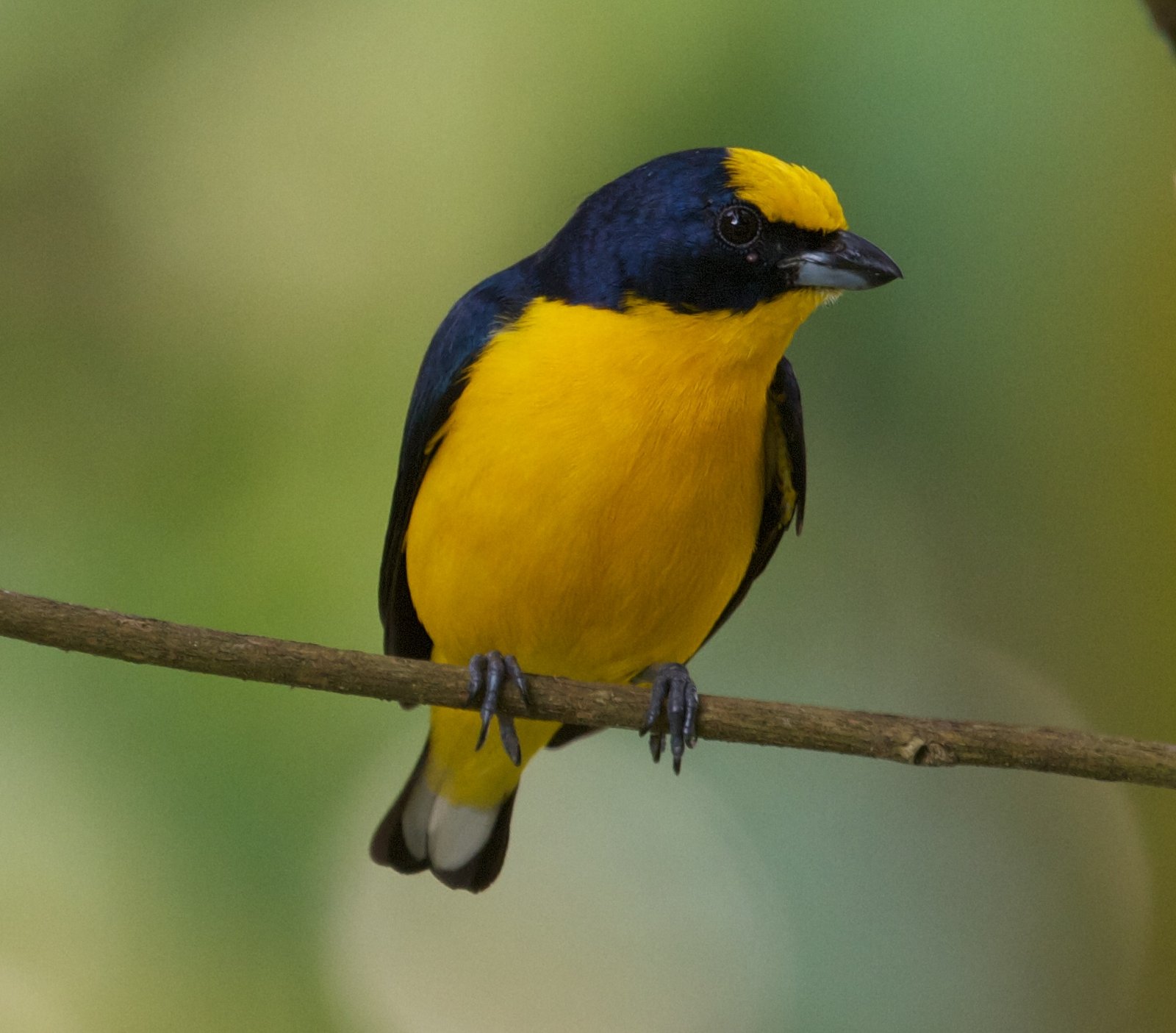
The Thick-billed Euphonia is the most widespread euphonia of the guide area, in the lowlands and foothills on both sides of the Andes. The male is blue-black and yellow, with a yellow throat and a notably thick bill. More than other euphonias it lives in semi-open country, plantations and gardens.
Voice
Varied: clear calls such as chweet and pee-pee, and a chattering song that often includes imitated calls and alarm notes of other birds.
Recording: Juan Freile — CC BY-NC-SA 4.0 · xeno-canto
Identification
10–11 cm, with a thick, short bill. The male is glossy steel-blue to blue-black above. The yellow forecrown starts at the bill and extends well behind the eye. The throat and entire underparts are yellow. There are white spots on the underside of the tail. The female is olive-green above and yellowish olive below, uniform and without grey. Young males are at first like the female and gradually acquire blue-black patches.
Confusion species
Violaceous Euphonia Euphonia violacea, which occurs only as a vagrant in the east, also has a yellow throat, but a thinner bill, a smaller yellow crown patch and deeper orange-yellow underparts. Purple-throated Euphonia Euphonia chlorotica, Trinidad Euphonia Euphonia trinitatis and White-vented Euphonia Euphonia minuta are smaller and have a dark throat. Orange-crowned Euphonia Euphonia saturata in the west has a dark throat and an orange-yellow crown reaching the hindcrown, without white in the tail. Females can often only be identified by bill shape or by the accompanying male.
Habitat
Forest edges, secondary forest, open woodland, dry forest, gallery forest, plantations, gardens and parks, mostly below 1500 m, locally in dry valleys up to about 2000 m. It avoids the interior of closed forest. It feeds on mistletoe berries and other small fruit. The nest is a domed structure with a side entrance, in a cavity, a bank, a clump of epiphytes or another nest.
Where the bird is most at home, classified by the vegetation units of the Andes and the west coast.


Range and movements
In Colombia widespread in the lowlands and lower valleys on both sides of the Andes. In Ecuador in the western lowlands, including dry areas, and in the eastern lowlands. In Peru in the north-west and in the lowlands east of the Andes. In Bolivia in the northern and central lowlands. Absent from the Galápagos. Outside the guide area in Costa Rica and Panama, Venezuela and western Brazilian Amazonia.
- Resident
- dark = core range, pale = thinly spread
How and when to look
Look for trees with mistletoe at forest edges, in gardens and plantations. The male often sings from a high, open branch, where the yellow throat and thick bill show well.
Conservation status
Least Concern. The species is common and locally benefits from open, man-altered country with scattered trees.
Scientific name
Euphonia laniirostris | d'Orbigny, ACVMD & de Lafresnaye, 1837
D'Orbigny, ACVMD & de Lafresnaye described the species in 1837 and placed it straight away in the genus where it still stands. The genus Euphonia was introduced in 1806 by Desmarest, A-G. The genus name comes from Greek euphōnos, from eu 'good' and phōnē 'sound', meaning 'sweet-voiced', after the calls of these birds. The species name comes from Lanius, 'shrike', and Latin rostrum, 'bill', after the thick, shrike-like bill. The specimen the first description was based on came from Yuracarés, Bolivia.