All species › Passerines › Finches, euphonias and allies › Fulvous-vented Euphonia
Fulvous-vented Euphonia | Euphonia fulvicrissa
Roestbuikorganist | Eufonia ventrileonada | Gaturamo-de-crisso-fulvo
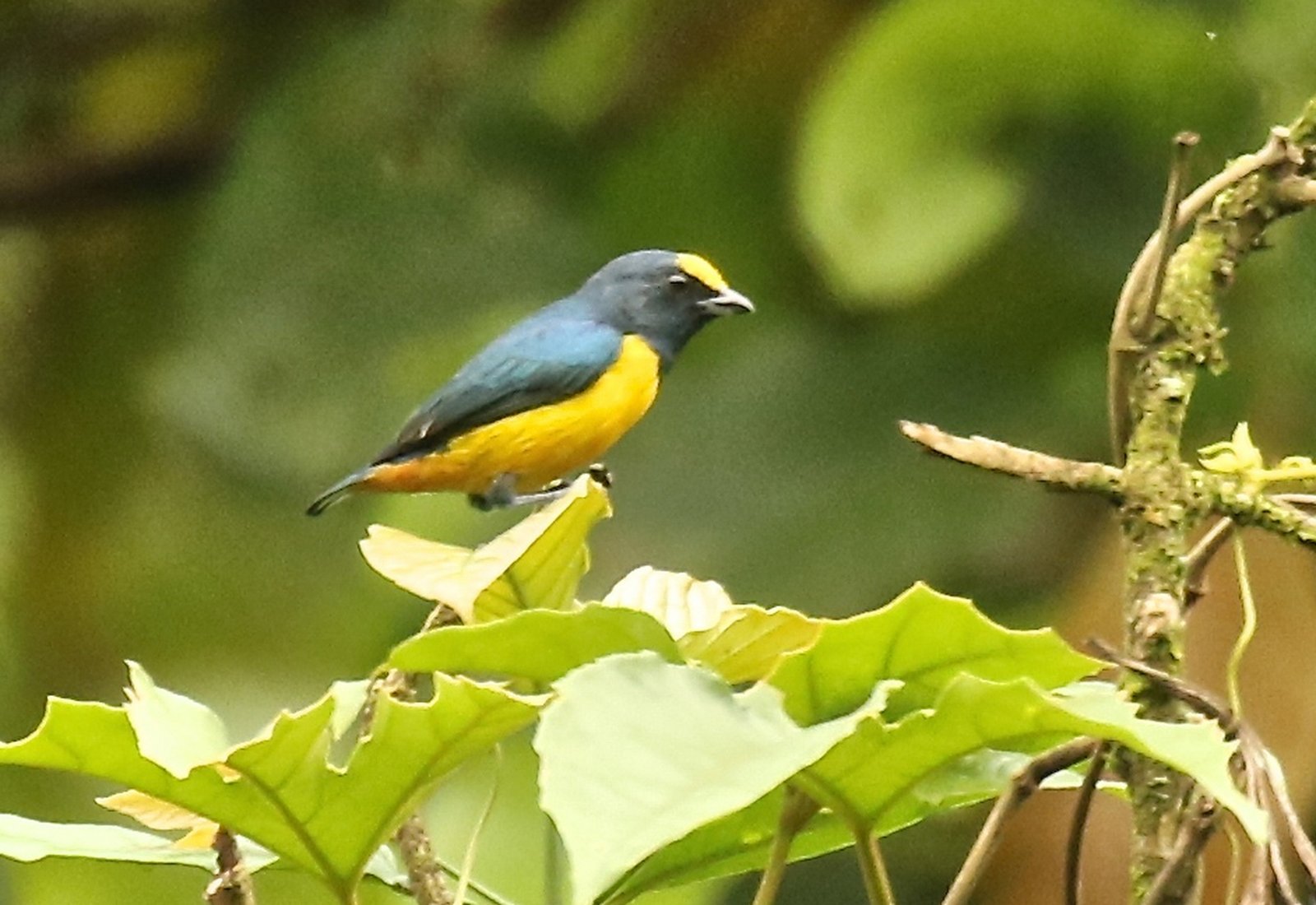
The Fulvous-vented Euphonia is a small euphonia of the humid lowland forest of the Chocó, from Panama to north-western Ecuador. Both sexes have a tawny to ochre centre of the belly and undertail, the feature that gives the species its name. More than many other euphonias it lives in the lower and middle levels of the forest.
Voice
A repeated, somewhat nasal dee-dee-dee and short, clear calls; the song is a fast twitter of high notes.
Recording: Juan Freile — CC BY-NC-SA 4.0 · xeno-canto
Identification
9–10 cm, with a short, thick bill. The male is glossy steel-blue above, with a blue-black throat and cheeks and a yellow forehead patch reaching to about above the eye. The breast and flanks are yellow, the centre of the lower belly and the undertail coverts tawny. The female is olive-green above, with a rufous forehead, and olive-yellow below, with a tawny to ochre centre of the belly. Young birds resemble the female.
Confusion species
White-vented Euphonia Euphonia minuta is very similar, but has a white rather than tawny lower belly and undertail; the female has a grey throat and no rufous forehead. Orange-bellied Euphonia Euphonia xanthogaster is larger, with a larger yellow crown patch and deeper orange-yellow underparts, and usually lives higher on the slopes; the female also has a rufous forehead, but a grey nape and a greyish belly. Thick-billed Euphonia Euphonia laniirostris has a yellow throat.
Habitat
The interior and edges of humid lowland forest and older secondary forest, up to about 1000 m. It forages in the lower and middle levels and in the canopy, often with mixed flocks. It feeds on mistletoe berries and other small fruit. The nest is a domed structure with a side entrance, in moss or epiphytes.
Where the bird is most at home, classified by the vegetation units of the Andes and the west coast.


Range and movements
In Colombia in the Pacific lowlands from Chocó to Nariño, in the north and in the middle Magdalena valley. In Ecuador only in the north-west. Absent from Peru, Bolivia and the Galápagos. Outside the guide area in Panama.
- Resident
- dark = core range, pale = thinly spread
How and when to look
In humid forest in the Chocó and north-western Ecuador, search along trails and forest edges at lower and middle levels. The species often travels with mixed flocks of tanagers and other euphonias.
Conservation status
Least Concern. Deforestation in the lowlands of the Chocó and north-western Ecuador is a threat, but the species also occurs in older secondary forest.
Scientific name
Euphonia fulvicrissa | Sclater, 1857
Sclater described the species in 1857 and placed it straight away in the genus where it still stands. The genus Euphonia was introduced in 1806 by Desmarest, A-G. The genus name comes from Greek euphōnos, from eu 'good' and phōnē 'sound', meaning 'sweet-voiced', after the calls of these birds. The species name comes from Latin fulvus, 'tawny', and crissum, 'vent', after the tawny undertail. The specimen the first description was based on came from Santa Marta, Colombia.