All species › Passerines › Finches, euphonias and allies › Orange-bellied Euphonia
Orange-bellied Euphonia | Euphonia xanthogaster
Vuurbuikorganist | Eufonia ventrinaranja | Fim-fim-grande
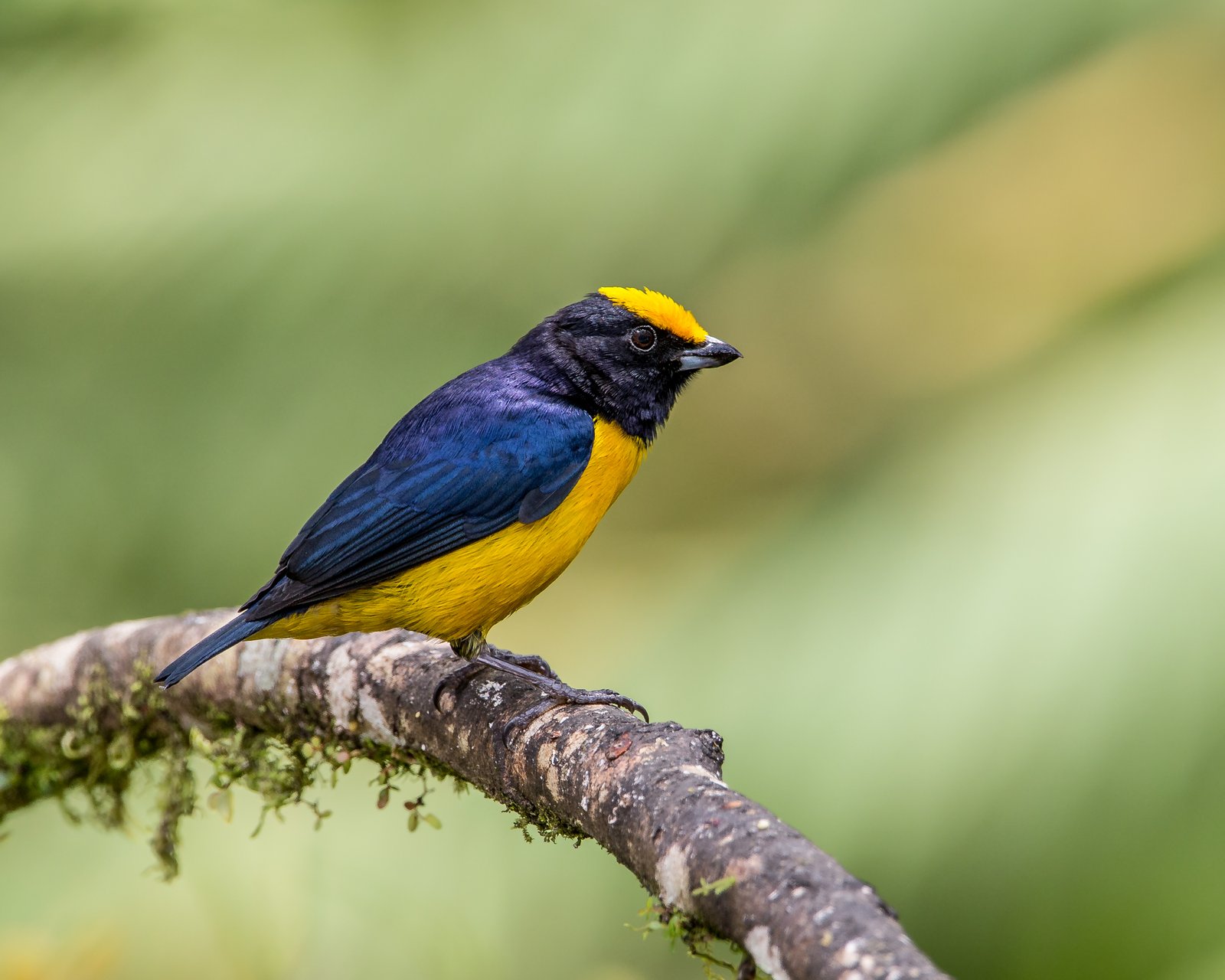
The Orange-bellied Euphonia is the most widespread euphonia of the foothills and lower slopes of the Andes in the guide area. The male has blue-black upperparts, a yellow forecrown and ochre-yellow underparts; the female is distinguished by her grey belly. It lives in pairs or small groups in the canopy and often joins mixed tanager flocks.
Voice
Clear, short whistles in series of two or three, like dee-dee or dee-dee-dee, and a nasal call. The song is a varied, rapid chatter of clear and rasping notes.
Recording: Juan Freile — CC BY-NC-SA 4.0 · xeno-canto
Identification
10–11 cm, compact, with a short, thick bill and a short tail. The male has glossy steel-blue to blue-black upperparts, head and throat. The yellow to orange-yellow forecrown extends to above or behind the eye; its size varies between subspecies. The underparts are deep ochre-yellow to orange-yellow. From below, white spots on the inner webs of the outer tail feathers are visible. The female is olive-green with a rufous forehead, a greyish nape and grey central breast and belly with olive-yellow flanks. Young males resemble the female and gradually acquire the dark plumage.
Confusion species
Orange-crowned Euphonia Euphonia saturata of western Colombia and western Ecuador has an orange crown that extends further back and no white in the tail. Thick-billed Euphonia Euphonia laniirostris has a yellow rather than dark throat. Purple-throated Euphonia Euphonia chlorotica is smaller, with a violet-black throat, a smaller yellow forecrown and yellower underparts. Fulvous-vented Euphonia Euphonia fulvicrissa of the Chocó has a tawny vent. The female can be told from most other female euphonias by the rufous forehead combined with the grey belly.
Habitat
Humid lowland forest, foothill forest and lower montane rainforest, mainly the canopy and forest edges, also older secondary forest and clearings with fruiting trees. Roughly from the lowlands to about 2000 m, locally higher. It feeds mainly on mistletoe berries and other small fruit, also on some insects. The nest is a domed structure with a side entrance, in moss, epiphytes or a hollow in a bank.
Where the bird is most at home, classified by the vegetation units of the Andes and the west coast.


Range and movements
In Colombia on the Pacific side, in the Andean ranges and in the eastern lowlands and foothills. In Ecuador on both slopes of the Andes and in the Amazonian lowlands. In Peru on the east slope of the Andes and in the adjacent Amazonian lowlands. In Bolivia in the Yungas and the lowlands of the north and centre of the country. Absent from the Galápagos. Outside the guide area in eastern Panama, Venezuela, Guyana and western Amazonian Brazil.
- Resident
- dark = core range, pale = thinly spread
How and when to look
In foothill forest, look for mixed tanager flocks in the crowns and for trees with mistletoe; the short dee-dee calls often give the birds away. Seen from below, the white in the tail and the grey belly of the female are useful features.
Conservation status
Least Concern. The species is common and tolerates forest edges and secondary forest; deforestation reduces its habitat locally.
Scientific name
Euphonia xanthogaster | Sundevall, 1834
Sundevall described the species in 1834 and placed it straight away in the genus where it still stands. The genus Euphonia was introduced in 1806 by Desmarest, A-G. The genus name comes from Greek euphōnos, from eu 'good' and phōnē 'sound', meaning 'sweet-voiced', after the calls of these birds. The species name comes from Greek xanthos, 'yellow', and gastēr, 'belly', after the yellow belly. The specimen the first description was based on came from Rio de Janeiro, Brazil.