All species › Passerines › New World warblers › Three-banded Warbler
Three-banded Warbler | Basileuterus trifasciatus
Driebandzanger | Reinita tribandeada | Pula-pula-de-três-faixas
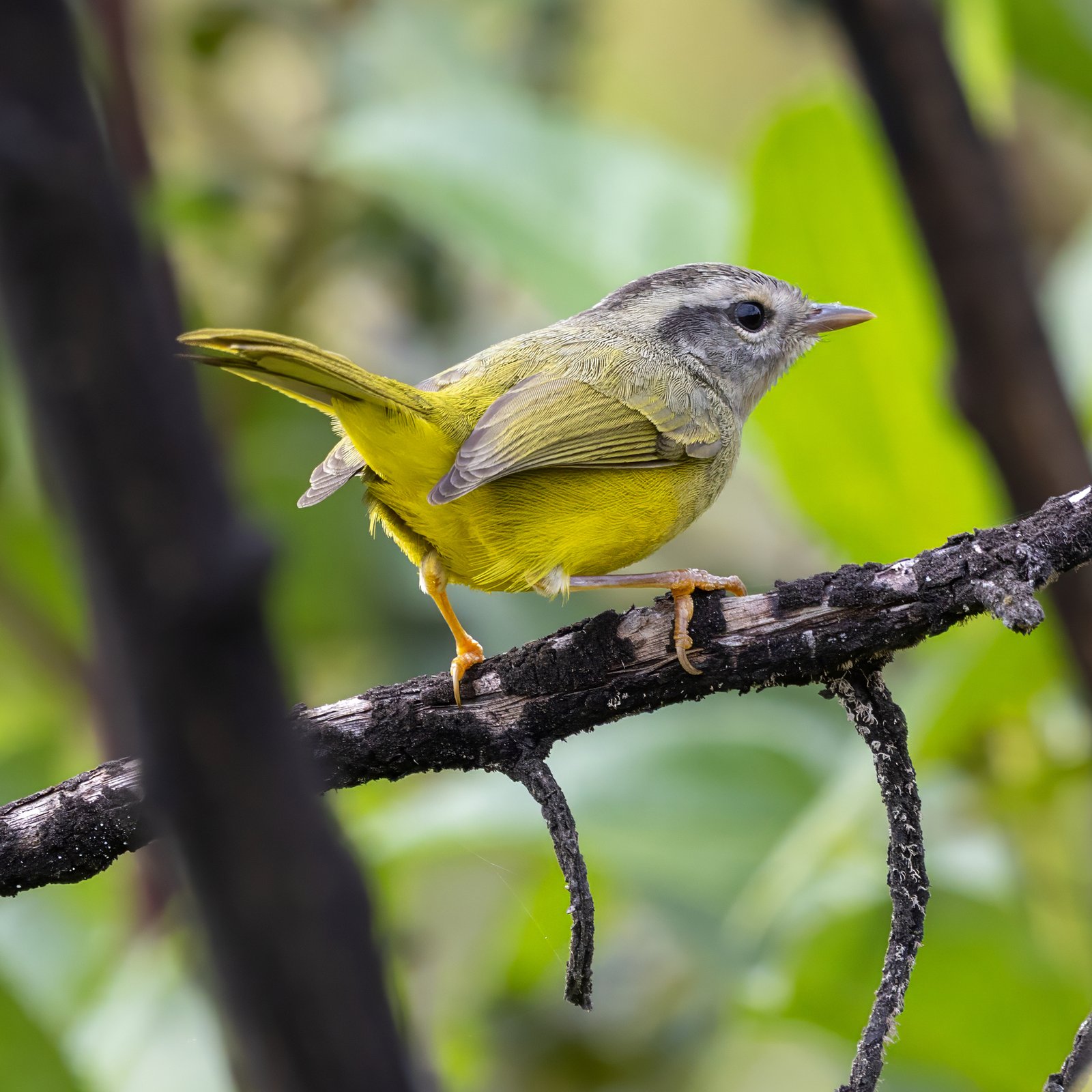
The Three-banded Warbler is a small warbler with a grey head marked with three black stripes, found only in the Tumbesian region of south-western Ecuador and north-western Peru. It lives in groups in the understorey of humid and semi-humid montane forests on the western side of the Andes. It is thus one of the species characteristic of this region rich in endemics.
Voice
The call is a dry chik; groups give a persistent chatter. The song is a fast, accelerating series of high, somewhat shrill notes, often by several birds at once.
Recording: Jerome Fischer — CC BY-NC-SA 4.0 · xeno-canto
Identification
13 cm. The head is grey with three black stripes: two lateral crown stripes and an eye-line, with a grey central crown stripe between them and a pale grey supercilium. The upperparts are olive-green. The throat and upper breast are greyish white, the rest of the underparts yellow, olive on the flanks. The sexes are alike; juveniles are duller and browner, with a fainter head pattern.
Confusion species
Three-striped Warbler Basileuterus tristriatus has a black cheek patch, a buff rather than grey head and wholly yellow underparts; in south-western Ecuador the two rarely occur together. Grey-and-gold Warbler Myiothlypis fraseri has grey upperparts, a yellow crown patch without black stripes and lives lower. Russet-crowned Warbler Myiothlypis coronata has a rufous crown stripe.
Habitat
Understorey and middle levels of humid and semi-humid montane forest, cloud forest and old secondary forest, also dense forest edges and scrub in ravines, mainly between 800 and 2800 m. It lives in groups that pick insects from leaves and twigs and often travel with mixed flocks. The nest is a domed structure on the ground.
Where the bird is most at home, classified by the vegetation units of the Andes and the west coast.


Range and movements
Ecuador: in the south-west, mainly in El Oro and Loja. Peru: on the western Andean slope of Tumbes and Piura south to Cajamarca and La Libertad. Absent from Colombia, Bolivia and the Galápagos. It does not occur outside the guide area.
- Resident
- dark = core range, pale = thinly spread
How and when to look
Search the montane forest remnants of south-western Ecuador, such as around Utuana and Sozoranga, and of north-western Peru for groups in mixed flocks; note the grey head with black stripes and the greyish-white throat.
Conservation status
Least Concern. Its range is small and strongly fragmented by logging, grazing and agriculture; however, the species tolerates old secondary forest and is fairly common in the remaining forests.
Scientific name
Basileuterus trifasciatus | Taczanowski, 1880
Taczanowski described the species in 1880 and placed it straight away in the genus where it still stands. The genus Basileuterus was introduced in 1848 by Cabanis. The genus name is an Ancient Greek bird name, basileuteros, 'more kingly'. The species name comes from Latin tri-, 'three', and fasciatus, 'banded', for the three head bands. The specimen the first description was based on came from Callacate, Cajamarca, Peru.