All species › Passerines › New World warblers › Canada Warbler
Canada Warbler | Cardellina canadensis
Canadese zanger | Reinita canadiense | Mariquita-do-canadá
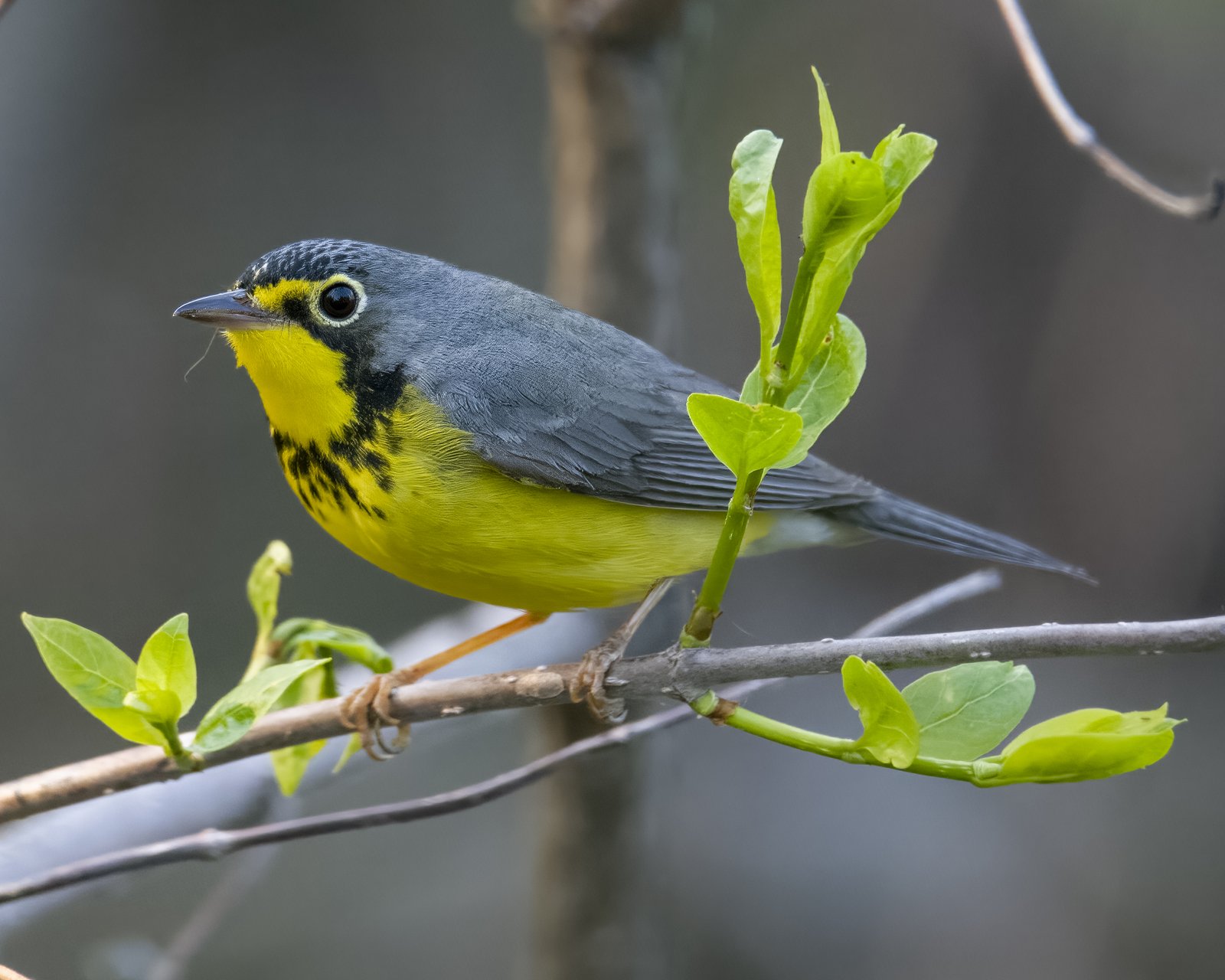
The Canada Warbler breeds in moist mixed forests of Canada and the north-eastern United States and winters largely in the Andes. It is grey above and yellow below, with a necklace of black streaks across the breast and pale spectacles. In the guide area it is a regular winter visitor to montane forest, often in mixed flocks.
Voice
The call is a sharp, somewhat clicking chip or chup. The song is a fast, irregular series of clear, chipping notes, often introduced by a chip; in the guide area heard mainly in spring.
Recording: Sue Riffe — CC BY-NC-SA 4.0 · xeno-canto
Identification
13–14 cm, with a fairly long tail without white spots. The upperparts are plain blue-grey, without wing bars. The underparts are bright yellow with white undertail coverts. The male has a blackish forehead and cheeks and a distinct necklace of black streaks across the breast; yellow lores and a white eye-ring form spectacles. Females and immatures have a greyer head and a faint grey necklace, but still show the spectacles.
Confusion species
Magnolia Warbler Setophaga magnolia has a yellow rump, white wing bars and white spots in the tail. Wilson's Warbler Cardellina pusilla is olive-green above and lacks the necklace. Spectacled Whitestart Myioborus melanocephalus also has spectacles and yellow underparts, but has a rufous or black crown and much white in the tail.
Habitat
In winter in the understorey and middle levels of humid montane forest and cloud forest, forest edges and old secondary forest, mainly between 1000 and 2500 m; lower on passage. It almost always joins mixed flocks and catches insects with short sallies and by gleaning them from leaves. It does not breed in the guide area.
Where the bird is most at home, classified by the vegetation units of the Andes and the west coast.


Range and movements
Colombia: fairly common winter visitor in the three Andean ranges, the Serranía de Perijá and the Sierra Nevada de Santa Marta; also in the northern lowlands on passage. Ecuador: on both Andean slopes. Peru: along the eastern Andean slope south to Cuzco and Puno, scarcer to the south. Bolivia: at most a few records. Absent from the Galápagos. Breeds in Canada and the north-eastern United States.
- Winter visitor (c. Oct–Mar)
- dark = core range, pale = thinly spread
How and when to look
Between November and March, follow mixed flocks in cloud forest along forest trails, for example in the eastern and western Andes of Ecuador; watch for a grey-and-yellow warbler with spectacles catching insects at low to middle levels.
Conservation status
Least Concern. The population has declined strongly in the long term; loss of montane forest in the Andes, where most birds winter, is an important threat.
Scientific name
Cardellina canadensis | (Linnaeus, 1766)
Linnaeus described the species in 1766 as Muscicapa canadensis; because it was later moved to another genus, the author and year stand in brackets. The genus Cardellina was introduced in 1850 by Bonaparte. The genus name is a diminutive of cardella, an Italian dialect word for the European goldfinch. The species name canadensis refers to Canada, not necessarily the type locality. The specimen the first description was based on came from Canada.