All species › Passerines › New World warblers › Slate-throated Whitestart
Slate-throated Whitestart | Myioborus miniatus
Meniezanger | Chipe de montaña | Mariquita-cinza
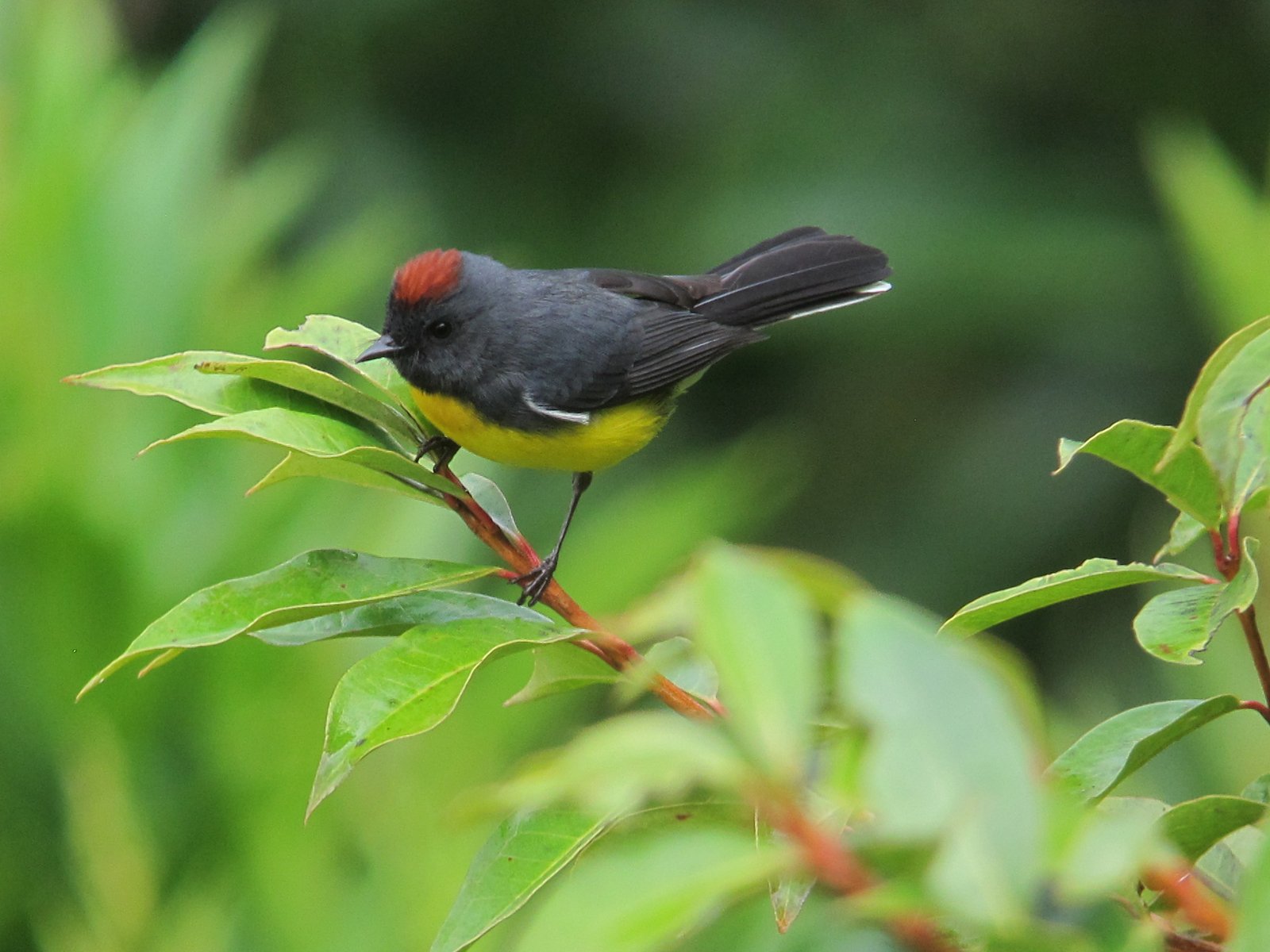
The Slate-throated Whitestart is the most widespread species of the genus Myioborus, ranging from Mexico to Bolivia. In the guide area it lives mainly on the lower and middle slopes of the Andes, below the altitudinal zone of Spectacled and Golden-fronted Whitestarts. It constantly fans its tail and droops its wings, flashing the white outer tail feathers.
Voice
The call is a thin, high tsip. The song is a series of rapid, high chip notes that often accelerates or changes in pitch, roughly chee-chee-chee-chewee-chewee.
Recording: Santiago Varela L. — CC BY-NC-SA 4.0 · xeno-canto
Identification
13 cm, with a long, rounded tail that is often fanned. The upperparts are slate-grey; forehead, face and throat are darker, blackish slate. A chestnut crown patch is often largely hidden. Breast and belly are yellow in the guide area, sometimes with an orange tinge on the breast; in Central America they are orange to reddish. The undertail coverts are white and the black tail has much white in the outer feathers. The sexes are alike. Juveniles are duller and brownish grey, without a crown patch and with a pale, ochre belly.
Confusion species
Spectacled Whitestart Myioborus melanocephalus lives higher, has yellow spectacles around the eye and a yellow throat. Golden-fronted Whitestart Myioborus ornatus has a yellow face, a yellow throat and an olive back. In the Sierra Nevada de Santa Marta, Yellow-crowned Whitestart Myioborus flavivertex has a black head with a yellow crown and an olive-green back. In Bolivia, Brown-capped Whitestart Myioborus brunniceps has a yellow throat and a rufous cap. American Redstart Setophaga ruticilla, a winter visitor, also fans its tail, but has orange or yellow instead of white tail patches.
Habitat
Humid montane forest, forest edges, clearings, secondary forest and shade coffee, in the guide area mainly from about 600 to 2200 m, locally lower or higher. It forages in the lower and middle levels of the forest, often in mixed flocks. It fans tail and wings to flush insects and catches them in short sallies. The nest is a partly domed cup of moss and grass on the ground, usually against a steep bank.
Where the bird is most at home, classified by the vegetation units of the Andes and the west coast.


Range and movements
Colombia: in all three Andean ranges, the Sierra Nevada de Santa Marta, the Serranía de Perijá and the Serranía de la Macarena. Ecuador: on both slopes of the Andes. Peru: along the east slope of the Andes over the whole length of the country. Bolivia: on the east slope of the Andes, in the Yungas. Absent from the Galápagos. Outside the guide area from Mexico to Panama, in Venezuela and in the tepui mountains of Guyana and northern Brazil.
- Resident
- dark = core range, pale = thinly spread
How and when to look
Walk forest edges along mountain roads between about 1000 and 2000 m, for example on the east slope in Ecuador and Peru. In mixed flocks, watch for a small warbler hopping about with fanned tail and drooped wings, showing the white tail sides.
Conservation status
Least Concern. The species is common over a large range and also uses forest edges and secondary growth.
Scientific name
Myioborus miniatus | (Swainson, 1827)
Swainson described the species in 1827 as Setophaga miniata; because it was later moved to another genus, the author and year stand in brackets. The genus Myioborus was introduced in 1865 by Baird. The genus name combines Greek muia, 'fly', with -boros, '-devouring': fly-eater. The species name comes from Latin miniatus, 'vermilion, coloured with red lead', from minium, 'red lead'. The specimen the first description was based on came from Morelia, Michoacán, Mexico.