All species › Passerines › New World warblers › Brown-capped Whitestart
Brown-capped Whitestart | Myioborus brunniceps
Bruinkapzanger | Candelita coronicastaña | Mariquita-de-cabeça-castanha
The Brown-capped Whitestart is the southernmost species of the genus Myioborus. In the guide area it occurs only in Bolivia, in the montane forests on the east slope of the Andes; further south it lives in north-western Argentina. The tepui birds of Venezuela and Brazil formerly included in it are now treated as a separate species.
Voice
The call is a thin, high tsip. The song is a rapid series of high chip notes and short trills.
Recording: Franco Vushurovich — CC BY-NC-SA 4.0 · xeno-canto
Identification
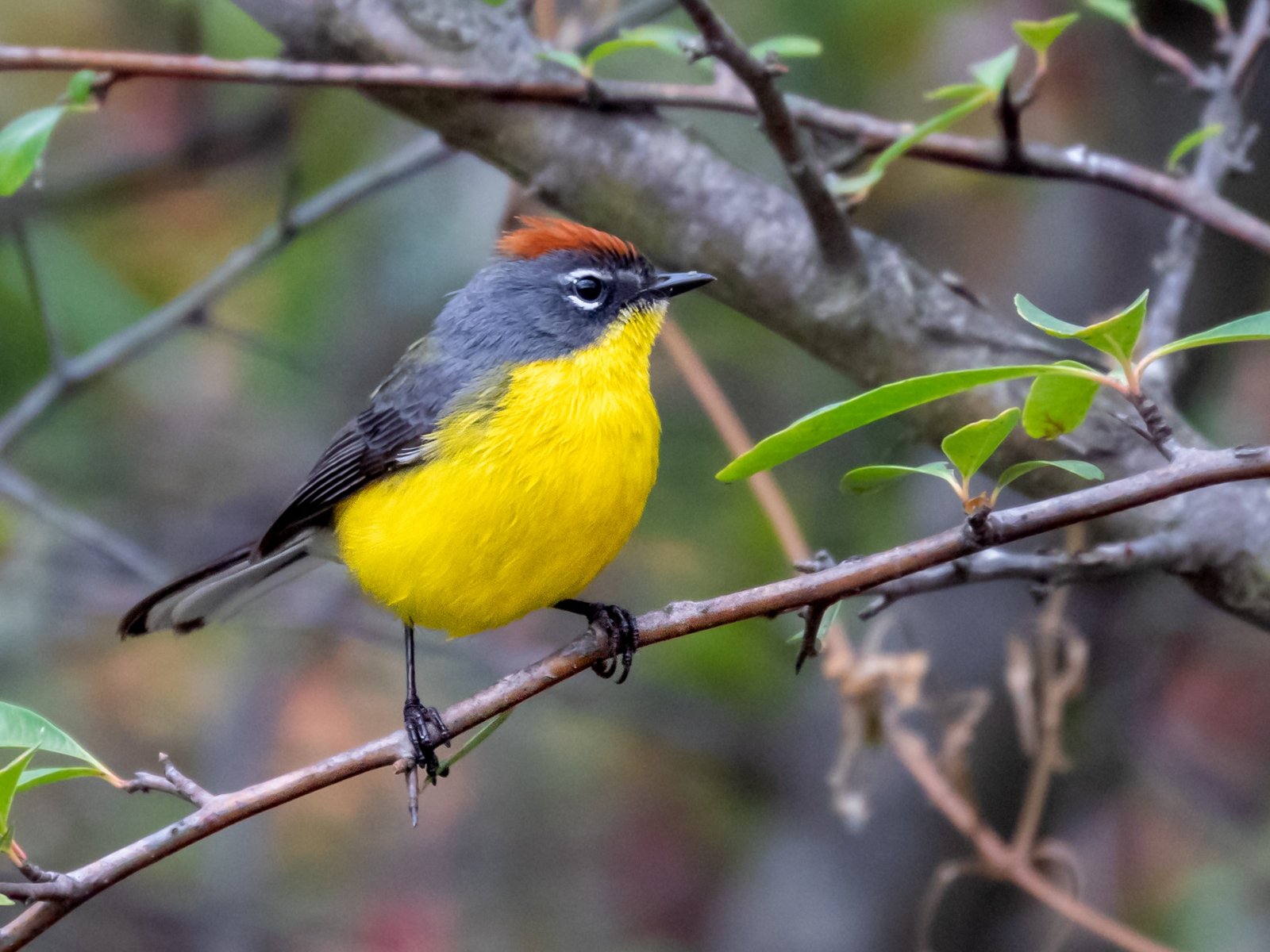
13 cm, with a long, often fanned tail. The head is grey with a rufous cap and a narrow pale eye-ring; the upperparts are grey with an olive tinge. Throat, breast and belly are yellow, the undertail coverts whitish. The blackish tail has much white in the outer feathers. The sexes are alike. Juveniles are duller and browner, with a less distinct cap.
Confusion species
Slate-throated Whitestart Myioborus miniatus lives lower, is slatier above and has a dark, blackish-grey throat. Spectacled Whitestart Myioborus melanocephalus, in northern Bolivia, has a black crown and yellow spectacles around the eye.
Habitat
Humid and semi-humid Yungas montane forest, forest edges, alder (Alnus) woodland and Polylepis woodland, mainly from about 1000 to 3000 m. It forages in the lower and middle levels, often in mixed flocks; it fans tail and wings to flush insects. As in related species, the nest is on or near the ground in a bank.
Where the bird is most at home, classified by the vegetation units of the Andes and the west coast.


Range and movements
Colombia, Ecuador and Peru: absent. Bolivia: on the east slope of the Andes in the centre and south of the country, roughly from Cochabamba to Tarija. Absent from the Galápagos. Outside the guide area in north-western Argentina.
- Resident
- dark = core range, pale = thinly spread
How and when to look
In the montane forests of Cochabamba, Chuquisaca and Tarija, check mixed flocks along forest edges and in alder woodland; the Brown-capped Whitestart stands out by its fanned, white-sided tail and rufous cap.
Conservation status
Least Concern. The species is fairly common in a reasonably large range; deforestation in the Yungas is a local threat.
Scientific name
Myioborus brunniceps | (d'Orbigny, ACVMD & de Lafresnaye, 1837)
D'Orbigny, ACVMD & de Lafresnaye described the species in 1837 as Setophaga brunniceps; because it was later moved to another genus, the author and year stand in brackets. The genus Myioborus was introduced in 1865 by Baird. The genus name combines Greek muia, 'fly', with -boros, '-devouring': fly-eater. The species name combines Medieval Latin brunneus, 'brown', and -ceps, '-headed'. The specimen the first description was based on came from Yungas, Bolivia.