All species › Passerines › New World warblers › Yellow-crowned Whitestart
Yellow-crowned Whitestart | Myioborus flavivertex
Geelkruinzanger | Candelita coronigualda | Mariquita-de-coroa-amarela
The Yellow-crowned Whitestart occurs only in the Sierra Nevada de Santa Marta in northern Colombia, an isolated massif with many endemic birds. There it is a common resident of montane forest above the zone of the Slate-throated Whitestart. Like the other species of the genus, it constantly fans its tail.
Voice
The call is a high, thin tsip. The song is a rapid, somewhat uneven series of high chip notes and short trills.
Recording: Ross Gallardy — CC BY-NC-SA 4.0 · xeno-canto
Identification
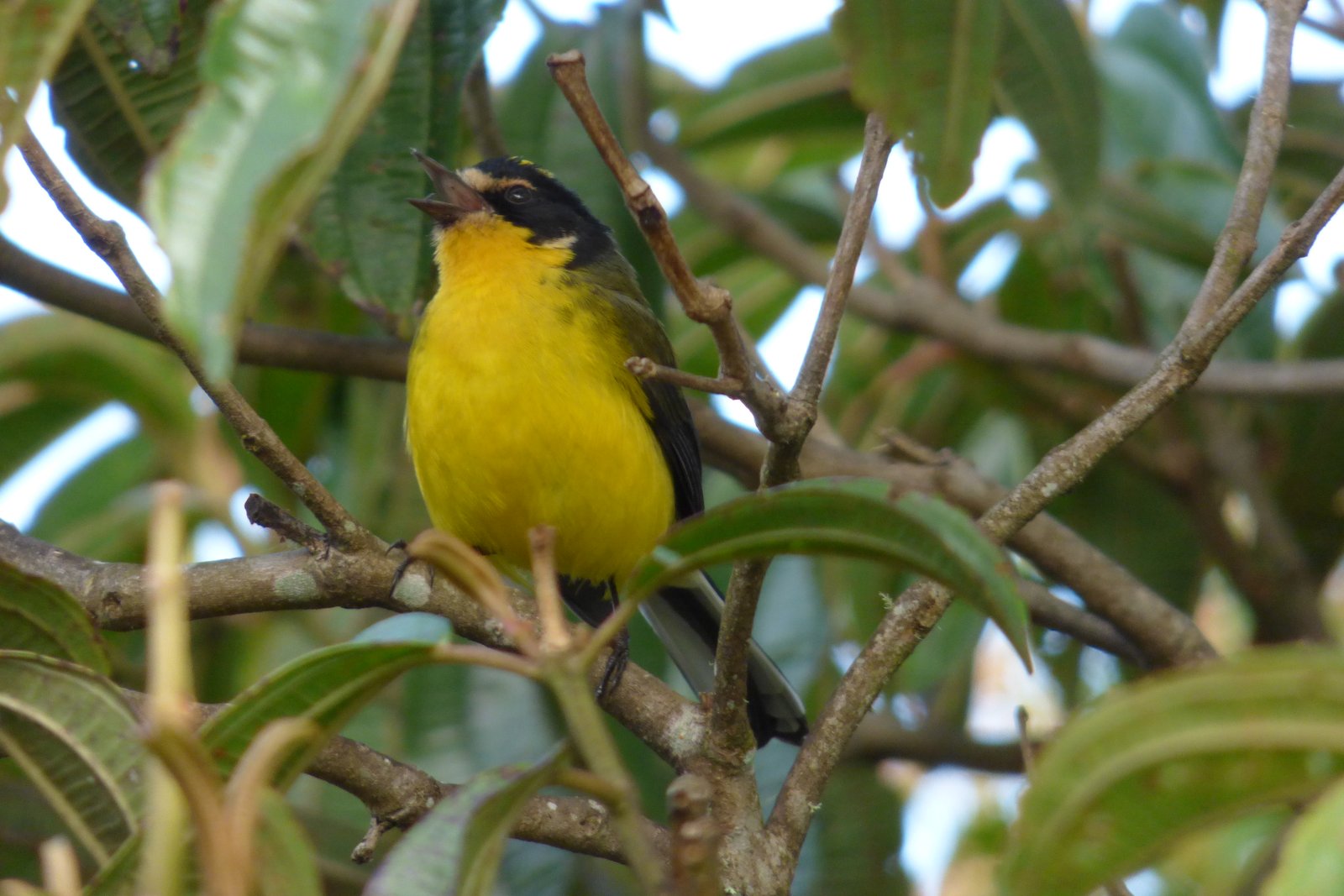
13 cm, with a long, often fanned tail. The head is black with a yellow crown patch; the lores are yellow. The upperparts are olive-green. Throat, breast and belly are yellow, the undertail coverts whitish. The black tail has white in the outer feathers, less than in Slate-throated Whitestart. The sexes are alike. Juveniles are duller, with a brownish head lacking the yellow crown.
Confusion species
Slate-throated Whitestart Myioborus miniatus occurs lower in the Sierra Nevada de Santa Marta and overlaps only at the lower edge; it has a slate-grey back, a dark throat and a chestnut crown patch. No other species of the genus occurs in the Sierra Nevada de Santa Marta.
Habitat
Humid montane and cloud forest, forest edges and older secondary growth, from about 1500 to 3000 m, mainly above 2000 m. It forages in the lower and middle levels, often in mixed flocks; it fans tail and wings to flush insects and catches them in short sallies. As in related species, the nest is on or near the ground in a bank.
Where the bird is most at home, classified by the vegetation units of the Andes and the west coast.


Range and movements
Colombia: endemic to the Sierra Nevada de Santa Marta. Absent from Ecuador, Peru, Bolivia and the Galápagos. Does not occur outside the guide area.
- Resident
- dark = core range, pale = thinly spread
How and when to look
On the Cuchilla de San Lorenzo, along the road above Minca, the Yellow-crowned Whitestart is regularly seen at forest edges and in mixed flocks from about 2000 m.
Conservation status
Least Concern. The range is small, but the species is fairly common there and also tolerates forest edges and secondary growth; deforestation in the Sierra Nevada de Santa Marta is a potential threat.
Scientific name
Myioborus flavivertex | (Salvin, 1887)
Salvin described the species in 1887 as Setophaga flavivertex; because it was later moved to another genus, the author and year stand in brackets. The genus Myioborus was introduced in 1865 by Baird. The genus name combines Greek muia, 'fly', with -boros, '-devouring': fly-eater. The species name combines Latin flavus, 'yellow', and vertex, 'crown'. The specimen the first description was based on came from Sierra Nevada de Santa Marta, Colombia.