All species › Passerines › Tanagers and allies › Three-striped Hemispingus
Three-striped Hemispingus | Microspingus trifasciatus
Driestreepboomgors | Hemispingo trilistado | Capacetinho-de-três-listras
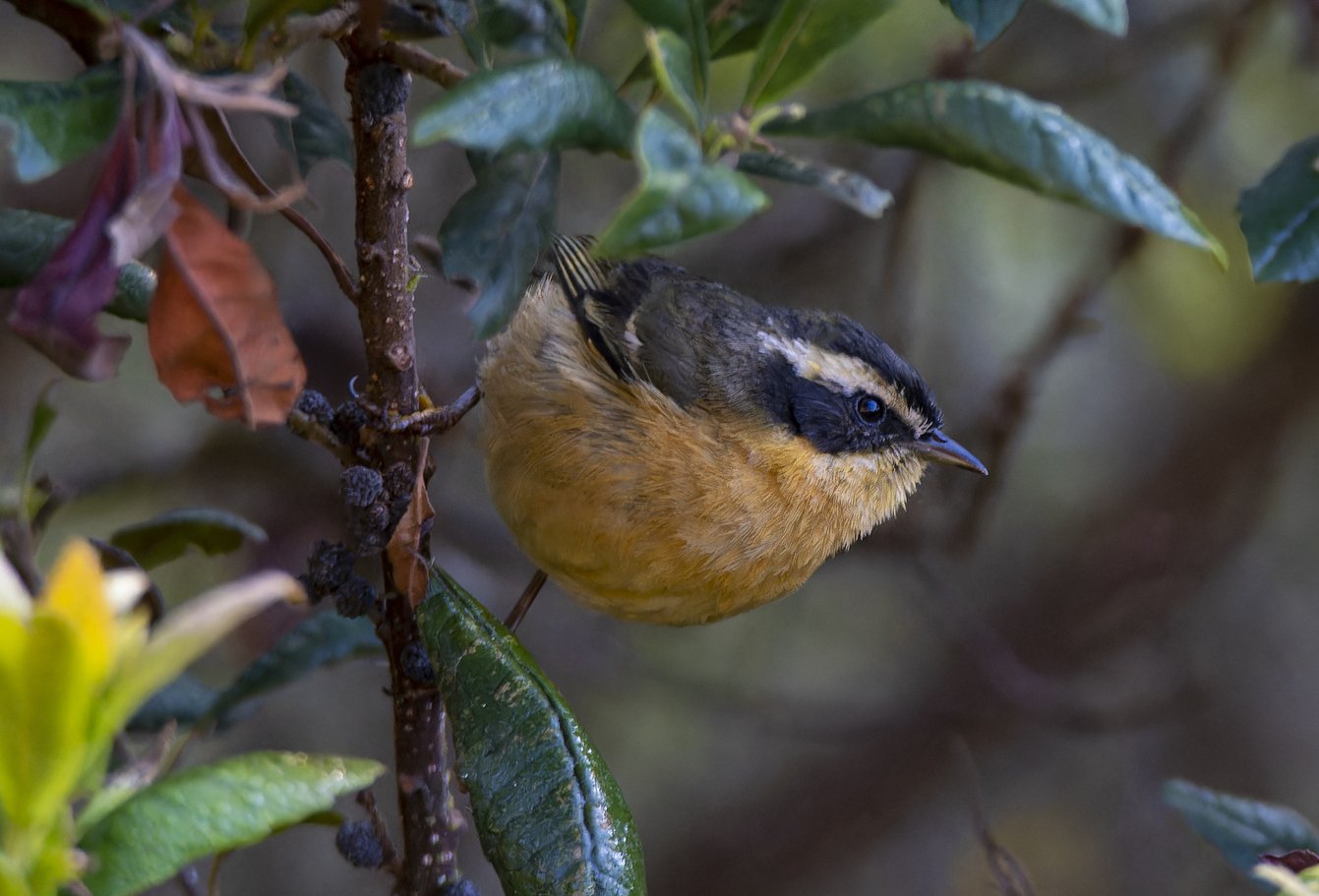
The Three-striped Hemispingus is a small, gregarious songbird of treeline forest in the Andes of Peru and Bolivia. It was long placed among the hemispingus tanagers but is now included in the same genus as the warbling finches. Small groups move restlessly through the high forest and often lead mixed flocks.
Voice
Groups keep in contact with high, thin tsit and tchip calls. The song is a fast, dry series of high notes, sometimes given by several birds at once.
Recording: Dan Lane — CC BY-NC-SA 3.0 · xeno-canto
Identification
14 cm, with a thin, pointed, dark bill and a fairly long tail. Crown and upperparts olive-brown, the head slightly darker. A long, whitish to pale buff supercilium contrasts with the dark ear-coverts. Throat and breast warm ochraceous-brown, belly paler and flanks washed olive-brown. Sexes alike. Young birds are duller, with a less sharply defined supercilium.
Confusion species
Drab Hemispingus Pseudospingus xanthophthalmus is uniform greyish brown, without a supercilium and with a pale eye. Black-capped Hemispingus Kleinothraupis atropileus is larger, with a black head and olive-yellow underparts. Orange-browed Hemispingus Kleinothraupis calophrys has a blackish head with an orange-yellow supercilium and yellow-orange underparts. Rusty-browed Warbling Finch Microspingus erythrophrys of dry scrub has a grey back, a rufous supercilium and white underparts.
Habitat
Humid montane forest, elfin forest and treeline scrub, also patches of Polylepis and Gynoxys, roughly between 2700 and 3600 m. It forages in groups of four to ten birds in the lower and middle levels for insects and other invertebrates. Little is known about the nest.
Where the bird is most at home, classified by the vegetation units of the Andes and the west coast.


Range and movements
In Peru along the Andes from the north (south of the Marañón) through Huánuco, Pasco and Junín to Cusco and Puno. In Bolivia in the Andes of La Paz and Cochabamba. Absent from Colombia, Ecuador and the Galápagos. Does not occur outside the guide area.
- Resident
- dark = core range, pale = thinly spread
How and when to look
At the treeline, follow mixed flocks in elfin forest and Polylepis patches, for example along the high roads on the eastern slope in Cusco; the groups draw attention with their constant high calls.
Conservation status
Least Concern. The species is fairly common in suitable habitat. Fires and clearing at the treeline locally reduce its habitat.
Scientific name
Microspingus trifasciatus | Taczanowski, 1874
Taczanowski described the species in 1874 and placed it straight away in the genus where it still stands. He introduced the genus Microspingus in that same work. The genus name comes from Greek mikros, 'small', and spingos, 'finch'. The species name comes from Latin tri-, 'three', and fasciatus, 'banded', after the three stripes on the head. The specimen the first description was based on came from Maraynioc, Junín, Peru.