All species › Passerines › Tanagers and allies › Green Honeycreeper
Green Honeycreeper | Chlorophanes spiza
Groene suikervogel | Mielero verde | Saí-verde
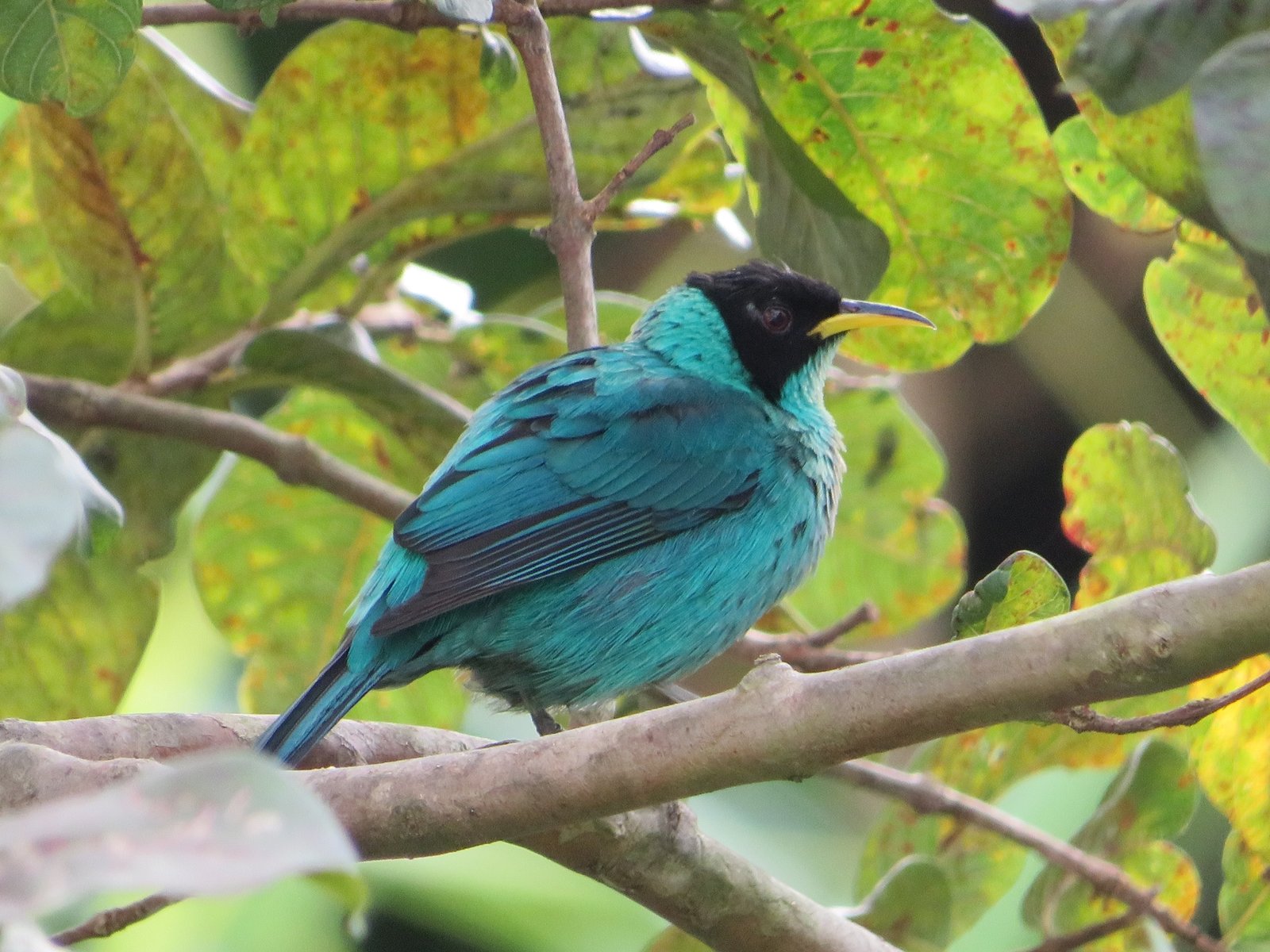
The Green Honeycreeper is a canopy tanager of the tropical lowlands, with a slightly decurved, largely yellow bill. The male is glossy blue-green with a black head, the female plain grass-green. It regularly visits fruiting trees and fruit feeders.
Voice
Sharp, short tsip and chip calls; the song, a rapid series of chipping notes, is rarely heard.
Recording: JAYRSON ARAUJO DE OLIVEIRA — CC BY-NC-SA 4.0 · xeno-canto
Identification
13–14 cm, with a fairly long, slightly decurved bill that is yellow with a dark ridge. The male is glossy emerald- to blue-green, depending on the light; head and face are largely black and the iris is red. The female is plain grass-green, with a paler, yellowish-green throat and no black on the head. Young males resemble the female.
Confusion species
The male Golden-collared Honeycreeper Iridophanes pulcherrimus is smaller and has a black head with a golden-yellow nuchal band. The female Blue Dacnis Dacnis cayana has a blue head and a shorter, straight, dark bill. The female Red-legged Honeycreeper Cyanerpes cyaneus is duller olive-green with faintly streaked underparts and a dark bill.
Habitat
Canopy and edges of humid lowland and foothill forest, also secondary forest, plantations and wooded gardens, up to about 1200 m, locally higher. It eats mainly fruit, as well as nectar and insects; often in pairs in mixed flocks. The nest is a small cup in a fork of a tree.
Where the bird is most at home, classified by the vegetation units of the Andes and the west coast.


Range and movements
In Colombia in the humid lowlands on both sides of the Andes, from the Pacific coast and the Caribbean lowlands to Amazonia. In Ecuador in the west and the east. In Peru mainly east of the Andes. In Bolivia in the north and along the foot of the Andes. Absent from the Galápagos. Outside the guide area from southern Mexico to Panama and in Venezuela, the Guianas and the Amazon basin and Atlantic Forest of Brazil.
- Resident
- dark = core range, pale = thinly spread
How and when to look
At fruit feeders and fruiting trees at lodges, both in western Ecuador and in Amazonia. From canopy towers in the lowlands it is regularly seen at eye level in the treetops.
Conservation status
Least Concern. Widespread and fairly common, also in secondary forest.
Scientific name
Chlorophanes spiza | (Linnaeus, 1758)
Linnaeus described the species in 1758 as Motacilla Spiza; because it was later moved to another genus, the author and year stand in brackets. The genus Chlorophanes was introduced in 1853 by Reichenbach. The genus name comes from Greek khlōros, 'green', and -phanēs, 'showing'. The species name is Greek spiza, the name for a common finch. The specimen the first description was based on came from Suriname.