All species › Passerines › Tanagers and allies › Grey-and-gold Tanager
Grey-and-gold Tanager | Poecilostreptus palmeri
Palmers tangare | Tangara grisdorada | Saíra-cinza-e-dourada
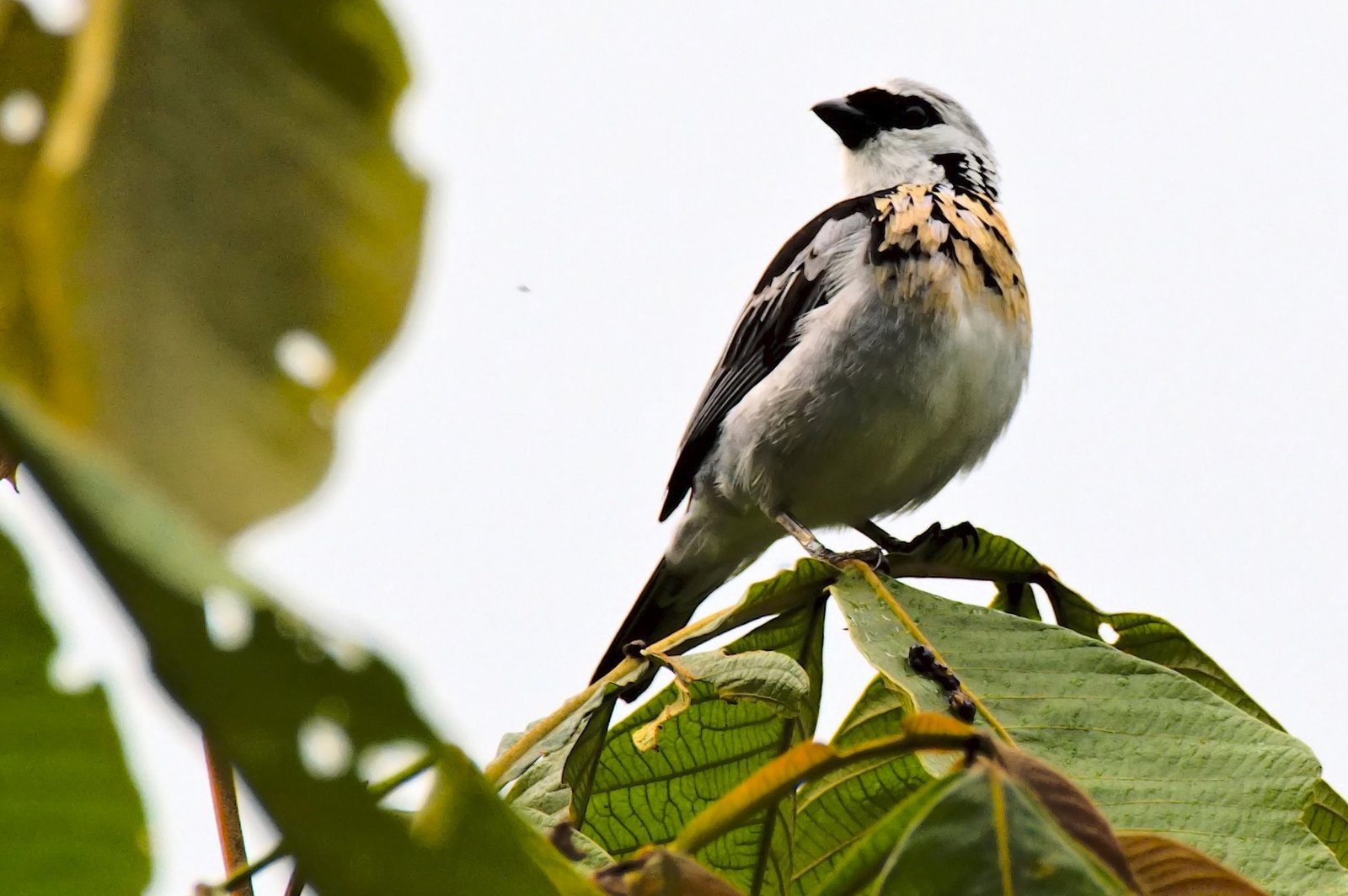
The Grey-and-gold Tanager is a fairly large grey-and-white tanager with a black mask and a golden-yellow wash, found in Chocó forest from eastern Panama to northwestern Ecuador. It often perches in the open on bare branches above the canopy and is a core species of mixed canopy flocks.
Voice
A loud, sharp tseep or chseep, often from a high branch; the song is a series of high, rapid chip notes, sometimes given as a duet.
Recording: Jerome Fischer — CC BY-NC-SA 4.0 · xeno-canto
Identification
15 cm. The upperparts are pale grey with black spots on the mantle and back. A black mask runs from the bill through the eye. The crown and nape are pale grey. The wings and tail are black with grey edges. The underparts are white to silvery white, with a row of black spots forming a broken breast band; the sides of the breast and flanks are washed golden yellow to yellow-green. The bill is black and relatively stout. The sexes are alike; juveniles are duller and less spotted.
Confusion species
Plain-colored Tanager Tangara inornata is smaller and plain grey, without a mask or black spots. Silver-throated Tanager Tangara icterocephala is yellow with a silvery-white throat and a black-streaked back. Blue-grey Tanager Thraupis episcopus is bluish grey, without spots or a mask.
Habitat
Canopy and edges of humid and very wet lowland and foothill forest and tall secondary growth, from about 100 to 1100 m. It eats fruit and insects, mainly high in the canopy; it often perches on bare branches above the canopy and forms the core of mixed tanager flocks. The nest is a cup high in a tree.
Where the bird is most at home, classified by the vegetation units of the Andes and the west coast.


Range and movements
In Colombia along the Pacific lowlands and foothills and the western slope of the Western Andes, and in the north into the lower parts of the Magdalena Valley. In Ecuador in the northwest, south to about Pichincha and Santo Domingo. Absent from Peru, Bolivia and the Galápagos. Outside the guide area only in eastern Panama.
- Resident
- dark = core range, pale = thinly spread
How and when to look
Check bare branches above the canopy along roads through foothill forest in northwestern Ecuador, for example around Milpe and Mashpi, or in the Colombian Chocó; the loud call often gives away a mixed flock.
Conservation status
Least Concern. Locally fairly common, but the range is limited and Chocó lowland and foothill forest is being heavily cleared.
Scientific name
Poecilostreptus palmeri | (Hellmayr, 1909)
Hellmayr described the species in 1909 as Calospiza palmeri; because it was later moved to another genus, the author and year stand in brackets. The genus Poecilostreptus was introduced in 2016 by Burns, Unitt & Mason. The genus name comes from Ancient Greek poikilos, 'variegated, spotted', and streptos, 'necklace, collar', for the black spots across the whitish chest. The species name honours Mervyn George Palmer (1882–1955), English naturalist and collector in tropical America. The specimen the first description was based on came from Río Sipí, Chocó, Colombia.