All species › Passerines › Tanagers and allies › Black-faced Tanager
Black-faced Tanager | Schistochlamys melanopis
Sluiertangare | Tangara carinegra | Sanhaço-de-coleira
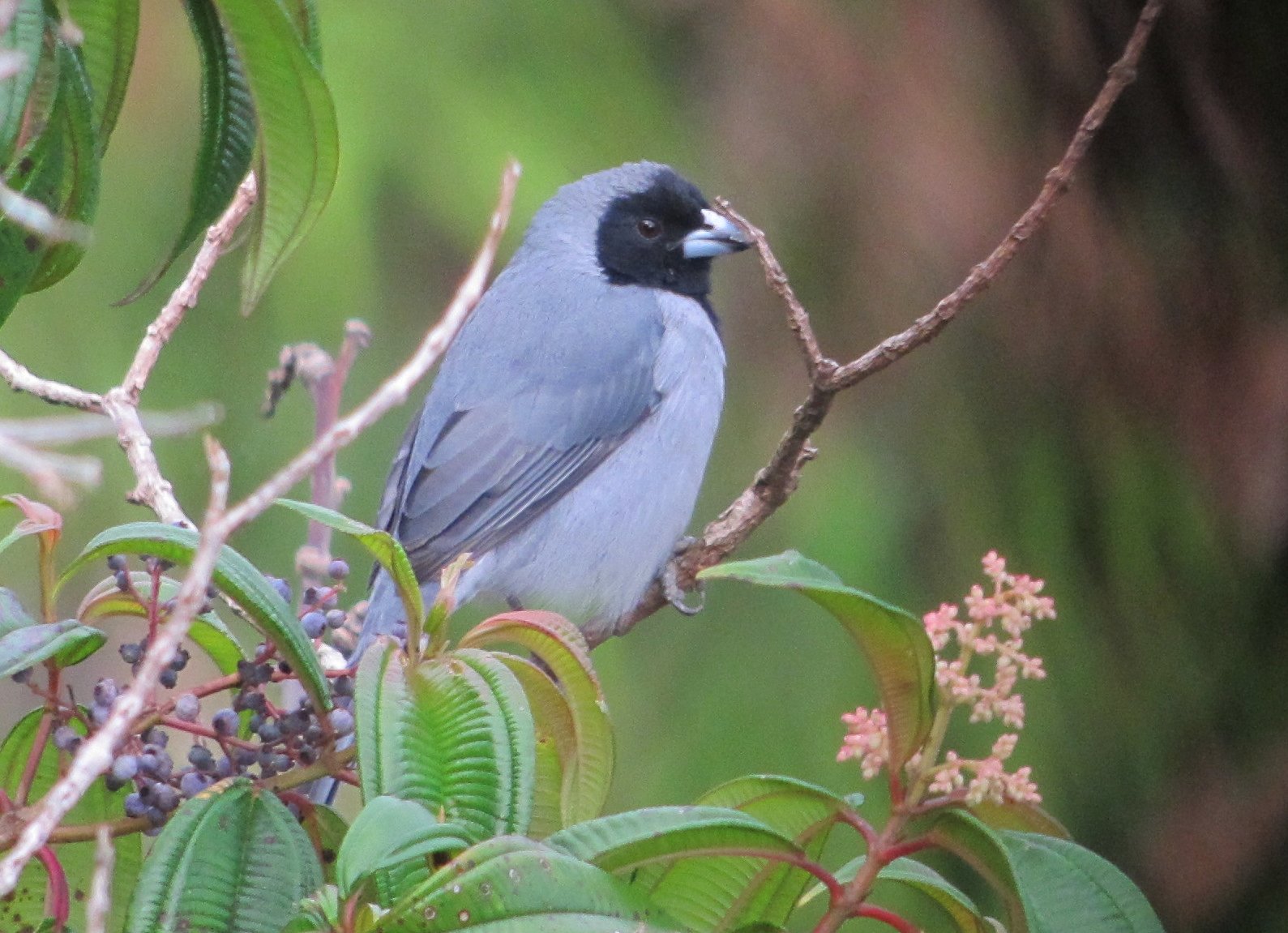
The Black-faced Tanager is a medium-sized, grey tanager with a black face and throat, of savannas and shrubby open country. It often sits quietly on a bush top or in a low tree. Immatures are olive-green and can already breed in that plumage.
Voice
The song is a short, clear phrase of whistled and somewhat twittering notes, often from a bush top. The call is a dry chek.
Recording: JAYRSON ARAUJO DE OLIVEIRA — CC BY-NC-SA 4.0 · xeno-canto
Identification
18 cm, with a short, thick, bluish-grey bill. Adults are plain slate-grey, slightly paler below, with a black forehead, lores, cheeks, throat and upper breast; the belly is paler grey to whitish. The sexes are alike. Immatures are olive-green, yellower green below, without a black face and with a broken pale eye-ring.
Confusion species
Bluish-grey Saltator Saltator coerulescens is larger, with a white supercilium and no black face. Male Hooded Tanager Nemosia pileata has a black cap, but a white throat and underparts and yellow eyes. Olive-green immatures resemble females of other tanagers, but have the thick, bluish-grey bill.
Habitat
Savanna with shrubs and scattered trees, cerrado, shrubby clearings, forest edges, overgrown pasture and vegetation near marshes, from the lowlands up to about 1500 m in the valleys of the eastern slope. It eats mainly fruit, also insects, mostly in shrubs and low trees. The nest is an open cup in a shrub.
Where the bird is most at home, classified by the vegetation units of the Andes and the west coast.


Range and movements
In Colombia mainly east of the Andes, in the Llanos and the savannas of the Amazon region, and locally west of them. In Ecuador only very locally. In Peru mainly in shrubby open country in the valleys at the foot of the eastern slope and in savannas in the south-east. In Bolivia in the savannas of the north and east. Absent from the Galápagos. Outside the guide area in Venezuela, the Guianas and much of Brazil.
- Resident
- dark = core range, pale = thinly spread
How and when to look
Search open, shrubby country and savannas, for example in the Llanos of Colombia or the savannas of Beni; birds often perch in the open on a bush or in a low tree.
Conservation status
Least Concern. Widespread; tolerates open and man-modified country.
Scientific name
Schistochlamys melanopis | (Latham, 1790)
Latham described the species in 1790 as T[anagra] melanopis; because it was later moved to another genus, the author and year stand in brackets. The genus Schistochlamys was introduced in 1850 by Reichenbach. The genus name combines Late Latin schistus, 'slate', and Greek khlamus, 'mantle, cloak'. The species name comes from Greek melas, 'zwart', en ōps, 'gezicht', for the black face. The specimen the first description was based on came from the Guianas.