All species › Passerines › Tanagers and allies › Grey-headed Tanager
Grey-headed Tanager | Eucometis penicillata
Amazonetangare | Tángara cabeza gris | Pipira-da-taoca
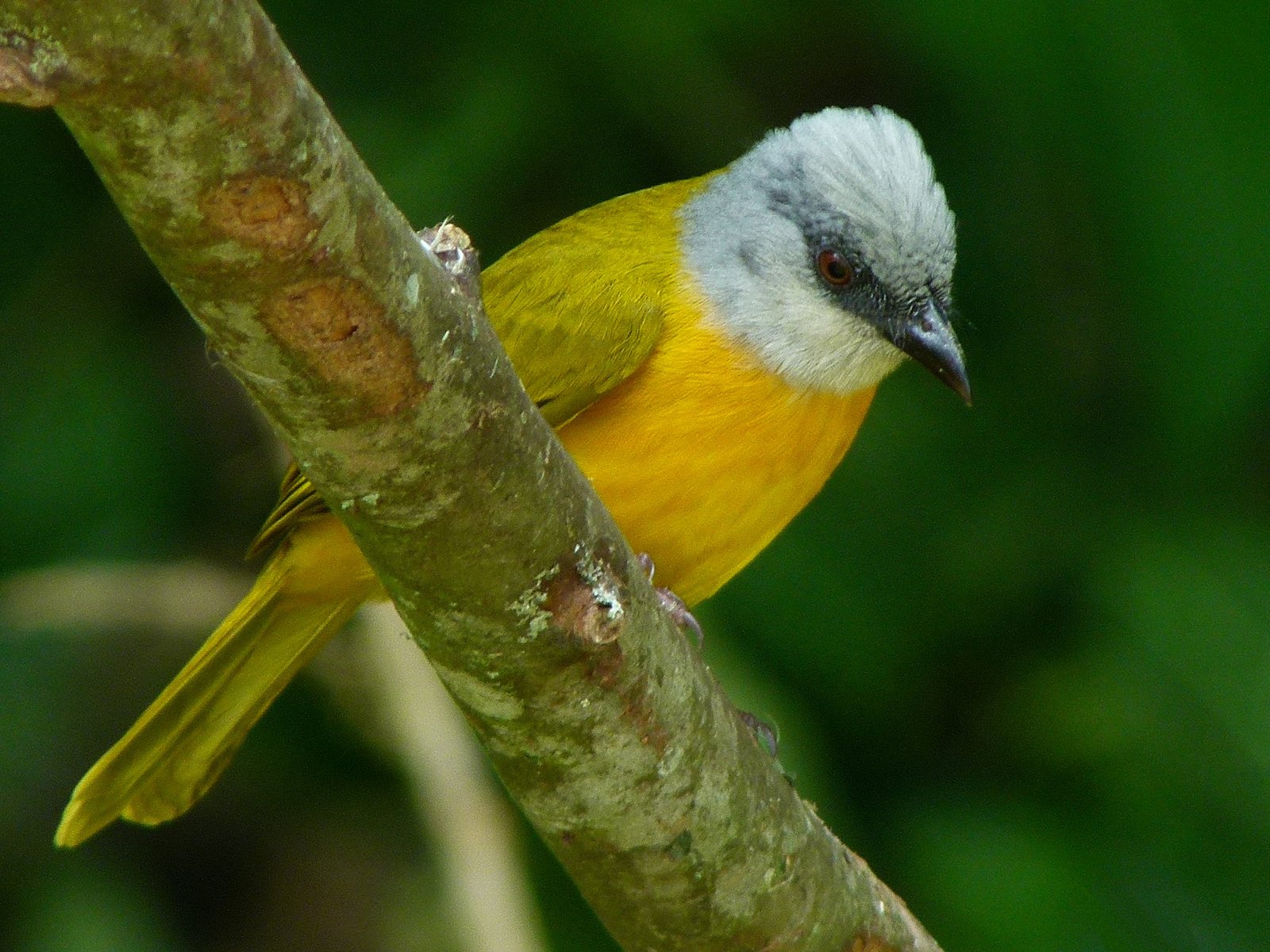
The Grey-headed Tanager is a tanager of the lower levels of lowland forest, with a grey head with a shaggy crest, an olive-green back and yellow underparts. It regularly follows army-ant swarms and catches the insects they flush. Pairs and small groups move actively through the lower strata.
Voice
The song is a fast series of high, thin, squeaky notes; the call is a sharp tseet, often repeated, especially at ant swarms.
Recording: JAYRSON ARAUJO DE OLIVEIRA — CC BY-NC-SA 4.0 · xeno-canto
Identification
17 cm, with a fairly long, dark bill. The head and throat are grey; the crown feathers form a short, shaggy crest, and the throat is slightly paler grey. The back, wings and tail are olive-green, the underparts yellow to ochre-yellow. The sexes are nearly alike. Juveniles are duller, with an olive-grey head.
Confusion species
Female White-shouldered Tanager Loriotus luctuosus also has a grey head, an olive-green back and yellow underparts, but is smaller, lacks a crest and lives higher in the forest. Female Yellow-crested Tanager Loriotus rufiventer is warmer ochre below. Females of the shrike-tanagers Lanio have a heavy, hook-tipped bill and a browner head.
Habitat
The lower levels of humid lowland forest, gallery forest, várzea, old secondary forest and dense forest edges, up to roughly 1000 m. It forages low in the forest and just above the ground for insects, often at army-ant swarms, and also eats fruit. The nest is a loose cup in a shrub or sapling.
Where the bird is most at home, classified by the vegetation units of the Andes and the west coast.


Range and movements
In Colombia in the Caribbean lowlands, the Magdalena valley and the lowlands east of the Andes. In Ecuador in the Amazonian lowlands. In Peru in the Amazonian lowlands. In Bolivia in the lowlands of the north and east. Absent from the Galápagos. Outside the guide area from southern Mexico to Venezuela, the Guianas, Brazil and Paraguay.
- Resident
- dark = core range, pale = thinly spread
How and when to look
In lowland forest, watch for army-ant swarms: the Grey-headed Tanager then often perches low on branches above the ants, together with woodcreepers and antbirds. Look for the grey, crested head and the yellow belly.
Conservation status
Least Concern. The species is fairly common and tolerates secondary forest and forest edges.
Scientific name
Eucometis penicillata | (Spix, 1825)
Spix described the species in 1825 as Tanagra penicillata; because it was later moved to another genus, the author and year stand in brackets. The genus Eucometis was introduced in 1856 by Sclater. The genus name comes from Greek eukomēs, 'well-haired', referring to the crest. The species name comes from Latin penicillatus, 'pencilled, tufted', diminutive of peniculus, 'brush', after the crest. The specimen the first description was based on came from Fonte Boa, Amazonas, Brazil.