All species › Passerines › Tanagers and allies › Santa Marta Mountain Tanager
Santa Marta Mountain Tanager | Anisognathus melanogenys
Zwartwangbergtangare | Tangara de Santa Marta | Sanhaço-montanhês-de-santa-marta
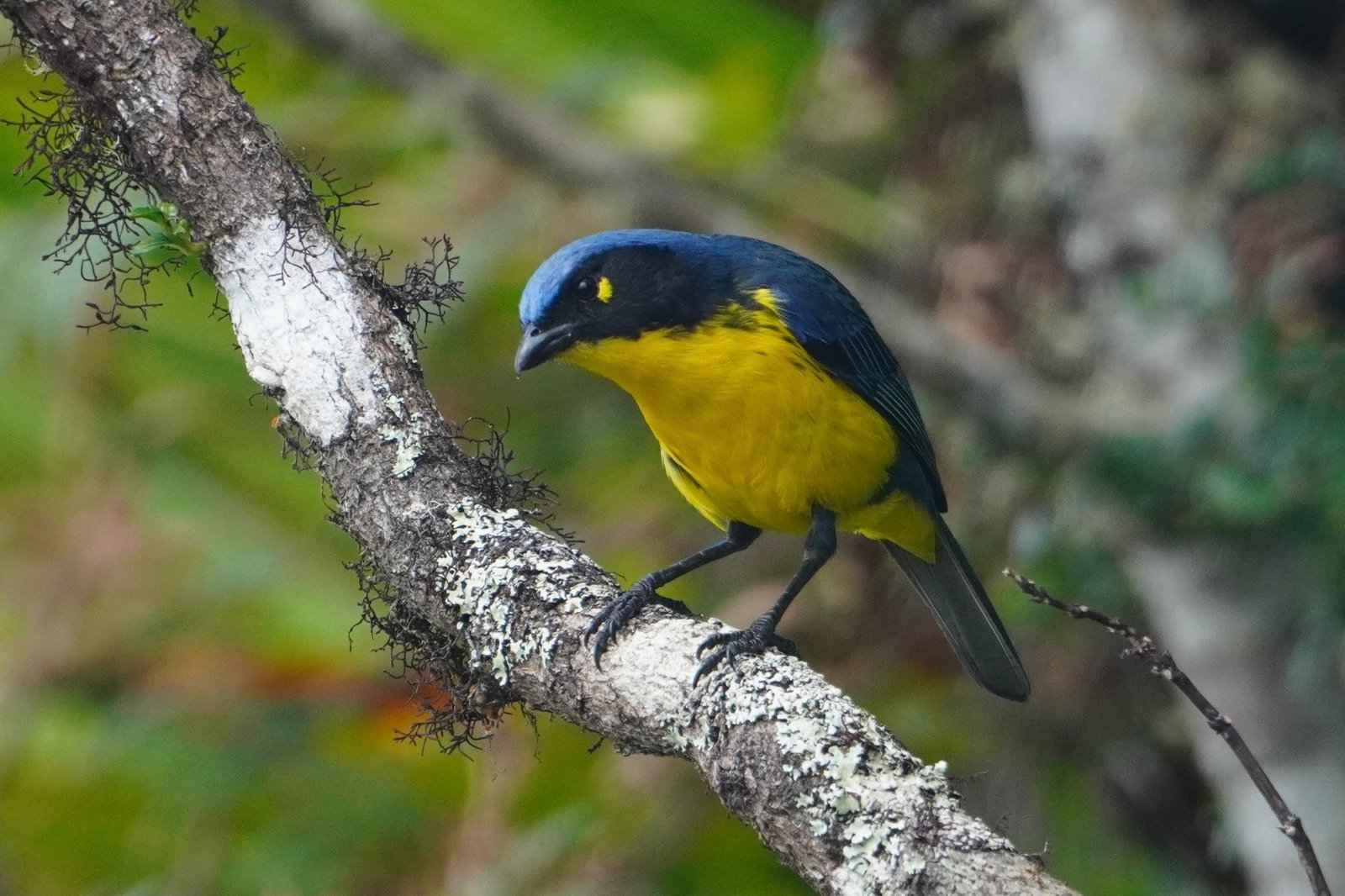
The Santa Marta Mountain Tanager occurs only in the Sierra Nevada de Santa Marta in northern Colombia. It has a blue crown, black cheeks and bright yellow underparts, and is fairly common in the higher forest of the massif, often in mixed flocks.
Voice
Gives high, thin notes; the song is a rapid series of squeaky notes, mainly in the early morning.
Recording: Ross Gallardy — CC BY-NC-SA 4.0 · xeno-canto
Identification
18 cm. The crown and nape are blue; the lores and cheeks black, with a small yellow spot below the eye. The back is grey-blue with an olive tinge, the wings and tail dark with blue edges. The underparts are bright yellow. The sexes are alike. Juveniles are duller.
Confusion species
Blue-capped Tanager Sporathraupis cyanocephala also has a blue cap, but an olive-green back and grey underparts. The related Lacrimose Mountain Tanager Anisognathus lacrymosus does not occur in the Sierra Nevada; it has a slate-grey back and ochre-yellow underparts with yellow spots on the face.
Habitat
Humid montane forest, forest edges and scrub, also secondary forest, from about 2000 to 3200 m. It forages in pairs or small groups, often with mixed flocks, for fruit and insects. Little is known about the nest.
Where the bird is most at home, classified by the vegetation units of the Andes and the west coast.


Range and movements
In Colombia only in the Sierra Nevada de Santa Marta. Does not occur in Ecuador, Peru, Bolivia or on the Galápagos. Not known outside the guide area.
- Resident
- dark = core range, pale = thinly spread
How and when to look
Search along the road to the San Lorenzo ridge above Minca, where small groups forage in the higher forest and along forest edges.
Conservation status
Least Concern. The range is small and confined to a single massif; deforestation and fires are threats there.
Scientific name
Anisognathus melanogenys | (Salvin & Godman, 1880)
Salvin & Godman described the species in 1880 as Poecilothraupis melanogenys; because it was later moved to another genus, the author and year stand in brackets. The genus Anisognathus was introduced in 1850 by Reichenbach. The genus name combines Ancient Greek anisos, 'unequal', and gnathos, 'lower jaw'. The species name comes from Greek melas, 'black', and genus, 'cheek'. The specimen the first description was based on came from San Sebastián, Sierra Nevada de Santa Marta, Colombia.