All species › Passerines › Tanagers and allies › Lacrimose Mountain Tanager
Lacrimose Mountain Tanager | Anisognathus lacrymosus
Druppelbergtangare | Tangara montana lagrimosa | Sanhaço-montanhês-lacrimoso
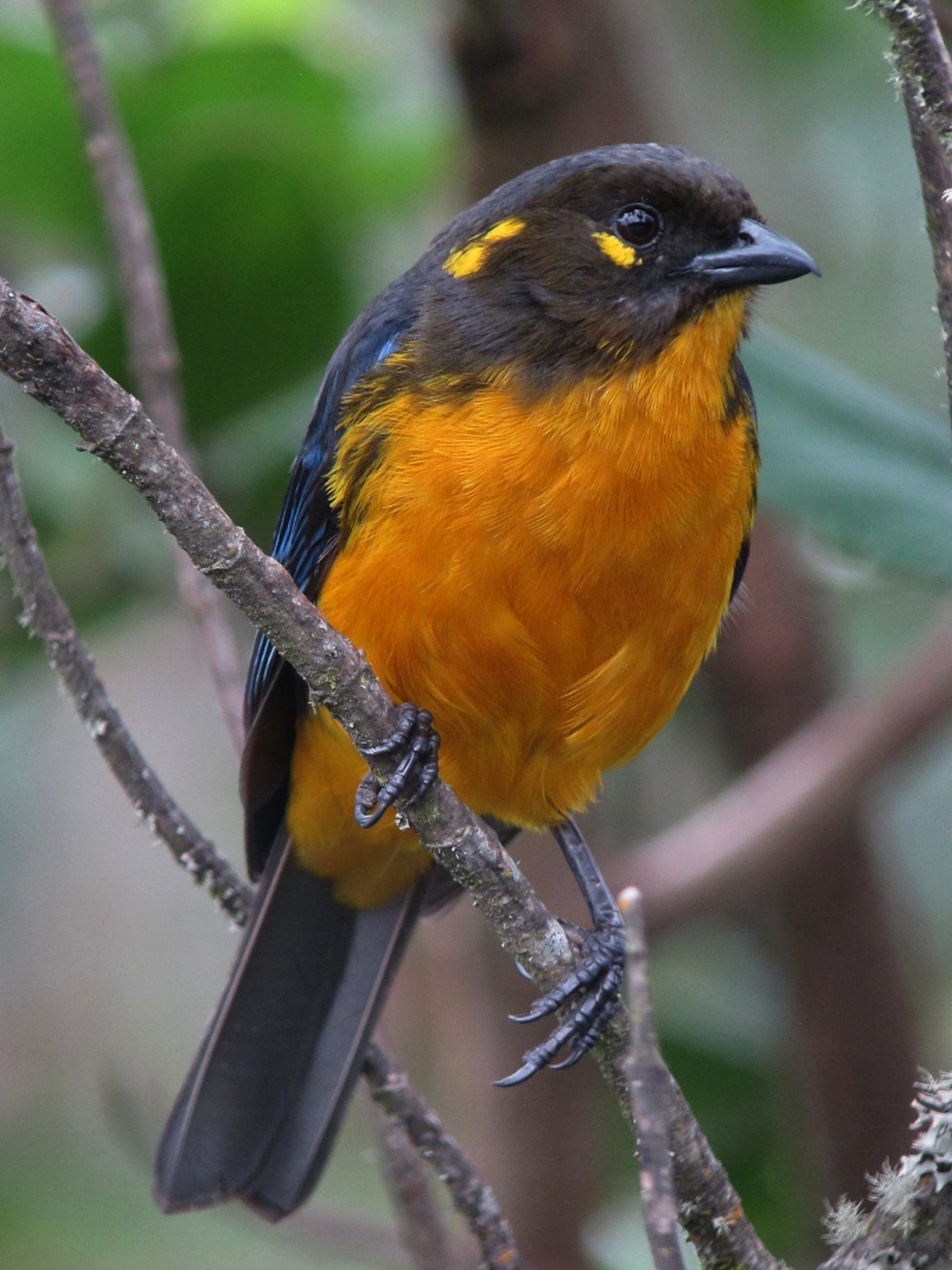
The Lacrimose Mountain Tanager owes its name to a yellow teardrop spot below the eye. It is a fairly common mountain tanager of upper cloud forest in the Andes from Colombia to Peru, with a dark slate-grey back and ochre-yellow underparts, and often travels with mixed flocks.
Voice
Gives high, thin tsit notes; the song is a rapid, somewhat squeaky series of high notes.
Recording: Mitch Lysinger — CC BY-NC-SA 4.0 · xeno-canto
Identification
18 cm. The upperparts are dark slate grey to blue-grey, with blue wing coverts and blue edges to the wings and tail. The face is blackish, with a yellow spot below the eye and a second yellow spot on the side of the neck. The underparts are ochre yellow to orange-yellow. The sexes are alike. The subspecies differ in the tone of the back and underparts.
Confusion species
Scarlet-bellied Mountain Tanager Anisognathus igniventris is black with a scarlet belly and ear patch. Blue-winged Mountain Tanager Anisognathus somptuosus has a yellow crown patch, a black or olive back and no yellow spots on the face. Masked Mountain Tanager Tephrophilus wetmorei is larger, with a yellow forehead and an olive-green back.
Habitat
Humid upper montane forest, elfin forest and forest edges up to the tree line, mostly from about 2300 to 3500 m. It forages low to mid-height for fruit and insects, often in mixed flocks. Little is known about the nest.
Where the bird is most at home, classified by the vegetation units of the Andes and the west coast.


Range and movements
In Colombia in all three Andean ranges and in the Sierra de Perijá. In Ecuador on both slopes of the Andes. In Peru on the eastern slope of the Andes, south to about Cusco. Does not occur in Bolivia or on the Galápagos. Outside the guide area in western Venezuela.
- Resident
- dark = core range, pale = thinly spread
How and when to look
In mixed flocks in upper cloud forest, look for a dark mountain tanager with ochre-yellow underparts, for example at Yanacocha and Papallacta in Ecuador; the yellow spots on the face are the clearest feature.
Conservation status
Least Concern. Fairly common in suitable forest; sensitive to deforestation.
Scientific name
Anisognathus lacrymosus | (Du Bus de Gisignies, B-AL, 1846)
Du Bus de Gisignies, B-AL described the species in 1846 as Tachyphonus lacrymosus; because it was later moved to another genus, the author and year stand in brackets. The genus Anisognathus was introduced in 1850 by Reichenbach. The genus name combines Ancient Greek anisos, 'unequal', and gnathos, 'lower jaw'. The species name is Latin lacrimosus, 'tearful', probably referring to the yellow spot below the eye. The specimen the first description was based on came from Peru (possibly Maraynioc, Junín).