All species › Passerines › Tanagers and allies › Scarlet-bellied Mountain Tanager
Scarlet-bellied Mountain Tanager | Anisognathus igniventris
Roodoorbergtangare | Tangara montana ventriescarlata | Sanhaço-montanhês-de-barriga-escarlate
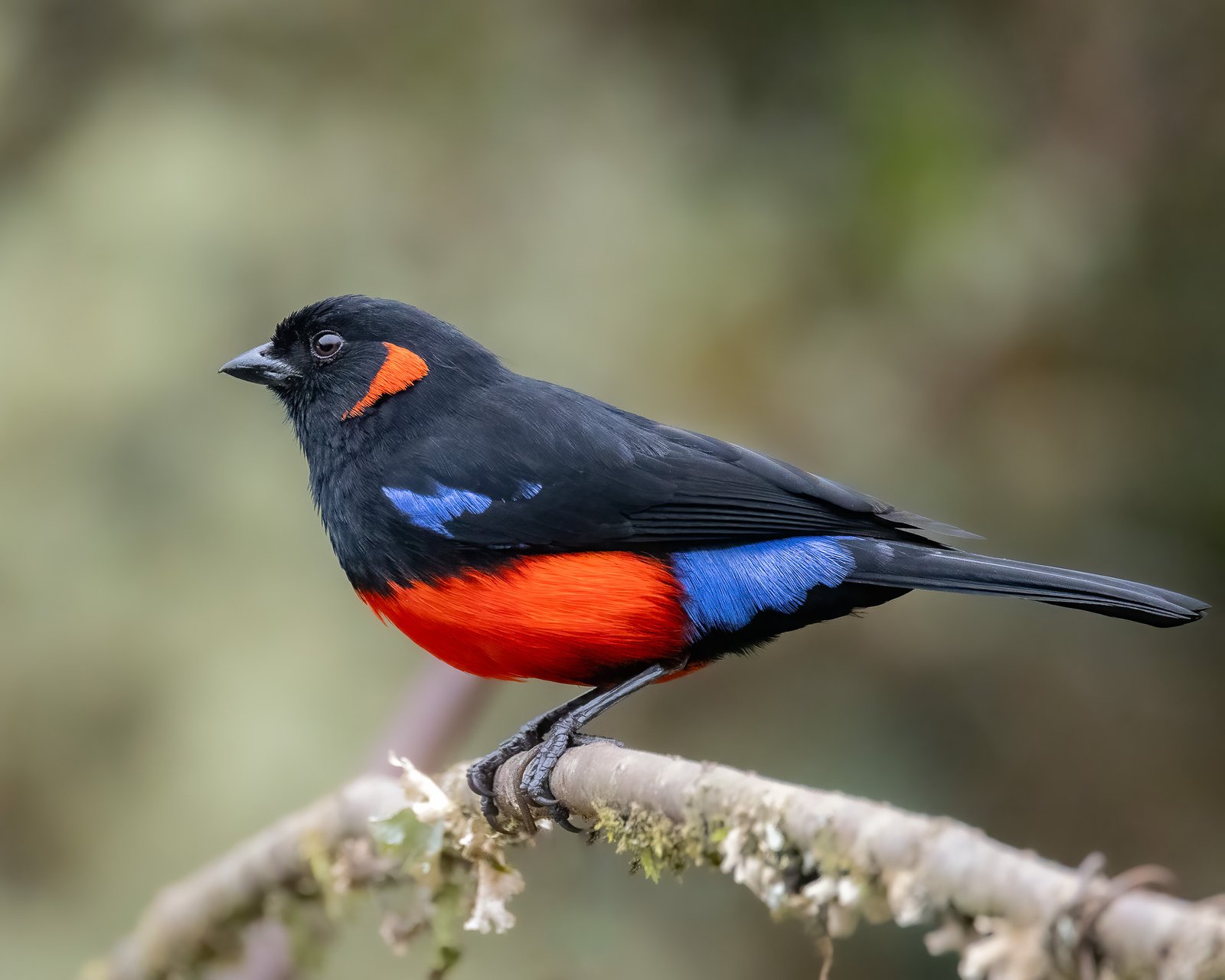
The Scarlet-bellied Mountain Tanager is a black mountain tanager with a scarlet belly and ear patch and blue shoulders, living in scrub and forest edges at the tree line of the Andes from Colombia to Bolivia. It sings mainly in the early morning and often perches in the open on shrubs.
Voice
The song is a rapid, tinkling series of high, somewhat broken notes, mainly at dawn; it gives thin tsit calls.
Recording: Mauricio Cuellar Ramirez (@Birding.travel) — CC BY-NC-SA 4.0 · xeno-canto
Identification
18 cm, with a short black bill. The head, throat, upper breast and upperparts are black. A patch on the ear coverts is scarlet. The lower breast and belly are scarlet, the undertail coverts black. The lesser wing coverts and rump are bright blue. The sexes are alike. Juveniles are duller, with duller red.
Confusion species
Lacrimose Mountain Tanager Anisognathus lacrymosus has yellow spots on the face and ochre-yellow underparts without red. Golden-backed Mountain Tanager Cnemathraupis aureodorsalis of central Peru is larger, with a golden-orange back and streaked yellow underparts. In Bolivia, Rufous-bellied Mountain Tanager Pseudosaltator rufiventris also has a reddish belly, but is blue-grey with a white supercilium.
Habitat
Scrub, forest edges, elfin forest, Polylepis groves and shrubbery at the edge of páramo and puna, also hedges and gardens near villages, mostly from about 2500 to 3900 m. It eats fruit and berries, also insects, in pairs or small groups. Little is known about the nest.
Where the bird is most at home, classified by the vegetation units of the Andes and the west coast.


Range and movements
In Colombia in the Central and Eastern Andes and in Nariño. In Ecuador on both slopes of the Andes. In Peru along the Andes for the whole length of the country. In Bolivia in the eastern Andes in La Paz and Cochabamba. Not on the Galápagos. Outside the guide area in western Venezuela.
- Resident
- dark = core range, pale = thinly spread
How and when to look
Search scrub along the tree line, for example at Papallacta in Ecuador or at Abra Málaga in Cusco; the birds often perch in the open on shrubs and flowering bushes.
Conservation status
Not Evaluated in its current circumscription. Common in suitable habitat along the tree line; locally sensitive to fires and grazing.
Scientific name
Anisognathus igniventris | (d'Orbigny, ACVMD & de Lafresnaye, 1837)
D'Orbigny, ACVMD & de Lafresnaye described the species in 1837 as A[glaia] igniventris; because it was later moved to another genus, the author and year stand in brackets. The genus Anisognathus was introduced in 1850 by Reichenbach. The genus name combines Ancient Greek anisos, 'unequal', and gnathos, 'lower jaw'. The species name comes from Latin ignis, 'fire', and venter, 'belly', referring to the red belly. The specimen the first description was based on came from Apolobamba, Bolivia.