All species › Passerines › Tanagers and allies › Blue-winged Mountain Tanager
Blue-winged Mountain Tanager | Anisognathus somptuosus
Blauwvleugelbergtangare | Tangara montana aliazul | Sanhaço-montanhês-de-asa-azul
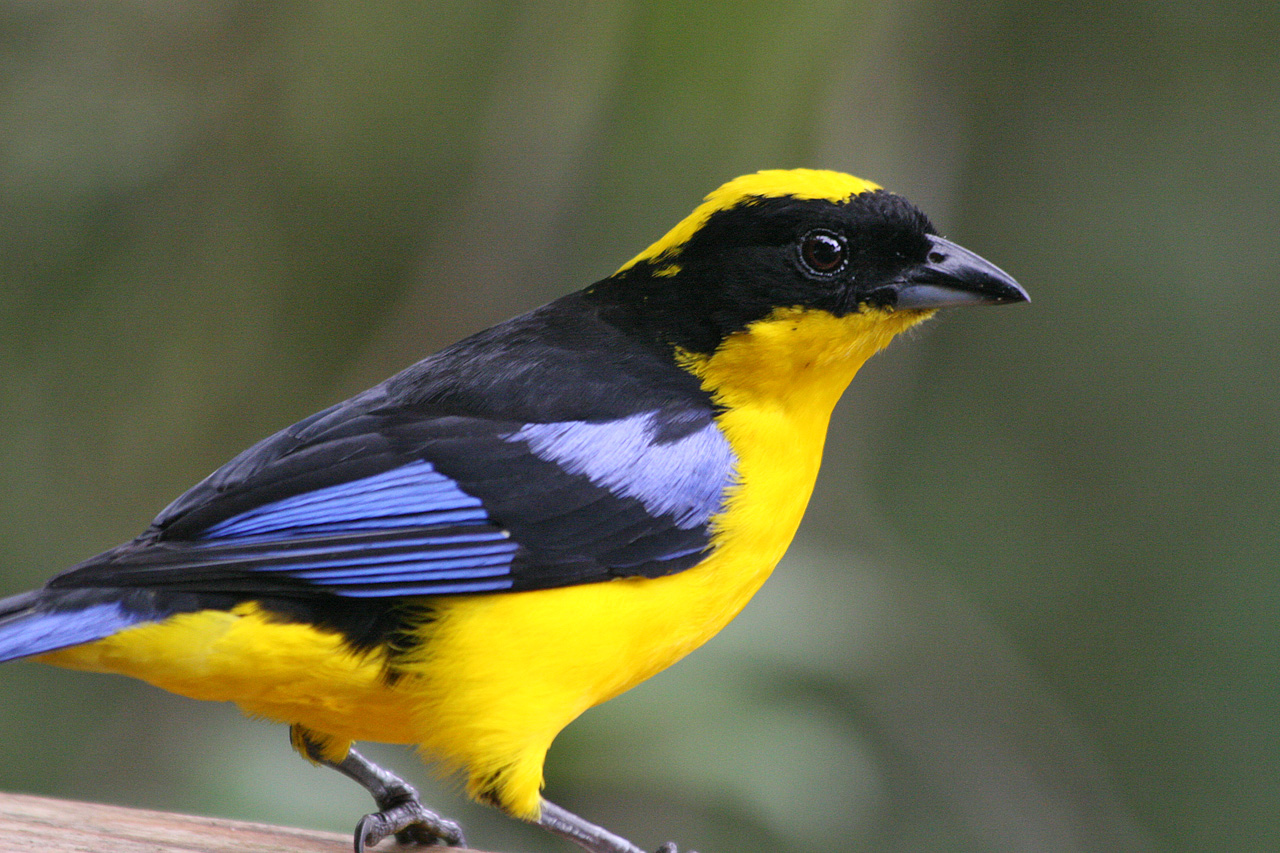
The Blue-winged Mountain Tanager is a large, boldly patterned tanager of Andean montane forest, with a black head, a yellow crown band, yellow underparts and a cobalt-blue shoulder patch. Small groups travel noisily with mixed flocks and are a regular part of the cloud-forest bird community from Colombia to Bolivia.
Voice
Groups give a hurried twittering of high, sharp tseet and chip notes. The song is a fast, tinkling series of high notes, mainly in the early morning.
Recording: rudy gelis — CC BY-NC-SA 4.0 · xeno-canto
Identification
18 cm, with a short, stout black bill. Head, throat and sides of the neck are black, with a broad yellow band across the crown, which in birds from Peru and Bolivia is placed further back towards the nape. The mantle is moss-green to blackish, depending on the subspecies. The lesser wing coverts form a cobalt-blue shoulder patch; flight feathers and tail are black with blue edges. The underparts are deep yellow. The sexes are alike. Juveniles are duller, with a greyer head and a faint crown band.
Confusion species
Black-chinned Mountain Tanager Anisognathus notabilis lives only on the Pacific slope in Colombia and Ecuador, is deeper orange-yellow below and shows little or no blue in the wing. Lacrimose Mountain Tanager Anisognathus lacrymosus is dark blue-grey above, ochre-yellow below and has yellow spots below the eye and on the side of the neck. Scarlet-bellied Mountain Tanager Anisognathus igniventris lives higher and has a red ear patch and red underparts. Hooded Mountain Tanager Buthraupis montana is clearly larger, with a purple-blue back, red eyes and no yellow crown band.
Habitat
Humid montane forest and cloud forest, forest edge and older secondary growth, mostly from about 1400 to 2800 m, locally lower on the western slope. It forages in groups of three to eight birds in the middle and upper canopy for fruit, berries and insects, often with other tanagers, bush tanagers and flycatchers. The nest is a cup of moss and fibres in a tree or among epiphytes.
Where the bird is most at home, classified by the vegetation units of the Andes and the west coast.


Range and movements
In Colombia in all three Andean ranges. In Ecuador on both slopes of the Andes. In Peru on the eastern slope from the north to the southeast. In Bolivia on the eastern slope in La Paz, Cochabamba and western Santa Cruz. Does not occur on the Galápagos. Outside the guide area in the Andes of western Venezuela.
- Resident
- dark = core range, pale = thinly spread
How and when to look
Watch for mixed flocks along forest edges and roads through cloud forest, for example at Río Blanco (Manizales) in Colombia, around Mindo and Tandayapa in Ecuador, along the road to Manu in Peru and in the Yungas near Coroico in Bolivia; the calls of the group are often heard before the birds are seen.
Conservation status
Not evaluated in this circumscription; the Red List divides the species differently, and its parts are rated Least Concern. Fairly common in suitable forest, also at forest edges; sensitive to deforestation at lower elevations.
Scientific name
Anisognathus somptuosus | (Lesson, 1831)
Lesson described the species in 1831 as Tachyphonus somptuosus; because it was later moved to another genus, the author and year stand in brackets. The genus Anisognathus was introduced in 1850 by Reichenbach. The genus name combines Ancient Greek anisos, 'unequal', and gnathos, 'lower jaw'. The species name comes from Latin sumptuosus, 'costly' or 'lavish'. The specimen the first description was based on came from Peru.