All species › Passerines › Tanagers and allies › Black-chinned Mountain Tanager
Black-chinned Mountain Tanager | Anisognathus notabilis
Zwartkinbergtangare | Tangara montana barbinegra | Sanhaço-montanhês-de-queixo-preto
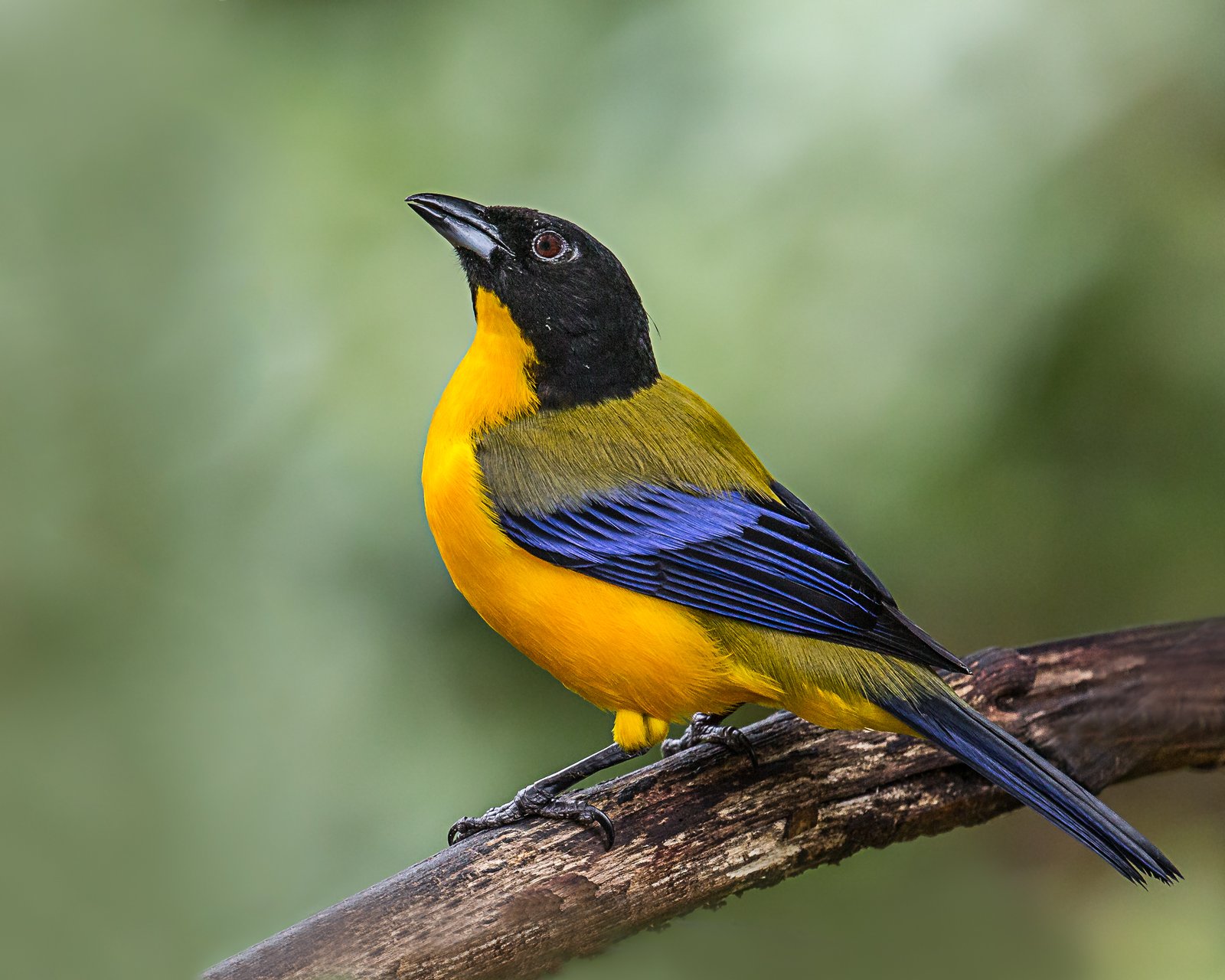
The Black-chinned Mountain Tanager is a sturdy mountain tanager of the humid, mossy forest on the Pacific slope of the Andes in southwestern Colombia and northwestern Ecuador. It has a black head with a yellow crown band, an olive-green back and orange-yellow underparts, and travels with mixed flocks.
Voice
Calls are high, sharp tseet notes; groups give a fast, tinkling twitter, similar to that of Blue-winged Mountain Tanager.
Recording: Olaf Jahn — CC BY-NC-SA 4.0 · xeno-canto
Identification
19 cm, with a short, thick black bill. Head, chin and sides of the neck are black; a broad yellow band runs across the crown to the nape. Mantle and rump are olive-green. Wings and tail are blackish, with little or no blue on the shoulder. The underparts are deep orange-yellow, warmest on the breast. The sexes are alike. Juveniles are duller and greener on the head.
Confusion species
Blue-winged Mountain Tanager Anisognathus somptuosus occurs in the same area, but has a cobalt-blue shoulder patch, blue edges to the flight feathers and purer yellow underparts. Lacrimose Mountain Tanager Anisognathus lacrymosus is dark blue-grey above and has yellow spots below the eye and on the side of the neck. Hooded Mountain Tanager Buthraupis montana is larger, with a purple-blue back and red eyes.
Habitat
Very humid, mossy montane forest and forest edge on the Pacific slope, mostly from about 1400 to 2300 m. It forages in pairs or small groups in the middle and upper canopy for fruit and insects, often with other tanagers in mixed flocks. Little is known about the nest.
Where the bird is most at home, classified by the vegetation units of the Andes and the west coast.


Range and movements
In Colombia on the Pacific slope of the Western Andes in the southwest, mainly in Nariño and Cauca. In Ecuador on the western slope of the Andes in the northwest, from Carchi south to Pichincha and Cotopaxi. Does not occur in Peru, Bolivia or on the Galápagos. Not known outside the guide area.
- Resident
- dark = core range, pale = thinly spread
How and when to look
Search mixed flocks in cloud forest on the Pacific slope of northwestern Ecuador and Nariño, along roads and forest edges at middle elevations; look for a mountain tanager with an olive-green back and orange-yellow belly without a blue shoulder patch.
Conservation status
Least Concern. The range is small; rather scarce to locally fairly common. Sensitive to deforestation on the Pacific slope.
Scientific name
Anisognathus notabilis | (Sclater, 1855)
Sclater described the species in 1855 as Tanagra notabilis; because it was later moved to another genus, the author and year stand in brackets. The genus Anisognathus was introduced in 1850 by Reichenbach. The genus name combines Ancient Greek anisos, 'unequal', and gnathos, 'lower jaw'. The species name is Latin notabilis, 'remarkable'. The specimen the first description was based on came from north of Quito, Ecuador.