All species › Passerines › New World warblers › Three-striped Warbler
Three-striped Warbler | Basileuterus tristriatus
Driestreepzanger | Reinita cabecilistada | Pula-pula-de-três-listras
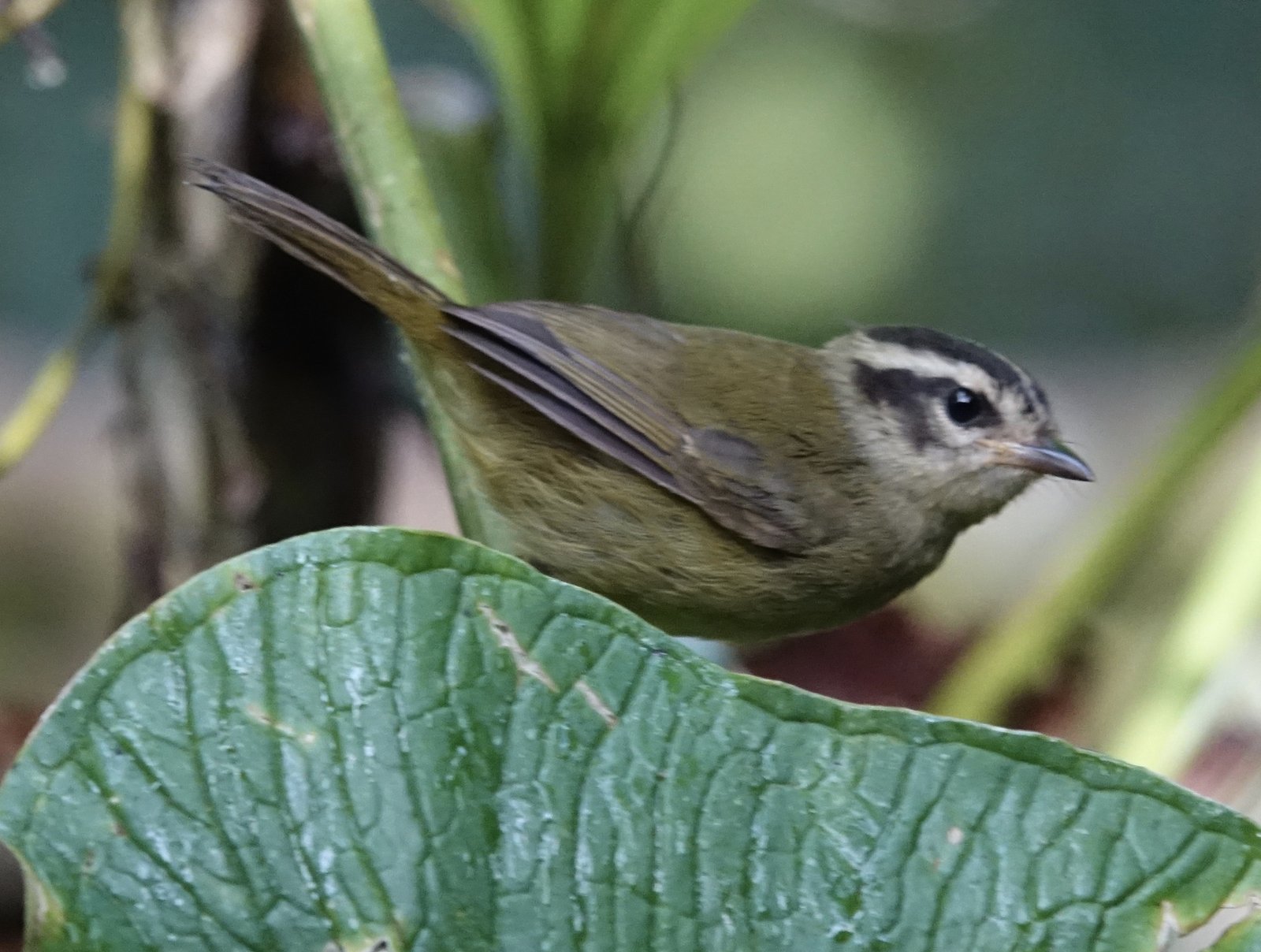
The Three-striped Warbler is a warbler of the Andean forest understorey with a strongly patterned head: black crown stripes, a pale central crown stripe and supercilium, and a black cheek patch. It lives in noisy small groups that often form the core of mixed flocks. After recent splits the species comprises the forms of Colombia, Ecuador and Peru; in the south of the guide area it is replaced by Yungas Warbler.
Voice
The call is a sharp chik; groups give a persistent, shrill chatter. The song is a fast, thin and somewhat shrill jumble of high notes, often sung by several birds at once.
Recording: Brian Cox — CC BY-NC-SA 4.0 · xeno-canto
Identification
13 cm. The head has two broad black crown stripes with a narrow buff to whitish central stripe between them, a pale supercilium and a black cheek patch below the eye. The upperparts are olive-green, the underparts dull yellow to buffy yellow, olive on the flanks. The legs are pink to yellowish. The sexes are alike; juveniles are duller and browner, with a less sharp head pattern.
Confusion species
Yungas Warbler Basileuterus punctipectus replaces it in south-eastern Peru and Bolivia and has spotting on the breast. Black-crested Warbler Myiothlypis nigrocristata has a black central crown, a yellow supercilium and no cheek patch, and lives higher in shrubbery. Russet-crowned Warbler Myiothlypis coronata has a rufous crown stripe and a grey head. Santa Marta Warbler Myiothlypis basilica lives only in the Sierra Nevada de Santa Marta, where Three-striped Warbler is absent.
Habitat
Understorey and lower middle levels of humid montane forest and cloud forest, also old secondary forest and sheltered forest edges, mainly between 1000 and 2500 m. It lives in groups of four to ten birds that move quickly through the foliage, picking insects from leaves and twigs. The nest is a domed structure with a side entrance on the ground, against a vegetated slope.
Where the bird is most at home, classified by the vegetation units of the Andes and the west coast.


Range and movements
Colombia: in all three Andean ranges and the Serranía de Perijá, but not in the Sierra Nevada de Santa Marta. Ecuador: on both Andean slopes. Peru: along the eastern Andean slope south into the south-east, where Yungas Warbler takes over. Absent from Bolivia and the Galápagos. Outside the guide area in the mountains of Venezuela.
- Resident
- dark = core range, pale = thinly spread
How and when to look
Walk forest trails in cloud forest and listen for the shrill chatter of a group moving low through the understorey; where such a group is, other species of a mixed flock often follow.
Conservation status
Least Concern. Common in continuous montane forest; the species depends on forest and disappears where montane forest is cleared.
Scientific name
Basileuterus tristriatus | (Tschudi, 1844)
Tschudi described the species in 1844 as Myiodioctes tristriatus; because it was later moved to another genus, the author and year stand in brackets. The genus Basileuterus was introduced in 1848 by Cabanis. The genus name is an Ancient Greek bird name, basileuteros, 'more kingly'. The species name comes from Latin tri-, 'three', and striatus, 'striped', for the three head stripes. The specimen the first description was based on came from Vitoc valley, Junín, Peru.