All species › Birds of prey › Kites, Old World vultures, eagles and hawks › Tiny Hawk
Tiny Hawk | Microspizias superciliosus
Amerikaanse dwergsperwer | Gavilán enano | Tauató-passarinho
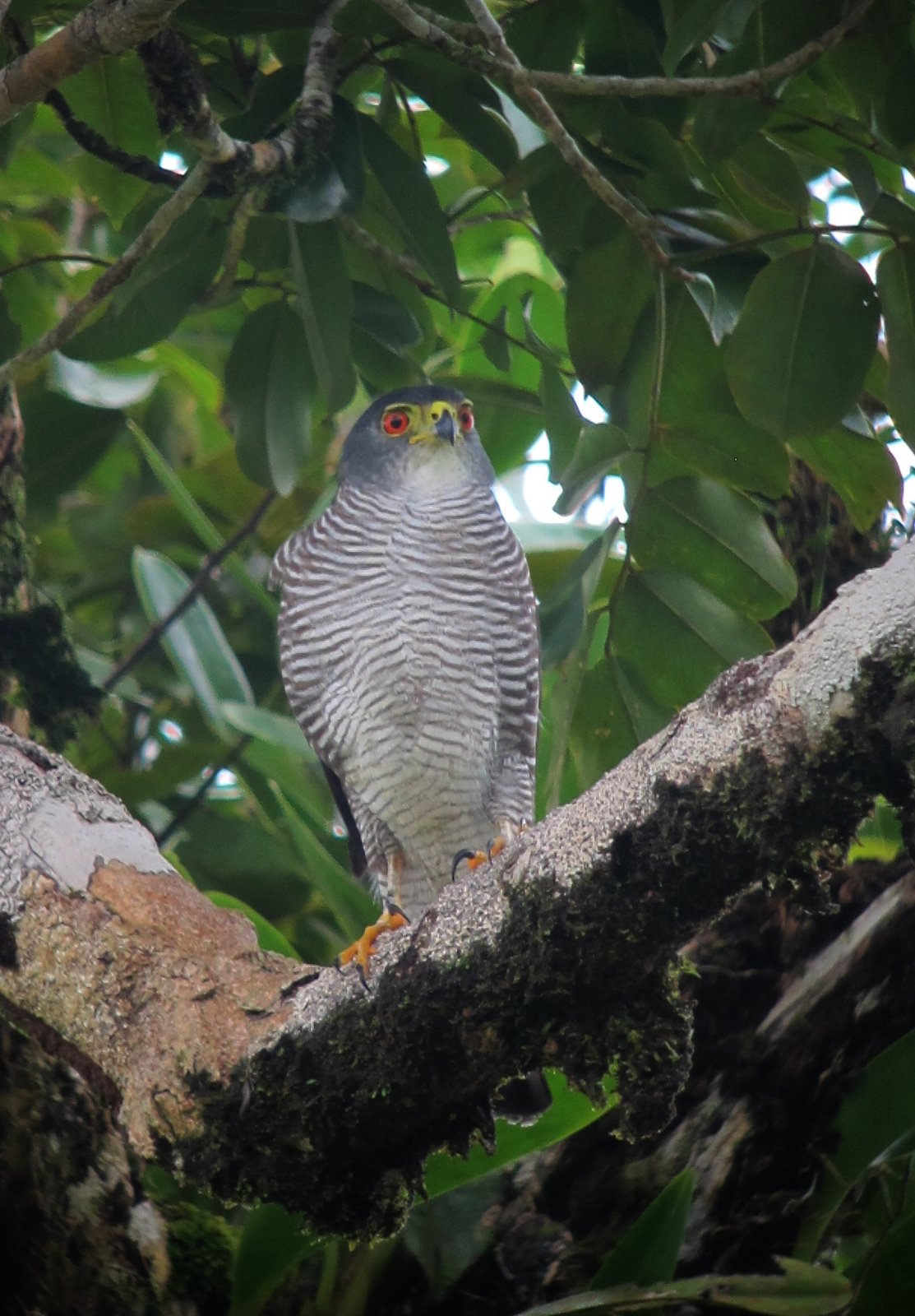
The Tiny Hawk is one of the smallest raptors of the New World, barely larger than a thrush. It hunts in the canopy and at forest edges in the humid lowlands, mainly for small birds such as hummingbirds.
Voice
Seldom heard. A high, sharp series kee-kee-kee.
No recording with a suitable Creative Commons licence is available for this species yet.
Identification
20–28 cm; the female is clearly larger than the male. Small and compact, with short, rounded wings and a fairly short tail. Adults are slate grey above, with a dark crown, a white throat and white underparts with fine grey barring; the tail is grey with dark bands. Juveniles are brown above and white to buff below with fine brown or rufous barring.
Confusion species
Semicollared Hawk Microspizias collaris lives higher in the Andes and has a pale collar, a dark cheek and coarser barring. Barred Forest Falcon Micrastur ruficollis and Lined Forest Falcon Micrastur gilvicollis are larger, with a longer tail and bare skin around the eye, and hunt low inside the forest. Double-toothed Kite Harpagus bidentatus is larger and has a black throat stripe.
Habitat
Humid lowland forest, especially edges, clearings, riverbanks and tall secondary forest; up to about 1000 m, locally higher. It perches concealed in the canopy and hunts with short, rapid sallies for small birds, often hummingbirds at flowering trees. The nest is a small stick cup high in a tree.
Where the bird is most at home, classified by the vegetation units of the Andes and the west coast.


Range and movements
In Colombia in the Pacific lowlands, the north and the Amazonian lowlands. In Ecuador in the western and eastern lowlands. In Peru in the Amazonian lowlands. In Bolivia in the northern and eastern lowlands. Outside the guide area from Nicaragua to Venezuela, the Guianas, Brazil, Paraguay and north-eastern Argentina.
- Resident
- dark = core range, pale = thinly spread
How and when to look
At flowering trees along forest edges and rivers, watch for hummingbirds suddenly scattering; the Tiny Hawk often perches quietly on a sheltered branch nearby and is most often seen flying low across a clearing or a river.
Conservation status
Least Concern. Widespread but scarce and dependent on forest.
Scientific name
Microspizias superciliosus | (Linnaeus, 1766) (GBIF: Accipiter superciliosus)
Linnaeus described the species in 1766 as Falco superciliosus; because it was later moved to another genus, the author and year stand in brackets. The genus Microspizias was introduced in 2021 by Sangster, Kirwan, Fuchs, Dickinson, Elliott & Gregory. The genus name comes from Greek mikros, 'small', and spizias, 'hawk', thus 'small hawk'. The species name comes from Latin superciliosus, 'with eyebrows', after the eyebrow stripe. The specimen the first description was based on came from Suriname.